

Catastrophic Phenomena on Marine Slopes and in Artificial Dams …
389
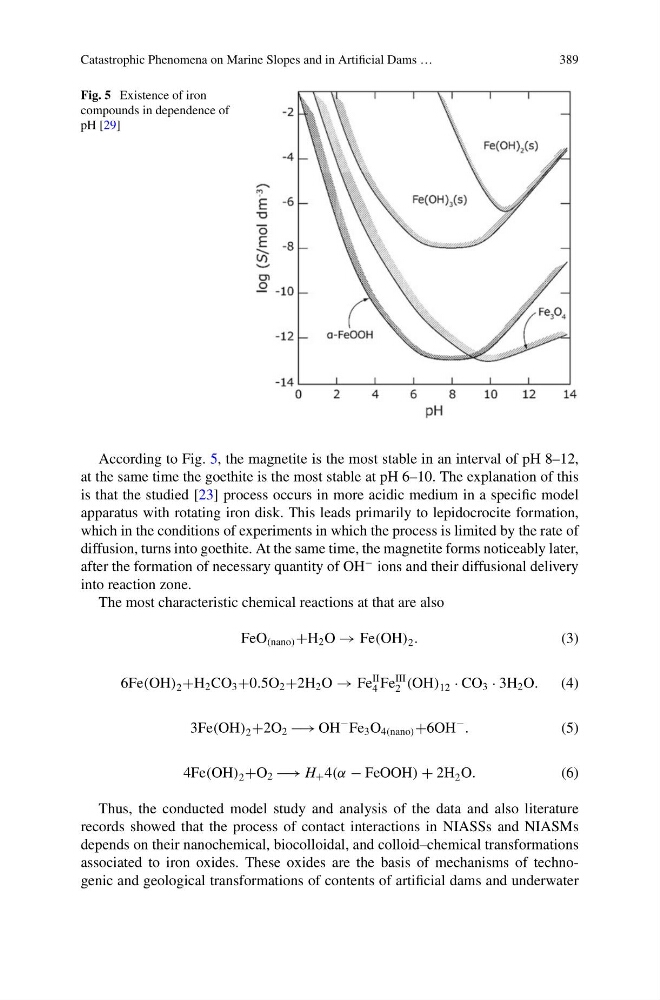
Fig. 5 Existence of iron
compounds in dependence of
pH [29]
According to Fig. 5, the magnetite is the most stable in an interval of pH 8–12,
at the same time the goethite is the most stable at pH 6–10. The explanation of this
is that the studied [23] process occurs in more acidic medium in a specific model
apparatus with rotating iron disk. This leads primarily to lepidocrocite formation,
which in the conditions of experiments in which the process is limited by the rate of
diffusion, turns into goethite. At the same time, the magnetite forms noticeably later,
after the formation of necessary quantity of OH
− ions and their diffusional delivery
into reaction zone.
The most characteristic chemical reactions at that are also
FeO (nano) +H 2 O → Fe(OH) 2 .
(3)
6Fe(OH) 2 +H 2 CO 3 +0.5O 2 +2H 2 O → Fe
II
4 Fe
III
2 (OH) 12 · CO 3 · 3H 2 O.
(4)
3Fe(OH) 2 +2O 2 −→ OH
− Fe 3 O 4(nano) +6OH
−
.
(5)
4Fe(OH) 2 +O 2 −→ H + 4(α − FeOOH) + 2H 2 O.
(6)
Thus, the conducted model study and analysis of the data and also literature
records showed that the process of contact interactions in NIASSs and NIASMs
depends on their nanochemical, biocolloidal, and colloid–chemical transformations
associated to iron oxides. These oxides are the basis of mechanisms of technogenic and geological transformations of contents of artificial dams and underwater
389
Fig. 5 Existence of iron
compounds in dependence of
pH [29]
According to Fig. 5, the magnetite is the most stable in an interval of pH 8–12,
at the same time the goethite is the most stable at pH 6–10. The explanation of this
is that the studied [23] process occurs in more acidic medium in a specific model
apparatus with rotating iron disk. This leads primarily to lepidocrocite formation,
which in the conditions of experiments in which the process is limited by the rate of
diffusion, turns into goethite. At the same time, the magnetite forms noticeably later,
after the formation of necessary quantity of OH
− ions and their diffusional delivery
into reaction zone.
The most characteristic chemical reactions at that are also
FeO (nano) +H 2 O → Fe(OH) 2 .
(3)
6Fe(OH) 2 +H 2 CO 3 +0.5O 2 +2H 2 O → Fe
II
4 Fe
III
2 (OH) 12 · CO 3 · 3H 2 O.
(4)
3Fe(OH) 2 +2O 2 −→ OH
− Fe 3 O 4(nano) +6OH
−
.
(5)
4Fe(OH) 2 +O 2 −→ H + 4(α − FeOOH) + 2H 2 O.
(6)
Thus, the conducted model study and analysis of the data and also literature
records showed that the process of contact interactions in NIASSs and NIASMs
depends on their nanochemical, biocolloidal, and colloid–chemical transformations
associated to iron oxides. These oxides are the basis of mechanisms of technogenic and geological transformations of contents of artificial dams and underwater