

374
T. A. Khalyavka et al.
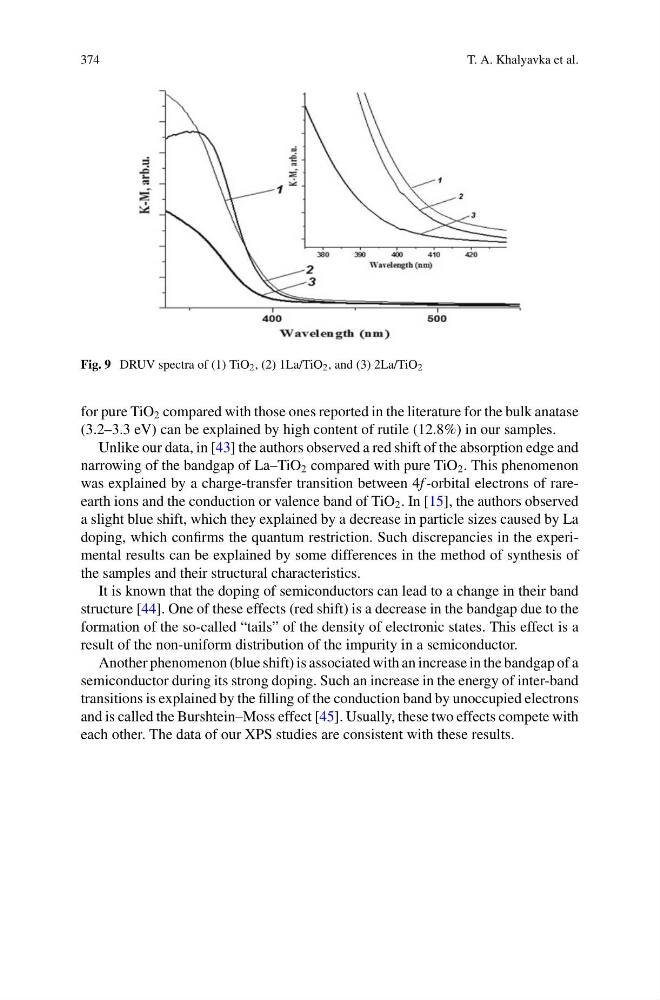
Fig. 9 DRUV spectra of (1) TiO 2 , (2) 1La/TiO 2 , and (3) 2La/TiO 2
for pure TiO 2 compared with those ones reported in the literature for the bulk anatase
(3.2–3.3 eV) can be explained by high content of rutile (12.8%) in our samples.
Unlike our data, in [43] the authors observed a red shift of the absorption edge and
narrowing of the bandgap of La–TiO 2 compared with pure TiO 2 . This phenomenon
was explained by a charge-transfer transition between 4f -orbital electrons of rareearth ions and the conduction or valence band of TiO 2 . In [15], the authors observed
a slight blue shift, which they explained by a decrease in particle sizes caused by La
doping, which confirms the quantum restriction. Such discrepancies in the experimental results can be explained by some differences in the method of synthesis of
the samples and their structural characteristics.
It is known that the doping of semiconductors can lead to a change in their band
structure [44]. One of these effects (red shift) is a decrease in the bandgap due to the
formation of the so-called “tails” of the density of electronic states. This effect is a
result of the non-uniform distribution of the impurity in a semiconductor.
Another phenomenon (blue shift) is associated with an increase in the bandgap of a
semiconductor during its strong doping. Such an increase in the energy of inter-band
transitions is explained by the filling of the conduction band by unoccupied electrons
and is called the Burshtein–Moss effect [45]. Usually, these two effects compete with
each other. The data of our XPS studies are consistent with these results.
T. A. Khalyavka et al.
Fig. 9 DRUV spectra of (1) TiO 2 , (2) 1La/TiO 2 , and (3) 2La/TiO 2
for pure TiO 2 compared with those ones reported in the literature for the bulk anatase
(3.2–3.3 eV) can be explained by high content of rutile (12.8%) in our samples.
Unlike our data, in [43] the authors observed a red shift of the absorption edge and
narrowing of the bandgap of La–TiO 2 compared with pure TiO 2 . This phenomenon
was explained by a charge-transfer transition between 4f -orbital electrons of rareearth ions and the conduction or valence band of TiO 2 . In [15], the authors observed
a slight blue shift, which they explained by a decrease in particle sizes caused by La
doping, which confirms the quantum restriction. Such discrepancies in the experimental results can be explained by some differences in the method of synthesis of
the samples and their structural characteristics.
It is known that the doping of semiconductors can lead to a change in their band
structure [44]. One of these effects (red shift) is a decrease in the bandgap due to the
formation of the so-called “tails” of the density of electronic states. This effect is a
result of the non-uniform distribution of the impurity in a semiconductor.
Another phenomenon (blue shift) is associated with an increase in the bandgap of a
semiconductor during its strong doping. Such an increase in the energy of inter-band
transitions is explained by the filling of the conduction band by unoccupied electrons
and is called the Burshtein–Moss effect [45]. Usually, these two effects compete with
each other. The data of our XPS studies are consistent with these results.