

The Influence of La Doping on Structural, Optical …
371
vibrations in adsorbed water. Peak around 1600–1700 cm
−1 represents the bending
vibrations of the O–H bonds. The adsorbed hydroxyl ions on the surface of catalyst
play an important role in increasing photocatalytic activity [33]. The absorption band
at 2340 cm
−1 corresponds to the physically adsorbed carbon dioxide [35–37]. The
peaks at 2856 and 2928 cm
−1 refer to the valence fluctuations of C–H and –CH 2
bonds [37]. The small absorption peaks around 2938 cm
−1 are probably due to the
stretching mode of unreacted organic groups such as Ti–OC x H y [38]. In the region of
about 3200–3400 cm
−1 intensive broad absorption bands of v(OH) valence vibrations
and adsorbed water molecules coordinated on the TiO 2 surface are observed for all
the samples. These OH groups after irradiation with light form •OH radicals are
directly involved in the process of photodegradation of organic compounds.
3.5 XPS Studies
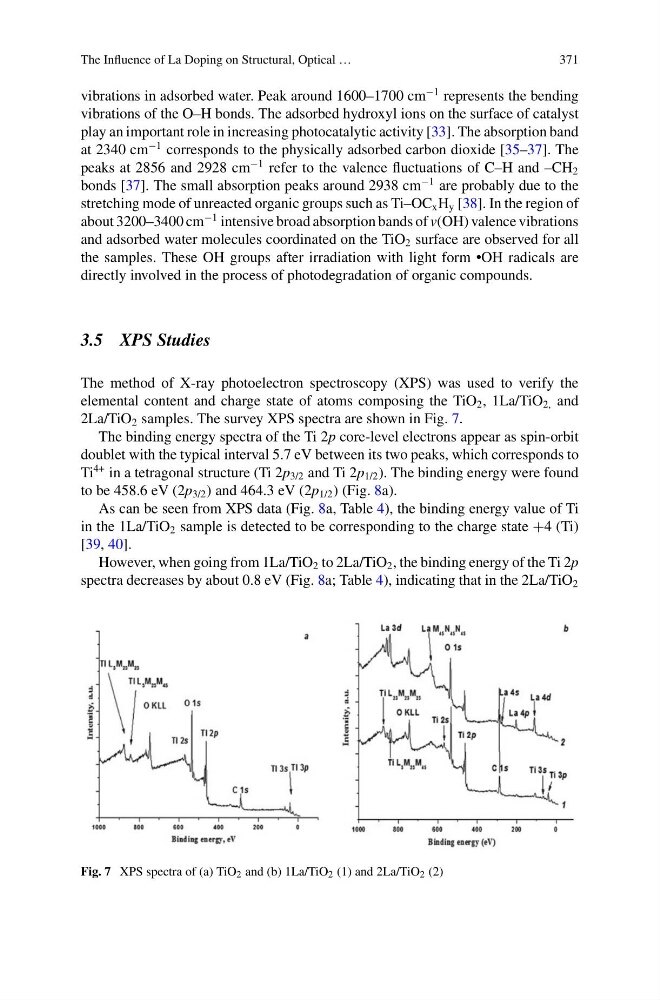
The method of X-ray photoelectron spectroscopy (XPS) was used to verify the
elemental content and charge state of atoms composing the TiO 2 , 1La/TiO 2, and
2La/TiO 2 samples. The survey XPS spectra are shown in Fig. 7.
The binding energy spectra of the Ti 2p core-level electrons appear as spin-orbit
doublet with the typical interval 5.7 eV between its two peaks, which corresponds to
Ti
4+ in a tetragonal structure (Ti 2p 3/2 and Ti 2p 1/2 ). The binding energy were found
to be 458.6 eV (2p 3/2 ) and 464.3 eV (2p 1/2 ) (Fig. 8a).
As can be seen from XPS data (Fig. 8a, Table 4), the binding energy value of Ti
in the 1La/TiO 2 sample is detected to be corresponding to the charge state +4 (Ti)
[39, 40].
However, when going from 1La/TiO 2 to 2La/TiO 2 , the binding energy of the Ti 2p
spectra decreases by about 0.8 eV (Fig. 8a; Table 4), indicating that in the 2La/TiO 2
Fig. 7 XPS spectra of (a) TiO 2 and (b) 1La/TiO 2 (1) and 2La/TiO 2 (2)
371
vibrations in adsorbed water. Peak around 1600–1700 cm
−1 represents the bending
vibrations of the O–H bonds. The adsorbed hydroxyl ions on the surface of catalyst
play an important role in increasing photocatalytic activity [33]. The absorption band
at 2340 cm
−1 corresponds to the physically adsorbed carbon dioxide [35–37]. The
peaks at 2856 and 2928 cm
−1 refer to the valence fluctuations of C–H and –CH 2
bonds [37]. The small absorption peaks around 2938 cm
−1 are probably due to the
stretching mode of unreacted organic groups such as Ti–OC x H y [38]. In the region of
about 3200–3400 cm
−1 intensive broad absorption bands of v(OH) valence vibrations
and adsorbed water molecules coordinated on the TiO 2 surface are observed for all
the samples. These OH groups after irradiation with light form •OH radicals are
directly involved in the process of photodegradation of organic compounds.
3.5 XPS Studies
The method of X-ray photoelectron spectroscopy (XPS) was used to verify the
elemental content and charge state of atoms composing the TiO 2 , 1La/TiO 2, and
2La/TiO 2 samples. The survey XPS spectra are shown in Fig. 7.
The binding energy spectra of the Ti 2p core-level electrons appear as spin-orbit
doublet with the typical interval 5.7 eV between its two peaks, which corresponds to
Ti
4+ in a tetragonal structure (Ti 2p 3/2 and Ti 2p 1/2 ). The binding energy were found
to be 458.6 eV (2p 3/2 ) and 464.3 eV (2p 1/2 ) (Fig. 8a).
As can be seen from XPS data (Fig. 8a, Table 4), the binding energy value of Ti
in the 1La/TiO 2 sample is detected to be corresponding to the charge state +4 (Ti)
[39, 40].
However, when going from 1La/TiO 2 to 2La/TiO 2 , the binding energy of the Ti 2p
spectra decreases by about 0.8 eV (Fig. 8a; Table 4), indicating that in the 2La/TiO 2
Fig. 7 XPS spectra of (a) TiO 2 and (b) 1La/TiO 2 (1) and 2La/TiO 2 (2)