

Formation of Manganese-Containing PEO Coatings on Aluminum Alloys
339
For this purpose, it is necessary to add into an electrolyte ligand L A , fulfilling to a
series of demands among which the most relevant are ability to create enough strong
(M x L Ay ) L complexes with IMC elements, such as Cu, Mn, and Mg; high solubility
of the ligand and formed complexes; intoxicity of the ligand particles and products
of probable transformations with its participant; compatibility with components of
an oxidizing electrolyte; thermal and chemical stability, in particular, resistance to
air oxidation; the low price.
Among the restricted number of the probable ligands, fulfilling to this list of
contradictory demands, we have chosen [14, 22] diphosphate-ion of a various degree
of protonation
L A ∈
P 2 O
4
−
7 , H P 2 O
3
−
7 , . . .
.
In these requirements, the most informative and objective estimation of dynamics
and efficiency of an oxide coating with high protective properties formation process
will be a variation of a ratio of specific surface areas on which aluminum alloys
structure parts and forming aluminum oxides are localized, in particular:
θ (Al 2 O 3 ) → 1, θ(Al 2 Cu) → 0, θ(Al 2 CuMg) → 0, θ(Cu) → 0.
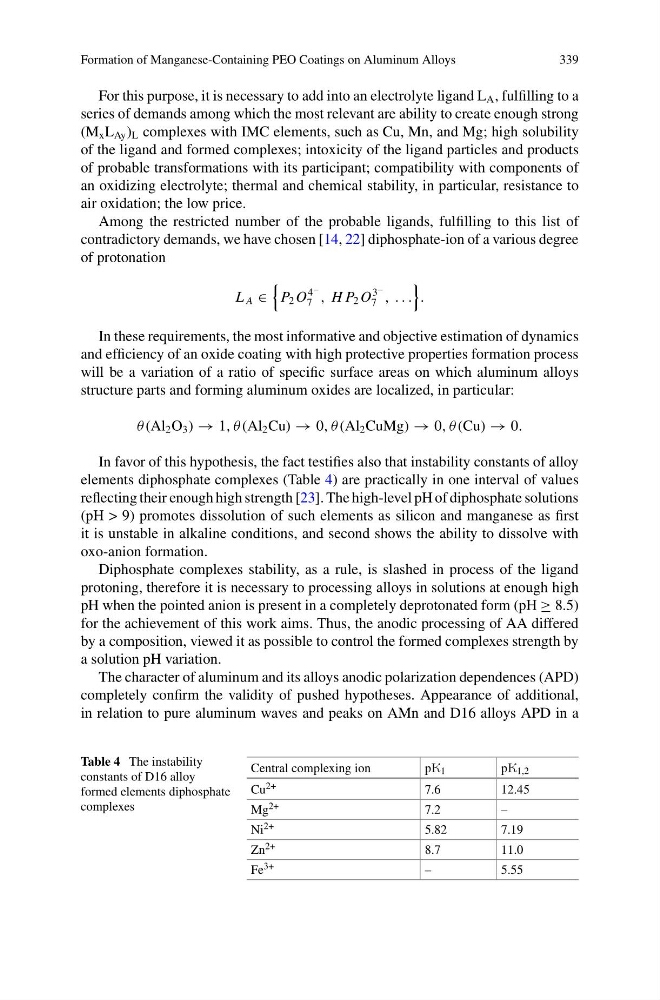
In favor of this hypothesis, the fact testifies also that instability constants of alloy
elements diphosphate complexes (Table 4) are practically in one interval of values
reflecting their enough high strength [23]. The high-level pH of diphosphate solutions
(pH > 9) promotes dissolution of such elements as silicon and manganese as first
it is unstable in alkaline conditions, and second shows the ability to dissolve with
oxo-anion formation.
Diphosphate complexes stability, as a rule, is slashed in process of the ligand
protoning, therefore it is necessary to processing alloys in solutions at enough high
pH when the pointed anion is present in a completely deprotonated form (pH ≥ 8.5)
for the achievement of this work aims. Thus, the anodic processing of AA differed
by a composition, viewed it as possible to control the formed complexes strength by
a solution pH variation.
The character of aluminum and its alloys anodic polarization dependences (APD)
completely confirm the validity of pushed hypotheses. Appearance of additional,
in relation to pure aluminum waves and peaks on AMn and D16 alloys APD in a
Table 4 The instability
constants of D16 alloy
formed elements diphosphate
complexes
Central complexing ion
pK 1
pK 1,2
Cu 2+
7.6
12.45
Mg 2+
7.2
–
Ni 2+
5.82
7.19
Zn 2+
8.7
11.0
Fe 3+
–
5.55
339
For this purpose, it is necessary to add into an electrolyte ligand L A , fulfilling to a
series of demands among which the most relevant are ability to create enough strong
(M x L Ay ) L complexes with IMC elements, such as Cu, Mn, and Mg; high solubility
of the ligand and formed complexes; intoxicity of the ligand particles and products
of probable transformations with its participant; compatibility with components of
an oxidizing electrolyte; thermal and chemical stability, in particular, resistance to
air oxidation; the low price.
Among the restricted number of the probable ligands, fulfilling to this list of
contradictory demands, we have chosen [14, 22] diphosphate-ion of a various degree
of protonation
L A ∈
P 2 O
4
−
7 , H P 2 O
3
−
7 , . . .
.
In these requirements, the most informative and objective estimation of dynamics
and efficiency of an oxide coating with high protective properties formation process
will be a variation of a ratio of specific surface areas on which aluminum alloys
structure parts and forming aluminum oxides are localized, in particular:
θ (Al 2 O 3 ) → 1, θ(Al 2 Cu) → 0, θ(Al 2 CuMg) → 0, θ(Cu) → 0.
In favor of this hypothesis, the fact testifies also that instability constants of alloy
elements diphosphate complexes (Table 4) are practically in one interval of values
reflecting their enough high strength [23]. The high-level pH of diphosphate solutions
(pH > 9) promotes dissolution of such elements as silicon and manganese as first
it is unstable in alkaline conditions, and second shows the ability to dissolve with
oxo-anion formation.
Diphosphate complexes stability, as a rule, is slashed in process of the ligand
protoning, therefore it is necessary to processing alloys in solutions at enough high
pH when the pointed anion is present in a completely deprotonated form (pH ≥ 8.5)
for the achievement of this work aims. Thus, the anodic processing of AA differed
by a composition, viewed it as possible to control the formed complexes strength by
a solution pH variation.
The character of aluminum and its alloys anodic polarization dependences (APD)
completely confirm the validity of pushed hypotheses. Appearance of additional,
in relation to pure aluminum waves and peaks on AMn and D16 alloys APD in a
Table 4 The instability
constants of D16 alloy
formed elements diphosphate
complexes
Central complexing ion
pK 1
pK 1,2
Cu 2+
7.6
12.45
Mg 2+
7.2
–
Ni 2+
5.82
7.19
Zn 2+
8.7
11.0
Fe 3+
–
5.55