

338
H. Karakurkchi et al.
Table 3 Corrosion potentials
in aqueous solutions
System
– E cor , V, in solutions
0,5 M NaCl NaCl—53 g/dm 3 , H 2 O 2–3 g/dm 3
D16T, D1T
0.37…0.39 0.47…0.48
AA 2024 –T3 –
0.35…0.37
AMn
–
0.83
Al 2 Cu
0.37…0.42
Al 2 CuMg
0.67…0.69 0.69
Al 6 Mn
0.58…0.61 –
Al 3 Mg 2
0.93…1.00 1.02
Al 2 MgSi
1.15
–
Al 3 Fe
0.14…0.33 0.34
Al 3 Ni
0.21…0.49 0.30
Mn (Fe, Si)
0.52
–
is necessary to allow the substantiation of electrolyte composition and development
of alloys anodic oxidation technological regimes.
In particular, at D16 alloy oxidizing the cuprum content increase negatively affects
thickness and a micro-hardness of oxides, therefore the oxide films by thickness no
more than 30…50 μm may be formed on such alloys. If cuprum content is more
than 5%, thick layer oxidizing in standard electrolytes is not recommended due to
the formed complication and low oxides electro-physical properties [20, 21]. It is
known that there are a number of electrolytes for thick (up to 100 μm) films on D16
alloys formation, but the time of oxidizing in them increases till 4 h.
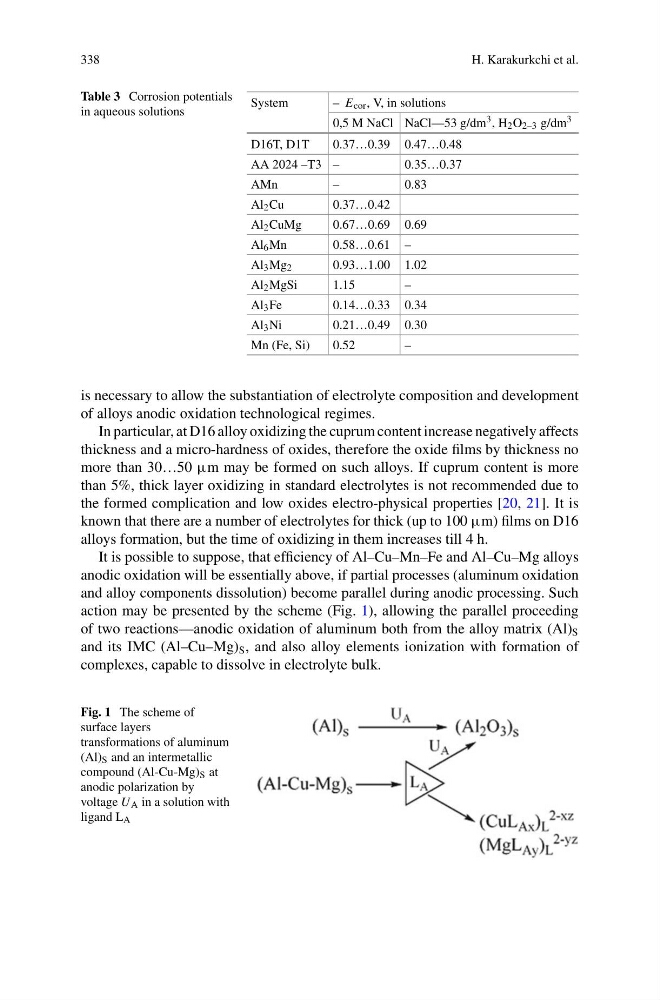
It is possible to suppose, that efficiency of Al–Cu–Mn–Fe and Al–Cu–Mg alloys
anodic oxidation will be essentially above, if partial processes (aluminum oxidation
and alloy components dissolution) become parallel during anodic processing. Such
action may be presented by the scheme (Fig. 1), allowing the parallel proceeding
of two reactions—anodic oxidation of aluminum both from the alloy matrix (Al) S
and its IMC (Al–Cu–Mg) S , and also alloy elements ionization with formation of
complexes, capable to dissolve in electrolyte bulk.
Fig. 1 The scheme of
surface layers
transformations of aluminum
(Al) S and an intermetallic
compound (Al-Cu-Mg) S at
anodic polarization by
voltage U A in a solution with
ligand L A
H. Karakurkchi et al.
Table 3 Corrosion potentials
in aqueous solutions
System
– E cor , V, in solutions
0,5 M NaCl NaCl—53 g/dm 3 , H 2 O 2–3 g/dm 3
D16T, D1T
0.37…0.39 0.47…0.48
AA 2024 –T3 –
0.35…0.37
AMn
–
0.83
Al 2 Cu
0.37…0.42
Al 2 CuMg
0.67…0.69 0.69
Al 6 Mn
0.58…0.61 –
Al 3 Mg 2
0.93…1.00 1.02
Al 2 MgSi
1.15
–
Al 3 Fe
0.14…0.33 0.34
Al 3 Ni
0.21…0.49 0.30
Mn (Fe, Si)
0.52
–
is necessary to allow the substantiation of electrolyte composition and development
of alloys anodic oxidation technological regimes.
In particular, at D16 alloy oxidizing the cuprum content increase negatively affects
thickness and a micro-hardness of oxides, therefore the oxide films by thickness no
more than 30…50 μm may be formed on such alloys. If cuprum content is more
than 5%, thick layer oxidizing in standard electrolytes is not recommended due to
the formed complication and low oxides electro-physical properties [20, 21]. It is
known that there are a number of electrolytes for thick (up to 100 μm) films on D16
alloys formation, but the time of oxidizing in them increases till 4 h.
It is possible to suppose, that efficiency of Al–Cu–Mn–Fe and Al–Cu–Mg alloys
anodic oxidation will be essentially above, if partial processes (aluminum oxidation
and alloy components dissolution) become parallel during anodic processing. Such
action may be presented by the scheme (Fig. 1), allowing the parallel proceeding
of two reactions—anodic oxidation of aluminum both from the alloy matrix (Al) S
and its IMC (Al–Cu–Mg) S , and also alloy elements ionization with formation of
complexes, capable to dissolve in electrolyte bulk.
Fig. 1 The scheme of
surface layers
transformations of aluminum
(Al) S and an intermetallic
compound (Al-Cu-Mg) S at
anodic polarization by
voltage U A in a solution with
ligand L A