

Formation and Transient Photovoltaic Properties of ZnO/Si …
319
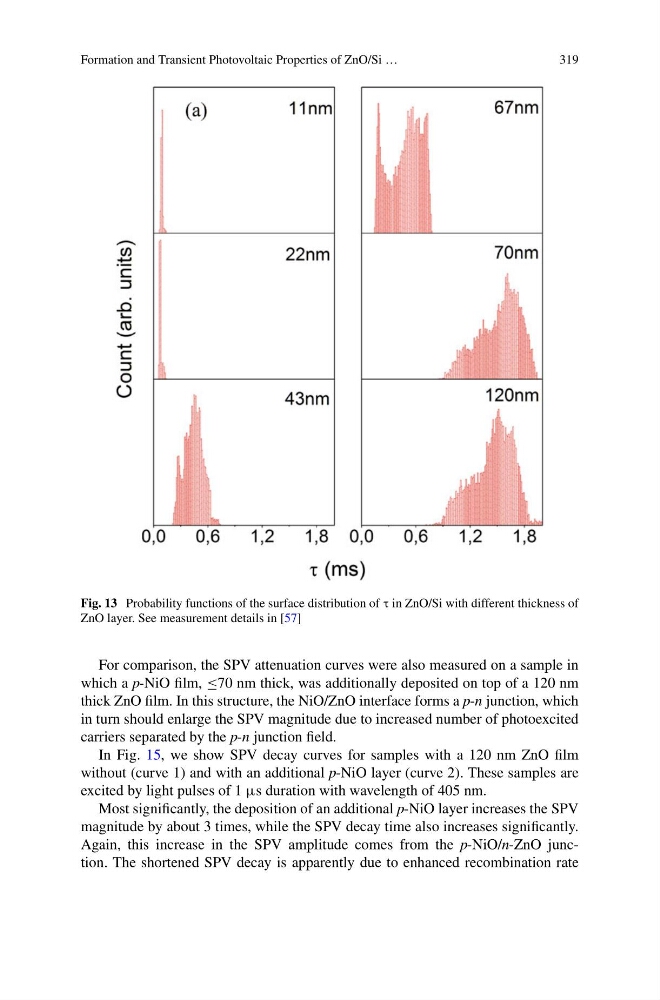
Fig. 13 Probability functions of the surface distribution of τ in ZnO/Si with different thickness of
ZnO layer. See measurement details in [57]
For comparison, the SPV attenuation curves were also measured on a sample in
which a p-NiO film, ≤70 nm thick, was additionally deposited on top of a 120 nm
thick ZnO film. In this structure, the NiO/ZnO interface forms a p-n junction, which
in turn should enlarge the SPV magnitude due to increased number of photoexcited
carriers separated by the p-n junction field.
In Fig. 15, we show SPV decay curves for samples with a 120 nm ZnO film
without (curve 1) and with an additional p-NiO layer (curve 2). These samples are
excited by light pulses of 1 μs duration with wavelength of 405 nm.
Most significantly, the deposition of an additional p-NiO layer increases the SPV
magnitude by about 3 times, while the SPV decay time also increases significantly.
Again, this increase in the SPV amplitude comes from the p-NiO/n-ZnO junction. The shortened SPV decay is apparently due to enhanced recombination rate
319
Fig. 13 Probability functions of the surface distribution of τ in ZnO/Si with different thickness of
ZnO layer. See measurement details in [57]
For comparison, the SPV attenuation curves were also measured on a sample in
which a p-NiO film, ≤70 nm thick, was additionally deposited on top of a 120 nm
thick ZnO film. In this structure, the NiO/ZnO interface forms a p-n junction, which
in turn should enlarge the SPV magnitude due to increased number of photoexcited
carriers separated by the p-n junction field.
In Fig. 15, we show SPV decay curves for samples with a 120 nm ZnO film
without (curve 1) and with an additional p-NiO layer (curve 2). These samples are
excited by light pulses of 1 μs duration with wavelength of 405 nm.
Most significantly, the deposition of an additional p-NiO layer increases the SPV
magnitude by about 3 times, while the SPV decay time also increases significantly.
Again, this increase in the SPV amplitude comes from the p-NiO/n-ZnO junction. The shortened SPV decay is apparently due to enhanced recombination rate