

310
V. Melnik et al.
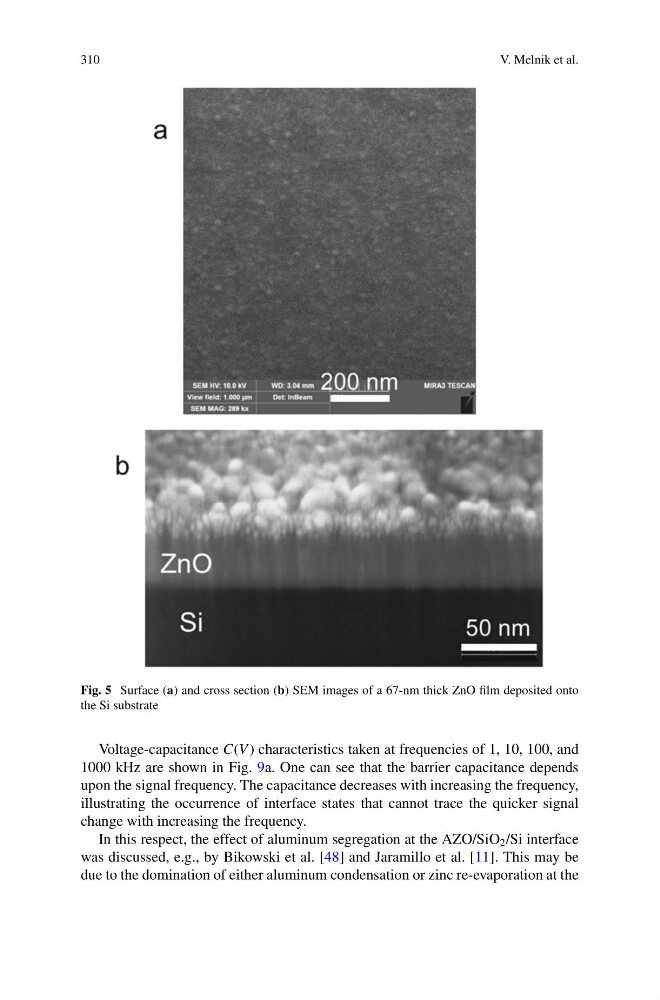
Fig. 5 Surface (a) and cross section (b) SEM images of a 67-nm thick ZnO film deposited onto
the Si substrate
Voltage-capacitance C(V ) characteristics taken at frequencies of 1, 10, 100, and
1000 kHz are shown in Fig. 9a. One can see that the barrier capacitance depends
upon the signal frequency. The capacitance decreases with increasing the frequency,
illustrating the occurrence of interface states that cannot trace the quicker signal
change with increasing the frequency.
In this respect, the effect of aluminum segregation at the AZO/SiO 2 /Si interface
was discussed, e.g., by Bikowski et al. [48] and Jaramillo et al. [11]. This may be
due to the domination of either aluminum condensation or zinc re-evaporation at the
V. Melnik et al.
Fig. 5 Surface (a) and cross section (b) SEM images of a 67-nm thick ZnO film deposited onto
the Si substrate
Voltage-capacitance C(V ) characteristics taken at frequencies of 1, 10, 100, and
1000 kHz are shown in Fig. 9a. One can see that the barrier capacitance depends
upon the signal frequency. The capacitance decreases with increasing the frequency,
illustrating the occurrence of interface states that cannot trace the quicker signal
change with increasing the frequency.
In this respect, the effect of aluminum segregation at the AZO/SiO 2 /Si interface
was discussed, e.g., by Bikowski et al. [48] and Jaramillo et al. [11]. This may be
due to the domination of either aluminum condensation or zinc re-evaporation at the