

Theoretical Modeling of Laser-Stimulated Nanostructures
285
b ≡
2R g m
2
a
3π
√ πγ μ a d 2
a k B
.
Equation (16) and (17) are differential equations of the shape of the crater, in
dimensional and dimensionless form. The equation includes the parameter P, or
, and requires its determination, since it changes during the irradiation of a solid
surface, and a consequence of its change is the formation of a crater on this surface.
The change of pressure and its dynamics is determined by a nonlinear differential
equation [13]. That is, the solution to the problem of surface destruction by a laser
pulse is a system of partial differential equations. Asymptotic estimates of the pressure behavior and the crater shape function [13] confirmed the consistency of the
presented model.
The next step in checking the model was a partial numerical calculation. The
equation of crater dynamics was presented in a cylindrical frame of reference:
∂Σ
∂θ
=
1 +
∂Σ
∂ R
2
.
(18)
The boundary conditions for this equation are obvious Σ(0, R) = 0, Σ(θ , ∞) = 0.
A typical model pressure form caused by a laser pulse was specified:
=
1 − exp(−θ
n
)
1 + exp(10(θ − τ ))
exp
R
2
R
2
0
,
where τ is the laser impulse length, R 0 is beam width. The impulse lengths had
femtosecond values at the values of the radiation flux q ∼ 10 TW/cm
2 . The function
of the crater shape Σ(θ, R)) was calculated in nanometers.
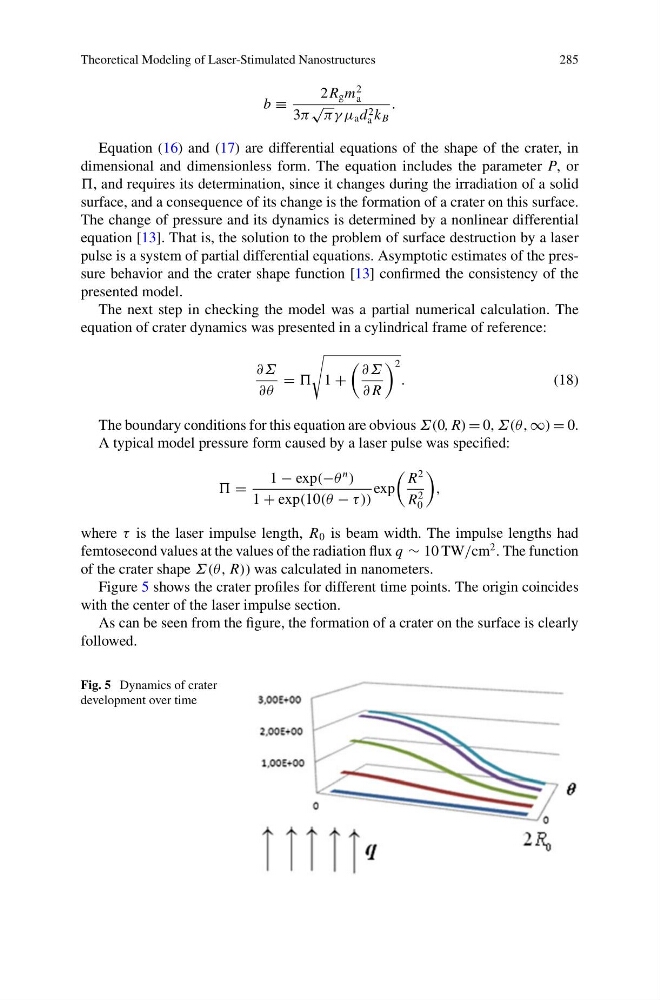
Figure 5 shows the crater profiles for different time points. The origin coincides
with the center of the laser impulse section.
As can be seen from the figure, the formation of a crater on the surface is clearly
followed.
Fig. 5 Dynamics of crater
development over time
285
b ≡
2R g m
2
a
3π
√ πγ μ a d 2
a k B
.
Equation (16) and (17) are differential equations of the shape of the crater, in
dimensional and dimensionless form. The equation includes the parameter P, or
, and requires its determination, since it changes during the irradiation of a solid
surface, and a consequence of its change is the formation of a crater on this surface.
The change of pressure and its dynamics is determined by a nonlinear differential
equation [13]. That is, the solution to the problem of surface destruction by a laser
pulse is a system of partial differential equations. Asymptotic estimates of the pressure behavior and the crater shape function [13] confirmed the consistency of the
presented model.
The next step in checking the model was a partial numerical calculation. The
equation of crater dynamics was presented in a cylindrical frame of reference:
∂Σ
∂θ
=
1 +
∂Σ
∂ R
2
.
(18)
The boundary conditions for this equation are obvious Σ(0, R) = 0, Σ(θ , ∞) = 0.
A typical model pressure form caused by a laser pulse was specified:
=
1 − exp(−θ
n
)
1 + exp(10(θ − τ ))
exp
R
2
R
2
0
,
where τ is the laser impulse length, R 0 is beam width. The impulse lengths had
femtosecond values at the values of the radiation flux q ∼ 10 TW/cm
2 . The function
of the crater shape Σ(θ, R)) was calculated in nanometers.
Figure 5 shows the crater profiles for different time points. The origin coincides
with the center of the laser impulse section.
As can be seen from the figure, the formation of a crater on the surface is clearly
followed.
Fig. 5 Dynamics of crater
development over time