

282
L. V. Shmeleva et al.
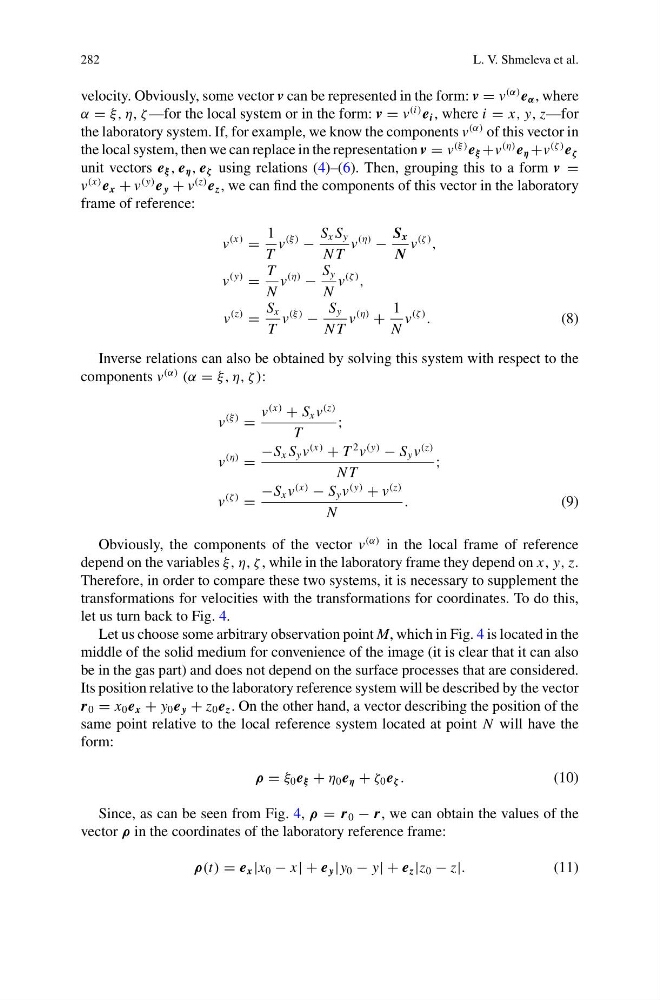
velocity. Obviously, some vector v can be represented in the form: v = v
(α) e α , where
α = ξ, η, ζ —for the local system or in the form: v = v
(i) e i , where i = x, y, z—for
the laboratory system. If, for example, we know the components v
(α) of this vector in
the local system, then we can replace in the representation v = v
(ξ ) e ξ +v
(η) e η +v
(ζ ) e ζ
unit vectors e ξ , e η , e ζ using relations (4)–(6). Then, grouping this to a form v =
v
(x) e x + v
(y) e y + v
(z) e z , we can find the components of this vector in the laboratory
frame of reference:
v
(x)
=
1
T
v
(ξ )
−
S x S y
N T
v
(η)
−
S x
N
v
(ζ )
,
v
(y)
=
T
N
v
(η)
−
S y
N
v
(ζ )
,
v
(z)
=
S x
T
v
(ξ )
−
S y
N T
v
(η)
+
1
N
v
(ζ )
.
(8)
Inverse relations can also be obtained by solving this system with respect to the
components v
(α)
(α = ξ, η, ζ ):
v
(ξ )
=
v
(x)
+ S x v
(z)
T
;
v
(η)
=
−S x S y v
(x)
+ T
2 v
(y)
− S y v
(z)
N T
;
v
(ζ )
=
−S x v
(x)
− S y v
(y)
+ v
(z)
N
.
(9)
Obviously, the components of the vector v
(α) in the local frame of reference
depend on the variables ξ, η, ζ , while in the laboratory frame they depend on x, y, z.
Therefore, in order to compare these two systems, it is necessary to supplement the
transformations for velocities with the transformations for coordinates. To do this,
let us turn back to Fig. 4.
Let us choose some arbitrary observation point M, which in Fig. 4 is located in the
middle of the solid medium for convenience of the image (it is clear that it can also
be in the gas part) and does not depend on the surface processes that are considered.
Its position relative to the laboratory reference system will be described by the vector
r 0 = x 0 e x + y 0 e y + z 0 e z . On the other hand, a vector describing the position of the
same point relative to the local reference system located at point N will have the
form:
ρ = ξ 0 e ξ + η 0 e η + ζ 0 e ζ .
(10)
Since, as can be seen from Fig. 4, ρ = r 0 − r, we can obtain the values of the
vector ρ in the coordinates of the laboratory reference frame:
ρ(t) = e x |x 0 − x| + e y |y 0 − y| + e z |z 0 − z|.
(11)
L. V. Shmeleva et al.
velocity. Obviously, some vector v can be represented in the form: v = v
(α) e α , where
α = ξ, η, ζ —for the local system or in the form: v = v
(i) e i , where i = x, y, z—for
the laboratory system. If, for example, we know the components v
(α) of this vector in
the local system, then we can replace in the representation v = v
(ξ ) e ξ +v
(η) e η +v
(ζ ) e ζ
unit vectors e ξ , e η , e ζ using relations (4)–(6). Then, grouping this to a form v =
v
(x) e x + v
(y) e y + v
(z) e z , we can find the components of this vector in the laboratory
frame of reference:
v
(x)
=
1
T
v
(ξ )
−
S x S y
N T
v
(η)
−
S x
N
v
(ζ )
,
v
(y)
=
T
N
v
(η)
−
S y
N
v
(ζ )
,
v
(z)
=
S x
T
v
(ξ )
−
S y
N T
v
(η)
+
1
N
v
(ζ )
.
(8)
Inverse relations can also be obtained by solving this system with respect to the
components v
(α)
(α = ξ, η, ζ ):
v
(ξ )
=
v
(x)
+ S x v
(z)
T
;
v
(η)
=
−S x S y v
(x)
+ T
2 v
(y)
− S y v
(z)
N T
;
v
(ζ )
=
−S x v
(x)
− S y v
(y)
+ v
(z)
N
.
(9)
Obviously, the components of the vector v
(α) in the local frame of reference
depend on the variables ξ, η, ζ , while in the laboratory frame they depend on x, y, z.
Therefore, in order to compare these two systems, it is necessary to supplement the
transformations for velocities with the transformations for coordinates. To do this,
let us turn back to Fig. 4.
Let us choose some arbitrary observation point M, which in Fig. 4 is located in the
middle of the solid medium for convenience of the image (it is clear that it can also
be in the gas part) and does not depend on the surface processes that are considered.
Its position relative to the laboratory reference system will be described by the vector
r 0 = x 0 e x + y 0 e y + z 0 e z . On the other hand, a vector describing the position of the
same point relative to the local reference system located at point N will have the
form:
ρ = ξ 0 e ξ + η 0 e η + ζ 0 e ζ .
(10)
Since, as can be seen from Fig. 4, ρ = r 0 − r, we can obtain the values of the
vector ρ in the coordinates of the laboratory reference frame:
ρ(t) = e x |x 0 − x| + e y |y 0 − y| + e z |z 0 − z|.
(11)