

Anomalously Large Absorption of Electromagnetic Radiation …
5
The complex reflection coefficient of the field G from the gold film in case of
shorting and the complex reflection G 1 and transmission T 1 coefficients of the field
in case of matched load are also indicated in Fig. 1.
The measurements of VSWR were made in the waveguide line which was
connected to the waveguide section with the sample as shown in Fig. 1.
Distance h was chosen to be 1 mm. The substrate thickness h 1 was 0.1 mm.
The power reflection coefficient R was calculated by the known formula
R =
(V SW R − 1)
2
(V SW R + 1) 2 .
(1)
The absorption coefficient A was calculated by
A = 1 − R.
(2)
3 Experimental Results and Discussion
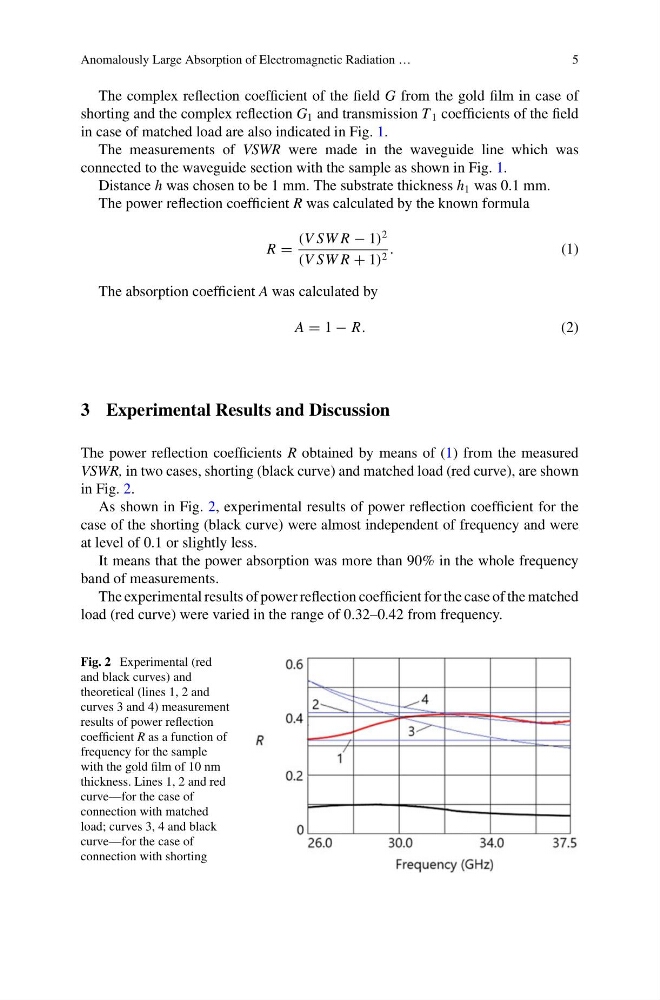
The power reflection coefficients R obtained by means of (1) from the measured
VSWR, in two cases, shorting (black curve) and matched load (red curve), are shown
in Fig. 2.
As shown in Fig. 2, experimental results of power reflection coefficient for the
case of the shorting (black curve) were almost independent of frequency and were
at level of 0.1 or slightly less.
It means that the power absorption was more than 90% in the whole frequency
band of measurements.
The experimental results of power reflection coefficient for the case of the matched
load (red curve) were varied in the range of 0.32–0.42 from frequency.
Fig. 2 Experimental (red
and black curves) and
theoretical (lines 1, 2 and
curves 3 and 4) measurement
results of power reflection
coefficient R as a function of
frequency for the sample
with the gold film of 10 nm
thickness. Lines 1, 2 and red
curve—for the case of
connection with matched
load; curves 3, 4 and black
curve—for the case of
connection with shorting
5
The complex reflection coefficient of the field G from the gold film in case of
shorting and the complex reflection G 1 and transmission T 1 coefficients of the field
in case of matched load are also indicated in Fig. 1.
The measurements of VSWR were made in the waveguide line which was
connected to the waveguide section with the sample as shown in Fig. 1.
Distance h was chosen to be 1 mm. The substrate thickness h 1 was 0.1 mm.
The power reflection coefficient R was calculated by the known formula
R =
(V SW R − 1)
2
(V SW R + 1) 2 .
(1)
The absorption coefficient A was calculated by
A = 1 − R.
(2)
3 Experimental Results and Discussion
The power reflection coefficients R obtained by means of (1) from the measured
VSWR, in two cases, shorting (black curve) and matched load (red curve), are shown
in Fig. 2.
As shown in Fig. 2, experimental results of power reflection coefficient for the
case of the shorting (black curve) were almost independent of frequency and were
at level of 0.1 or slightly less.
It means that the power absorption was more than 90% in the whole frequency
band of measurements.
The experimental results of power reflection coefficient for the case of the matched
load (red curve) were varied in the range of 0.32–0.42 from frequency.
Fig. 2 Experimental (red
and black curves) and
theoretical (lines 1, 2 and
curves 3 and 4) measurement
results of power reflection
coefficient R as a function of
frequency for the sample
with the gold film of 10 nm
thickness. Lines 1, 2 and red
curve—for the case of
connection with matched
load; curves 3, 4 and black
curve—for the case of
connection with shorting