

4
O. R. Bediukh et al.
thickness of the skin layer in the selected band of wavelengths [2, 3]. At a film
thickness of 10÷100 nm, this assumption holds for the microwave range.
In this paper, an anomalously large absorption of electromagnetic radiation by a
gold film of 10 nm thickness in the band 26÷37.5 GHz was studied.
2 Measurement Method
A gold film of 10 nm thickness obtained by thermal vacuum deposition on a dielectric
polymer substrate of 0.1 mm thickness was used in research. Controlled film thickness
was implemented by the known method of quartz oscillator.
The measurements were made in the band 26÷37.5 GHz with using of VSWR
(voltage standing wave ratio) meter panoramic P2-65 (similar to a scalar network
analyzer). The sample—the gold film on polymer substrate—was placed in a segment
of the rectangular waveguide with cross section 3.4 × 7.2 mm
2 . Measurements
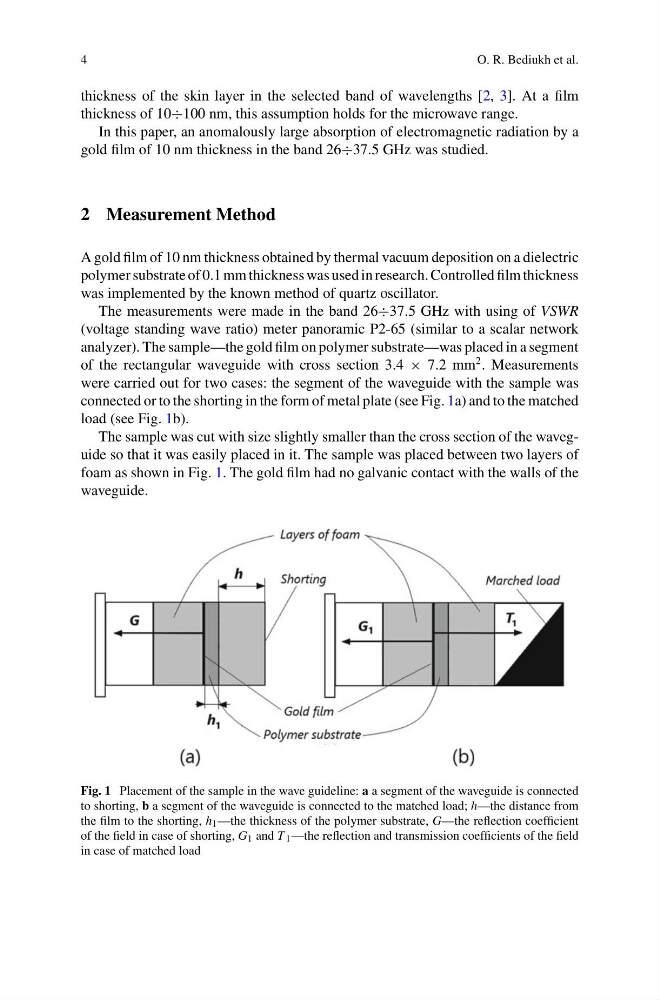
were carried out for two cases: the segment of the waveguide with the sample was
connected or to the shorting in the form of metal plate (see Fig. 1a) and to the matched
load (see Fig. 1b).
The sample was cut with size slightly smaller than the cross section of the waveguide so that it was easily placed in it. The sample was placed between two layers of
foam as shown in Fig. 1. The gold film had no galvanic contact with the walls of the
waveguide.
Fig. 1 Placement of the sample in the wave guideline: a a segment of the waveguide is connected
to shorting, b a segment of the waveguide is connected to the matched load; h—the distance from
the film to the shorting, h 1 —the thickness of the polymer substrate, G—the reflection coefficient
of the field in case of shorting, G 1 and T 1 —the reflection and transmission coefficients of the field
in case of matched load
O. R. Bediukh et al.
thickness of the skin layer in the selected band of wavelengths [2, 3]. At a film
thickness of 10÷100 nm, this assumption holds for the microwave range.
In this paper, an anomalously large absorption of electromagnetic radiation by a
gold film of 10 nm thickness in the band 26÷37.5 GHz was studied.
2 Measurement Method
A gold film of 10 nm thickness obtained by thermal vacuum deposition on a dielectric
polymer substrate of 0.1 mm thickness was used in research. Controlled film thickness
was implemented by the known method of quartz oscillator.
The measurements were made in the band 26÷37.5 GHz with using of VSWR
(voltage standing wave ratio) meter panoramic P2-65 (similar to a scalar network
analyzer). The sample—the gold film on polymer substrate—was placed in a segment
of the rectangular waveguide with cross section 3.4 × 7.2 mm
2 . Measurements
were carried out for two cases: the segment of the waveguide with the sample was
connected or to the shorting in the form of metal plate (see Fig. 1a) and to the matched
load (see Fig. 1b).
The sample was cut with size slightly smaller than the cross section of the waveguide so that it was easily placed in it. The sample was placed between two layers of
foam as shown in Fig. 1. The gold film had no galvanic contact with the walls of the
waveguide.
Fig. 1 Placement of the sample in the wave guideline: a a segment of the waveguide is connected
to shorting, b a segment of the waveguide is connected to the matched load; h—the distance from
the film to the shorting, h 1 —the thickness of the polymer substrate, G—the reflection coefficient
of the field in case of shorting, G 1 and T 1 —the reflection and transmission coefficients of the field
in case of matched load