

Theoretical Modeling of Laser-Stimulated Nanostructures
279
2 Features of the Boundary Conditions for the Problem
of Surface Destruction by a Laser Pulse
In this research, the interaction of powerful pulses of femtosecond duration with
the solid surface is theoretically investigated. The condition that provides a crater
formation without melting edges, as we received earlier, has the form: q >
ρ 0 RgT c c
μ
·
1
1−R 2 . Here q—power of electromagnetic wave falling on the matter surface, R g —the
universal gas constant, T c —the critical temperature which the surface region reached
under irradiation as the phase state changes, μ—the molecular weight, ρ—the density
of the irradiated material, R—light reflectivity.
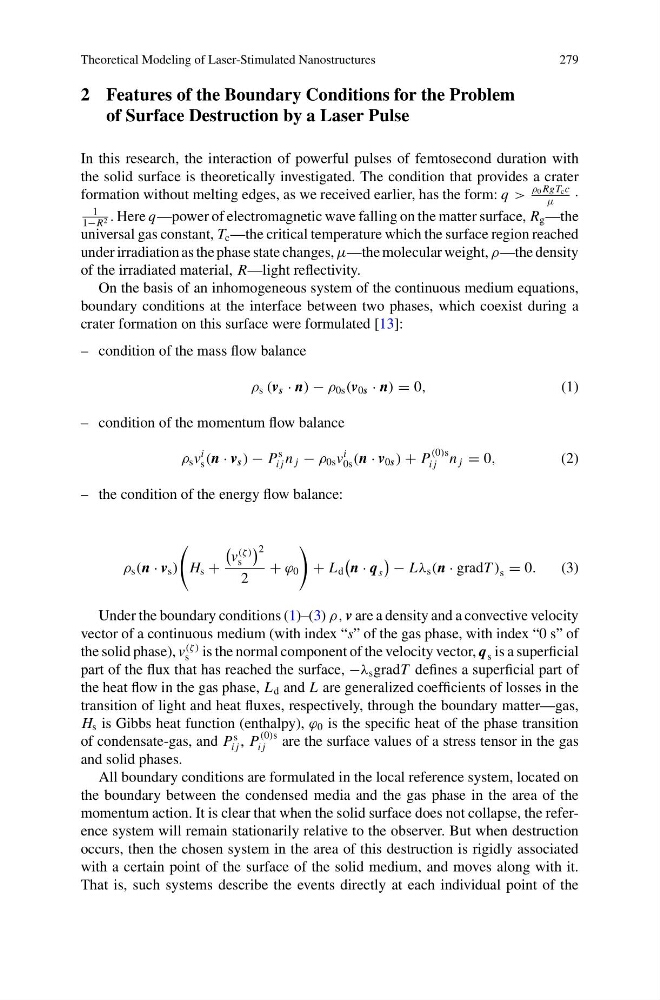
On the basis of an inhomogeneous system of the continuous medium equations,
boundary conditions at the interface between two phases, which coexist during a
crater formation on this surface were formulated [13]:
– condition of the mass flow balance
ρ s (v s · n) − ρ 0s (v 0s · n) = 0,
(1)
– condition of the momentum flow balance
ρ s v
i
s (n · v s ) − P
s
i j n j − ρ 0s v
i
0s (n · v 0s ) + P
(0)s
i j n j = 0,
(2)
– the condition of the energy flow balance:
ρ s (n · v s )
H s +
v
(ζ )
s
2
2
+ ϕ 0
+ L d
n · q s
− Lλ s (n · gradT ) s = 0.
(3)
Under the boundary conditions (1)–(3) ρ, v are a density and a convective velocity
vector of a continuous medium (with index “s” of the gas phase, with index “0 s” of
the solid phase), v
(ζ )
s is the normal component of the velocity vector, q s is a superficial
part of the flux that has reached the surface, −λ s gradT defines a superficial part of
the heat flow in the gas phase, L d and L are generalized coefficients of losses in the
transition of light and heat fluxes, respectively, through the boundary matter—gas,
H s is Gibbs heat function (enthalpy), ϕ 0 is the specific heat of the phase transition
of condensate-gas, and P
s
i j , P
(0)s
i j
are the surface values of a stress tensor in the gas
and solid phases.
All boundary conditions are formulated in the local reference system, located on
the boundary between the condensed media and the gas phase in the area of the
momentum action. It is clear that when the solid surface does not collapse, the reference system will remain stationarily relative to the observer. But when destruction
occurs, then the chosen system in the area of this destruction is rigidly associated
with a certain point of the surface of the solid medium, and moves along with it.
That is, such systems describe the events directly at each individual point of the
279
2 Features of the Boundary Conditions for the Problem
of Surface Destruction by a Laser Pulse
In this research, the interaction of powerful pulses of femtosecond duration with
the solid surface is theoretically investigated. The condition that provides a crater
formation without melting edges, as we received earlier, has the form: q >
ρ 0 RgT c c
μ
·
1
1−R 2 . Here q—power of electromagnetic wave falling on the matter surface, R g —the
universal gas constant, T c —the critical temperature which the surface region reached
under irradiation as the phase state changes, μ—the molecular weight, ρ—the density
of the irradiated material, R—light reflectivity.
On the basis of an inhomogeneous system of the continuous medium equations,
boundary conditions at the interface between two phases, which coexist during a
crater formation on this surface were formulated [13]:
– condition of the mass flow balance
ρ s (v s · n) − ρ 0s (v 0s · n) = 0,
(1)
– condition of the momentum flow balance
ρ s v
i
s (n · v s ) − P
s
i j n j − ρ 0s v
i
0s (n · v 0s ) + P
(0)s
i j n j = 0,
(2)
– the condition of the energy flow balance:
ρ s (n · v s )
H s +
v
(ζ )
s
2
2
+ ϕ 0
+ L d
n · q s
− Lλ s (n · gradT ) s = 0.
(3)
Under the boundary conditions (1)–(3) ρ, v are a density and a convective velocity
vector of a continuous medium (with index “s” of the gas phase, with index “0 s” of
the solid phase), v
(ζ )
s is the normal component of the velocity vector, q s is a superficial
part of the flux that has reached the surface, −λ s gradT defines a superficial part of
the heat flow in the gas phase, L d and L are generalized coefficients of losses in the
transition of light and heat fluxes, respectively, through the boundary matter—gas,
H s is Gibbs heat function (enthalpy), ϕ 0 is the specific heat of the phase transition
of condensate-gas, and P
s
i j , P
(0)s
i j
are the surface values of a stress tensor in the gas
and solid phases.
All boundary conditions are formulated in the local reference system, located on
the boundary between the condensed media and the gas phase in the area of the
momentum action. It is clear that when the solid surface does not collapse, the reference system will remain stationarily relative to the observer. But when destruction
occurs, then the chosen system in the area of this destruction is rigidly associated
with a certain point of the surface of the solid medium, and moves along with it.
That is, such systems describe the events directly at each individual point of the