

278
L. V. Shmeleva et al.
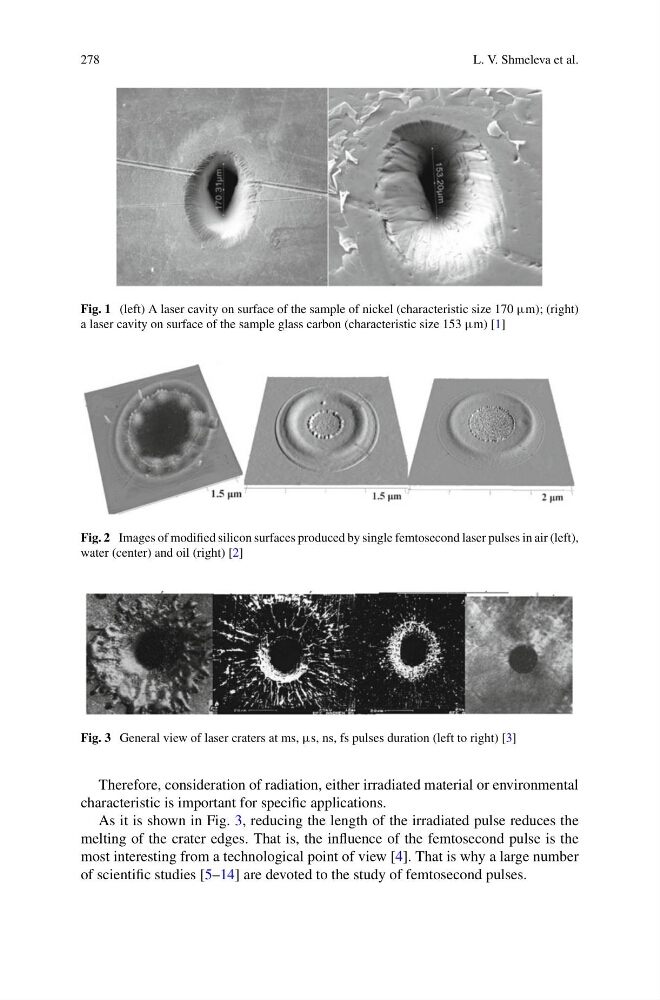
Fig. 1 (left) A laser cavity on surface of the sample of nickel (characteristic size 170 µm); (right)
a laser cavity on surface of the sample glass carbon (characteristic size 153 µm) [1]
Fig. 2 Images of modified silicon surfaces produced by single femtosecond laser pulses in air (left),
water (center) and oil (right) [2]
Fig. 3 General view of laser craters at ms, µs, ns, fs pulses duration (left to right) [3]
Therefore, consideration of radiation, either irradiated material or environmental
characteristic is important for specific applications.
As it is shown in Fig. 3, reducing the length of the irradiated pulse reduces the
melting of the crater edges. That is, the influence of the femtosecond pulse is the
most interesting from a technological point of view [4]. That is why a large number
of scientific studies [5–14] are devoted to the study of femtosecond pulses.
L. V. Shmeleva et al.
Fig. 1 (left) A laser cavity on surface of the sample of nickel (characteristic size 170 µm); (right)
a laser cavity on surface of the sample glass carbon (characteristic size 153 µm) [1]
Fig. 2 Images of modified silicon surfaces produced by single femtosecond laser pulses in air (left),
water (center) and oil (right) [2]
Fig. 3 General view of laser craters at ms, µs, ns, fs pulses duration (left to right) [3]
Therefore, consideration of radiation, either irradiated material or environmental
characteristic is important for specific applications.
As it is shown in Fig. 3, reducing the length of the irradiated pulse reduces the
melting of the crater edges. That is, the influence of the femtosecond pulse is the
most interesting from a technological point of view [4]. That is why a large number
of scientific studies [5–14] are devoted to the study of femtosecond pulses.