

258
D. Makieła and Z. Gburski
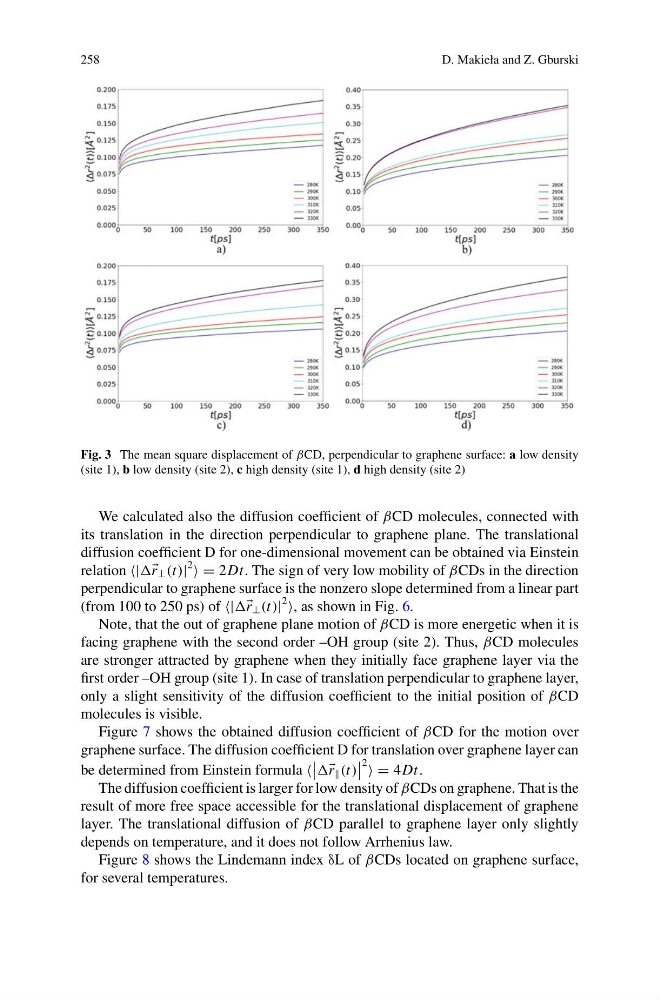
Fig. 3 The mean square displacement of βCD, perpendicular to graphene surface: a low density
(site 1), b low density (site 2), c high density (site 1), d high density (site 2)
We calculated also the diffusion coefficient of βCD molecules, connected with
its translation in the direction perpendicular to graphene plane. The translational
diffusion coefficient D for one-dimensional movement can be obtained via Einstein
relation | r ⊥ (t)|
2 = 2Dt. The sign of very low mobility of βCDs in the direction
perpendicular to graphene surface is the nonzero slope determined from a linear part
(from 100 to 250 ps) of | r ⊥ (t)|
2 , as shown in Fig. 6.
Note, that the out of graphene plane motion of βCD is more energetic when it is
facing graphene with the second order –OH group (site 2). Thus, βCD molecules
are stronger attracted by graphene when they initially face graphene layer via the
first order –OH group (site 1). In case of translation perpendicular to graphene layer,
only a slight sensitivity of the diffusion coefficient to the initial position of βCD
molecules is visible.
Figure 7 shows the obtained diffusion coefficient of βCD for the motion over
graphene surface. The diffusion coefficient D for translation over graphene layer can
be determined from Einstein formula
r (t)
2 = 4Dt.
The diffusion coefficient is larger for low density of βCDs on graphene. That is the
result of more free space accessible for the translational displacement of graphene
layer. The translational diffusion of βCD parallel to graphene layer only slightly
depends on temperature, and it does not follow Arrhenius law.
Figure 8 shows the Lindemann index δL of βCDs located on graphene surface,
for several temperatures.
D. Makieła and Z. Gburski
Fig. 3 The mean square displacement of βCD, perpendicular to graphene surface: a low density
(site 1), b low density (site 2), c high density (site 1), d high density (site 2)
We calculated also the diffusion coefficient of βCD molecules, connected with
its translation in the direction perpendicular to graphene plane. The translational
diffusion coefficient D for one-dimensional movement can be obtained via Einstein
relation | r ⊥ (t)|
2 = 2Dt. The sign of very low mobility of βCDs in the direction
perpendicular to graphene surface is the nonzero slope determined from a linear part
(from 100 to 250 ps) of | r ⊥ (t)|
2 , as shown in Fig. 6.
Note, that the out of graphene plane motion of βCD is more energetic when it is
facing graphene with the second order –OH group (site 2). Thus, βCD molecules
are stronger attracted by graphene when they initially face graphene layer via the
first order –OH group (site 1). In case of translation perpendicular to graphene layer,
only a slight sensitivity of the diffusion coefficient to the initial position of βCD
molecules is visible.
Figure 7 shows the obtained diffusion coefficient of βCD for the motion over
graphene surface. The diffusion coefficient D for translation over graphene layer can
be determined from Einstein formula
r (t)
2 = 4Dt.
The diffusion coefficient is larger for low density of βCDs on graphene. That is the
result of more free space accessible for the translational displacement of graphene
layer. The translational diffusion of βCD parallel to graphene layer only slightly
depends on temperature, and it does not follow Arrhenius law.
Figure 8 shows the Lindemann index δL of βCDs located on graphene surface,
for several temperatures.