

Thin Layer of Cyclodextrins on Graphene—MD Simulations
257
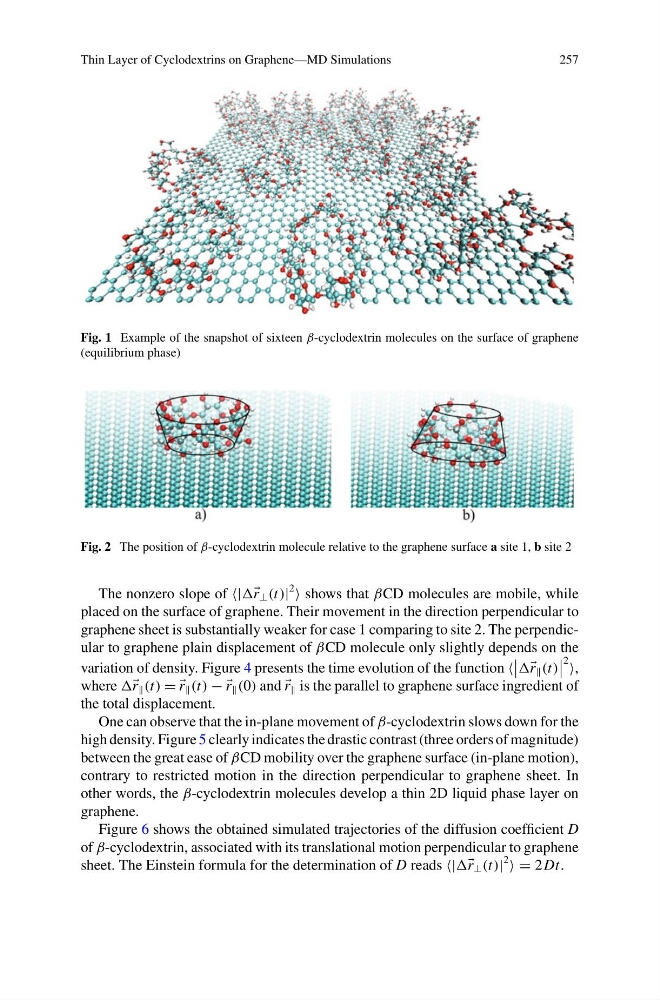
Fig. 1 Example of the snapshot of sixteen β-cyclodextrin molecules on the surface of graphene
(equilibrium phase)
Fig. 2 The position of β-cyclodextrin molecule relative to the graphene surface a site 1, b site 2
The nonzero slope of | r ⊥ (t)|
2 shows that βCD molecules are mobile, while
placed on the surface of graphene. Their movement in the direction perpendicular to
graphene sheet is substantially weaker for case 1 comparing to site 2. The perpendicular to graphene plain displacement of βCD molecule only slightly depends on the
variation of density. Figure 4 presents the time evolution of the function
r (t)
2 ,
where r (t) = =
r (t) − −
r (0) and
r is the parallel to graphene surface ingredient of
the total displacement.
One can observe that the in-plane movement of β-cyclodextrin slows down for the
high density. Figure 5 clearly indicates the drastic contrast (three orders of magnitude)
between the great ease of βCD mobility over the graphene surface (in-plane motion),
contrary to restricted motion in the direction perpendicular to graphene sheet. In
other words, the β-cyclodextrin molecules develop a thin 2D liquid phase layer on
graphene.
Figure 6 shows the obtained simulated trajectories of the diffusion coefficient D
of β-cyclodextrin, associated with its translational motion perpendicular to graphene
sheet. The Einstein formula for the determination of D reads | r ⊥ (t)|
2 = 2Dt.
257
Fig. 1 Example of the snapshot of sixteen β-cyclodextrin molecules on the surface of graphene
(equilibrium phase)
Fig. 2 The position of β-cyclodextrin molecule relative to the graphene surface a site 1, b site 2
The nonzero slope of | r ⊥ (t)|
2 shows that βCD molecules are mobile, while
placed on the surface of graphene. Their movement in the direction perpendicular to
graphene sheet is substantially weaker for case 1 comparing to site 2. The perpendicular to graphene plain displacement of βCD molecule only slightly depends on the
variation of density. Figure 4 presents the time evolution of the function
r (t)
2 ,
where r (t) = =
r (t) − −
r (0) and
r is the parallel to graphene surface ingredient of
the total displacement.
One can observe that the in-plane movement of β-cyclodextrin slows down for the
high density. Figure 5 clearly indicates the drastic contrast (three orders of magnitude)
between the great ease of βCD mobility over the graphene surface (in-plane motion),
contrary to restricted motion in the direction perpendicular to graphene sheet. In
other words, the β-cyclodextrin molecules develop a thin 2D liquid phase layer on
graphene.
Figure 6 shows the obtained simulated trajectories of the diffusion coefficient D
of β-cyclodextrin, associated with its translational motion perpendicular to graphene
sheet. The Einstein formula for the determination of D reads | r ⊥ (t)|
2 = 2Dt.