

Nanostructural Changes in a Ni/NiO Cermet During …
221
2 Materials and Methods
The disk-shaped NiO ceramic specimens were sintered from pure NiO powders [14].
The specimens manufacturing procedure comprised of the following stages: the NiO
powder was milled in a rotating mill for 24 h, then it was dried, compacted by
applying the pressure 20 MPa, and sintered for 2 h at 1400 °C in air. Finally, we
obtained disks of a thickness of 1.8 mm, and their diameter was 27 mm. To measure
their porosity, we used a hydrostatic method. The average value of porosity based
on measurements of all sintered specimens was in a range of 41–42%.
Series of disks were subjected to one-time reduction in hydrogen of 99.99 vol%
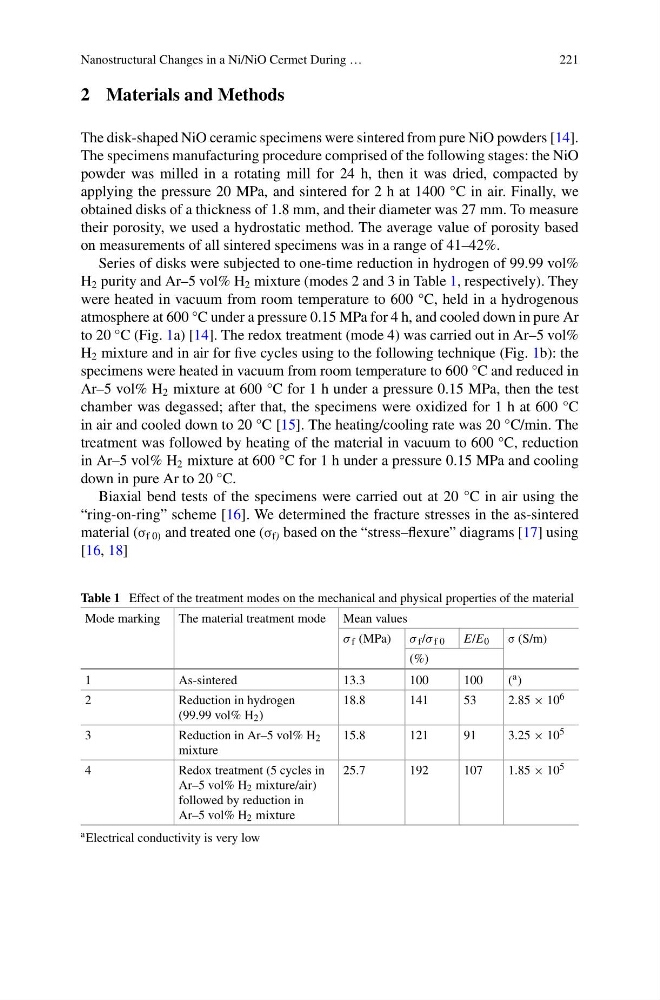
H 2 purity and Ar–5 vol% H 2 mixture (modes 2 and 3 in Table 1, respectively). They
were heated in vacuum from room temperature to 600 °C, held in a hydrogenous
atmosphere at 600 °C under a pressure 0.15 MPa for 4 h, and cooled down in pure Ar
to 20 °C (Fig. 1a) [14]. The redox treatment (mode 4) was carried out in Ar–5 vol%
H 2 mixture and in air for five cycles using to the following technique (Fig. 1b): the
specimens were heated in vacuum from room temperature to 600 °C and reduced in
Ar–5 vol% H 2 mixture at 600 °C for 1 h under a pressure 0.15 MPa, then the test
chamber was degassed; after that, the specimens were oxidized for 1 h at 600 °C
in air and cooled down to 20 °C [15]. The heating/cooling rate was 20 °C/min. The
treatment was followed by heating of the material in vacuum to 600 °C, reduction
in Ar–5 vol% H 2 mixture at 600 °C for 1 h under a pressure 0.15 MPa and cooling
down in pure Ar to 20 °C.
Biaxial bend tests of the specimens were carried out at 20 °C in air using the
“ring-on-ring” scheme [16]. We determined the fracture stresses in the as-sintered
material (σ f 0) and treated one (σ f) based on the “stress–flexure” diagrams [17] using
[16, 18]
Table 1 Effect of the treatment modes on the mechanical and physical properties of the material
Mode marking The material treatment mode Mean values
σ f (MPa) σ f /σ f 0
E/E 0
σ (S/m)
(%)
1
As-sintered
13.3
100
100
( a )
2
Reduction in hydrogen
(99.99 vol% H 2 )
18.8
141
53
2.85 × 10 6
3
Reduction in Ar–5 vol% H 2
mixture
15.8
121
91
3.25 × 10 5
4
Redox treatment (5 cycles in
Ar–5 vol% H 2 mixture/air)
followed by reduction in
Ar–5 vol% H 2 mixture
25.7
192
107
1.85 × 10 5
a Electrical conductivity is very low
221
2 Materials and Methods
The disk-shaped NiO ceramic specimens were sintered from pure NiO powders [14].
The specimens manufacturing procedure comprised of the following stages: the NiO
powder was milled in a rotating mill for 24 h, then it was dried, compacted by
applying the pressure 20 MPa, and sintered for 2 h at 1400 °C in air. Finally, we
obtained disks of a thickness of 1.8 mm, and their diameter was 27 mm. To measure
their porosity, we used a hydrostatic method. The average value of porosity based
on measurements of all sintered specimens was in a range of 41–42%.
Series of disks were subjected to one-time reduction in hydrogen of 99.99 vol%
H 2 purity and Ar–5 vol% H 2 mixture (modes 2 and 3 in Table 1, respectively). They
were heated in vacuum from room temperature to 600 °C, held in a hydrogenous
atmosphere at 600 °C under a pressure 0.15 MPa for 4 h, and cooled down in pure Ar
to 20 °C (Fig. 1a) [14]. The redox treatment (mode 4) was carried out in Ar–5 vol%
H 2 mixture and in air for five cycles using to the following technique (Fig. 1b): the
specimens were heated in vacuum from room temperature to 600 °C and reduced in
Ar–5 vol% H 2 mixture at 600 °C for 1 h under a pressure 0.15 MPa, then the test
chamber was degassed; after that, the specimens were oxidized for 1 h at 600 °C
in air and cooled down to 20 °C [15]. The heating/cooling rate was 20 °C/min. The
treatment was followed by heating of the material in vacuum to 600 °C, reduction
in Ar–5 vol% H 2 mixture at 600 °C for 1 h under a pressure 0.15 MPa and cooling
down in pure Ar to 20 °C.
Biaxial bend tests of the specimens were carried out at 20 °C in air using the
“ring-on-ring” scheme [16]. We determined the fracture stresses in the as-sintered
material (σ f 0) and treated one (σ f) based on the “stress–flexure” diagrams [17] using
[16, 18]
Table 1 Effect of the treatment modes on the mechanical and physical properties of the material
Mode marking The material treatment mode Mean values
σ f (MPa) σ f /σ f 0
E/E 0
σ (S/m)
(%)
1
As-sintered
13.3
100
100
( a )
2
Reduction in hydrogen
(99.99 vol% H 2 )
18.8
141
53
2.85 × 10 6
3
Reduction in Ar–5 vol% H 2
mixture
15.8
121
91
3.25 × 10 5
4
Redox treatment (5 cycles in
Ar–5 vol% H 2 mixture/air)
followed by reduction in
Ar–5 vol% H 2 mixture
25.7
192
107
1.85 × 10 5
a Electrical conductivity is very low