

Configuration of Charge Waves in Polymethine Linear Dye Systems
191
R αn = e x (R 0 n + αb cos ψ) + e y αd sin ϕ; α = {0; 1},
(14.1)
wherever R 0 = d cos ϕ + b cos ψ.
To explain the electron dynamics, when the electron is inserted inside polymethylene chain, we use the Hamiltonian [7] that has this form with considering peculiarity
of this item:
E({a}) =E c + W
(0)
+
1
2
α n
β m
w αn,β m +
1
2
α n
D αn + W
(1)
αn
|a αn |
2
+
α n
β m
M αn,β m a
∗
αn a β m .
(14.2)
It is typical for condensates of the crystalline type with the semiconductor or
dielectric zone structure [7]. The first part of it E c of (14.2) shows the energy of N
isolated molecular groups electrons (in the case of polymethines it could be the carbon
CH groups), to which the energy of the injected electron that interacts only with the
electrons of such isolated molecular group is added. “W
(0) is the energy of interaction
of the external field with the electrons of the valence zone. The energy w αn,β m in
(14.2) plays the main role in incorporation of the isolated molecular groups into the
united bonded system and determines interaction between them under conditions of
the absence of excitation. Energy D αn in the Hamiltonian (14.2) by its physical sense
reflects the change in the interaction of the exited molecular group with non-exited
surrounding in comparison with the similar interaction, when all molecular groups
are not exited. The summand W
(1)
αn represents the influence of the external field on
the injected electron. Value a α n is, in fact, the wave function of the variables α, n,
which determines the distribution in the molecular chain of the electron, injected
in the conduction zone, and |a α n |
2 is usually interpreted as the probability of the
localization of the electron on the knot with the number α n. At last, the energy
M αn,β m , which is included in the Hamiltonian (14.2), is called the energy of the
resonance exchange interaction. By its physical sense it determines not so much
additional interaction among molecular groups, as the dynamics of the considered
charge excitation in the polyene chain” [7].
“Hereinafter, only varying part of the Hamiltonian (14.2) [7] is considered:
E({a}) ≡ E({a}) − E c − W
(0)
.
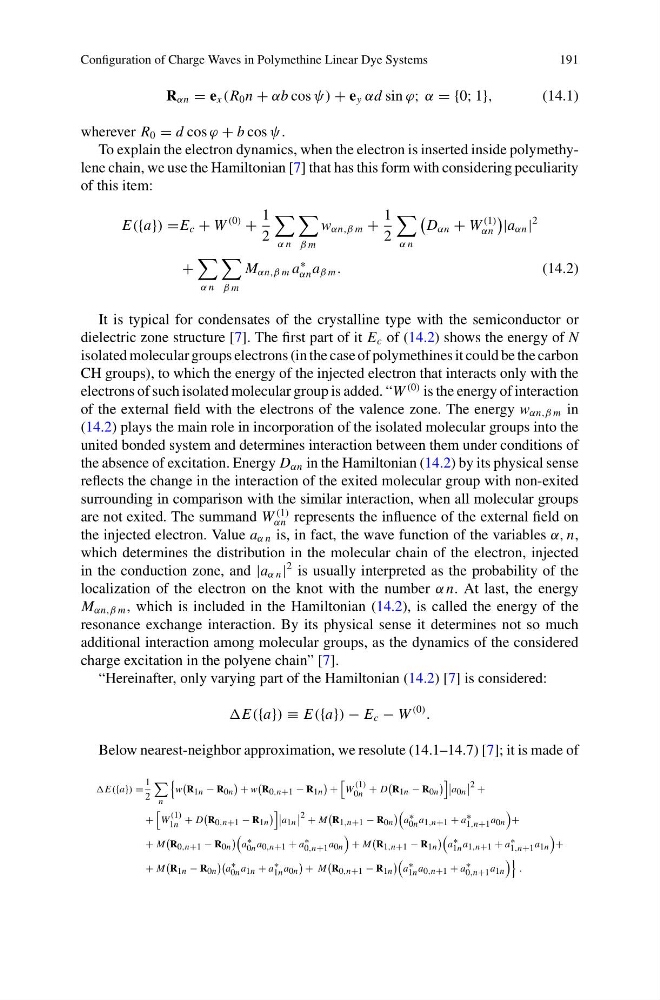
Below nearest-neighbor approximation, we resolute (14.1–14.7) [7]; it is made of
E({a}) =
1
2
n
w
R 1n − R 0n
+ w
R 0,n+1 − R 1n
+
W
(1)
0n + D
R 1n − R 0n
a 0n
2 +
+
W
(1)
1n + D
R 0,n+1 − R 1n
a 1n
2 + M
R 1,n+1 − R 0n
a ∗
0n a 1,n+1 + a ∗
1,n+1 a 0n
+
+ M
R 0,n+1 − R 0n
a ∗
0n a 0,n+1 + a ∗
0,n+1 a 0n
+ M
R 1,n+1 − R 1n
a ∗
1n a 1,n+1 + a ∗
1,n+1 a 1n
+
+ M
R 1n − R 0n
a ∗
0n a 1n + a ∗
1n a 0n
+ M
R 0,n+1 − R 1n
a ∗
1n a 0,n+1 + a ∗
0,n+1 a 1n
.
191
R αn = e x (R 0 n + αb cos ψ) + e y αd sin ϕ; α = {0; 1},
(14.1)
wherever R 0 = d cos ϕ + b cos ψ.
To explain the electron dynamics, when the electron is inserted inside polymethylene chain, we use the Hamiltonian [7] that has this form with considering peculiarity
of this item:
E({a}) =E c + W
(0)
+
1
2
α n
β m
w αn,β m +
1
2
α n
D αn + W
(1)
αn
|a αn |
2
+
α n
β m
M αn,β m a
∗
αn a β m .
(14.2)
It is typical for condensates of the crystalline type with the semiconductor or
dielectric zone structure [7]. The first part of it E c of (14.2) shows the energy of N
isolated molecular groups electrons (in the case of polymethines it could be the carbon
CH groups), to which the energy of the injected electron that interacts only with the
electrons of such isolated molecular group is added. “W
(0) is the energy of interaction
of the external field with the electrons of the valence zone. The energy w αn,β m in
(14.2) plays the main role in incorporation of the isolated molecular groups into the
united bonded system and determines interaction between them under conditions of
the absence of excitation. Energy D αn in the Hamiltonian (14.2) by its physical sense
reflects the change in the interaction of the exited molecular group with non-exited
surrounding in comparison with the similar interaction, when all molecular groups
are not exited. The summand W
(1)
αn represents the influence of the external field on
the injected electron. Value a α n is, in fact, the wave function of the variables α, n,
which determines the distribution in the molecular chain of the electron, injected
in the conduction zone, and |a α n |
2 is usually interpreted as the probability of the
localization of the electron on the knot with the number α n. At last, the energy
M αn,β m , which is included in the Hamiltonian (14.2), is called the energy of the
resonance exchange interaction. By its physical sense it determines not so much
additional interaction among molecular groups, as the dynamics of the considered
charge excitation in the polyene chain” [7].
“Hereinafter, only varying part of the Hamiltonian (14.2) [7] is considered:
E({a}) ≡ E({a}) − E c − W
(0)
.
Below nearest-neighbor approximation, we resolute (14.1–14.7) [7]; it is made of
E({a}) =
1
2
n
w
R 1n − R 0n
+ w
R 0,n+1 − R 1n
+
W
(1)
0n + D
R 1n − R 0n
a 0n
2 +
+
W
(1)
1n + D
R 0,n+1 − R 1n
a 1n
2 + M
R 1,n+1 − R 0n
a ∗
0n a 1,n+1 + a ∗
1,n+1 a 0n
+
+ M
R 0,n+1 − R 0n
a ∗
0n a 0,n+1 + a ∗
0,n+1 a 0n
+ M
R 1,n+1 − R 1n
a ∗
1n a 1,n+1 + a ∗
1,n+1 a 1n
+
+ M
R 1n − R 0n
a ∗
0n a 1n + a ∗
1n a 0n
+ M
R 0,n+1 − R 1n
a ∗
1n a 0,n+1 + a ∗
0,n+1 a 1n
.