

190
S. V. Vasylyuk et al.
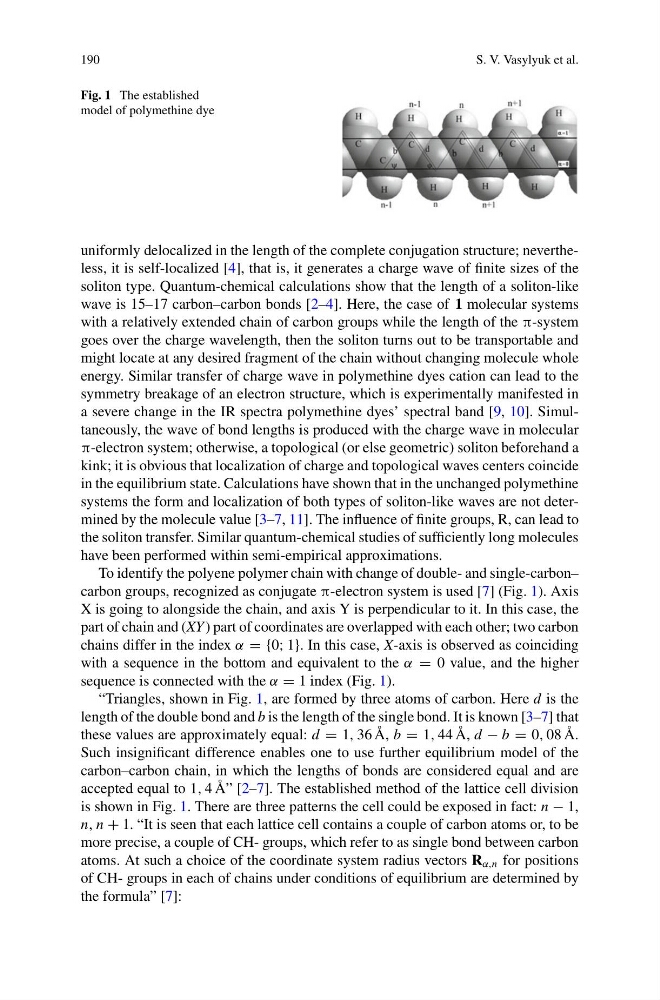
Fig. 1 The established
model of polymethine dye
uniformly delocalized in the length of the complete conjugation structure; nevertheless, it is self-localized [4], that is, it generates a charge wave of finite sizes of the
soliton type. Quantum-chemical calculations show that the length of a soliton-like
wave is 15–17 carbon–carbon bonds [2–4]. Here, the case of 1 molecular systems
with a relatively extended chain of carbon groups while the length of the π-system
goes over the charge wavelength, then the soliton turns out to be transportable and
might locate at any desired fragment of the chain without changing molecule whole
energy. Similar transfer of charge wave in polymethine dyes cation can lead to the
symmetry breakage of an electron structure, which is experimentally manifested in
a severe change in the IR spectra polymethine dyes’ spectral band [9, 10]. Simultaneously, the wave of bond lengths is produced with the charge wave in molecular
π-electron system; otherwise, a topological (or else geometric) soliton beforehand a
kink; it is obvious that localization of charge and topological waves centers coincide
in the equilibrium state. Calculations have shown that in the unchanged polymethine
systems the form and localization of both types of soliton-like waves are not determined by the molecule value [3–7, 11]. The influence of finite groups, R, can lead to
the soliton transfer. Similar quantum-chemical studies of sufficiently long molecules
have been performed within semi-empirical approximations.
To identify the polyene polymer chain with change of double- and single-carbon–
carbon groups, recognized as conjugate π-electron system is used [7] (Fig. 1). Axis
X is going to alongside the chain, and axis Y is perpendicular to it. In this case, the
part of chain and (XY ) part of coordinates are overlapped with each other; two carbon
chains differ in the index α = {0; 1}. In this case, X-axis is observed as coinciding
with a sequence in the bottom and equivalent to the α = 0 value, and the higher
sequence is connected with the α = 1 index (Fig. 1).
“Triangles, shown in Fig. 1, are formed by three atoms of carbon. Here d is the
length of the double bond and b is the length of the single bond. It is known [3–7] that
these values are approximately equal: d = 1, 36 Å, b = 1, 44 Å, d − b = 0, 08 Å.
Such insignificant difference enables one to use further equilibrium model of the
carbon–carbon chain, in which the lengths of bonds are considered equal and are
accepted equal to 1, 4 Å” [2–7]. The established method of the lattice cell division
is shown in Fig. 1. There are three patterns the cell could be exposed in fact: n − 1,
n, n + 1. “It is seen that each lattice cell contains a couple of carbon atoms or, to be
more precise, a couple of CH- groups, which refer to as single bond between carbon
atoms. At such a choice of the coordinate system radius vectors R α,n for positions
of CH- groups in each of chains under conditions of equilibrium are determined by
the formula” [7]:
S. V. Vasylyuk et al.
Fig. 1 The established
model of polymethine dye
uniformly delocalized in the length of the complete conjugation structure; nevertheless, it is self-localized [4], that is, it generates a charge wave of finite sizes of the
soliton type. Quantum-chemical calculations show that the length of a soliton-like
wave is 15–17 carbon–carbon bonds [2–4]. Here, the case of 1 molecular systems
with a relatively extended chain of carbon groups while the length of the π-system
goes over the charge wavelength, then the soliton turns out to be transportable and
might locate at any desired fragment of the chain without changing molecule whole
energy. Similar transfer of charge wave in polymethine dyes cation can lead to the
symmetry breakage of an electron structure, which is experimentally manifested in
a severe change in the IR spectra polymethine dyes’ spectral band [9, 10]. Simultaneously, the wave of bond lengths is produced with the charge wave in molecular
π-electron system; otherwise, a topological (or else geometric) soliton beforehand a
kink; it is obvious that localization of charge and topological waves centers coincide
in the equilibrium state. Calculations have shown that in the unchanged polymethine
systems the form and localization of both types of soliton-like waves are not determined by the molecule value [3–7, 11]. The influence of finite groups, R, can lead to
the soliton transfer. Similar quantum-chemical studies of sufficiently long molecules
have been performed within semi-empirical approximations.
To identify the polyene polymer chain with change of double- and single-carbon–
carbon groups, recognized as conjugate π-electron system is used [7] (Fig. 1). Axis
X is going to alongside the chain, and axis Y is perpendicular to it. In this case, the
part of chain and (XY ) part of coordinates are overlapped with each other; two carbon
chains differ in the index α = {0; 1}. In this case, X-axis is observed as coinciding
with a sequence in the bottom and equivalent to the α = 0 value, and the higher
sequence is connected with the α = 1 index (Fig. 1).
“Triangles, shown in Fig. 1, are formed by three atoms of carbon. Here d is the
length of the double bond and b is the length of the single bond. It is known [3–7] that
these values are approximately equal: d = 1, 36 Å, b = 1, 44 Å, d − b = 0, 08 Å.
Such insignificant difference enables one to use further equilibrium model of the
carbon–carbon chain, in which the lengths of bonds are considered equal and are
accepted equal to 1, 4 Å” [2–7]. The established method of the lattice cell division
is shown in Fig. 1. There are three patterns the cell could be exposed in fact: n − 1,
n, n + 1. “It is seen that each lattice cell contains a couple of carbon atoms or, to be
more precise, a couple of CH- groups, which refer to as single bond between carbon
atoms. At such a choice of the coordinate system radius vectors R α,n for positions
of CH- groups in each of chains under conditions of equilibrium are determined by
the formula” [7]: