

182
Yu. Kotsiuba et al.
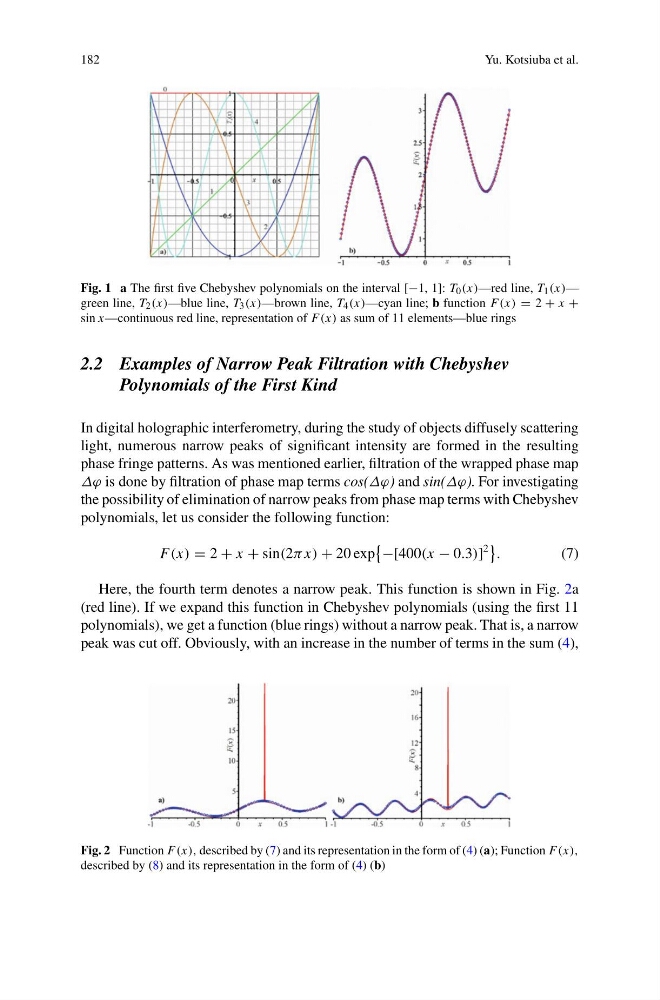
Fig. 1 a The first five Chebyshev polynomials on the interval [−1, 1]: T 0 (x)—red line, T 1 (x)—
green line, T 2 (x)—blue line, T 3 (x)—brown line, T 4 (x)—cyan line; b function F(x) = 2 + x +
sin x—continuous red line, representation of F(x) as sum of 11 elements—blue rings
2.2 Examples of Narrow Peak Filtration with Chebyshev
Polynomials of the First Kind
In digital holographic interferometry, during the study of objects diffusely scattering
light, numerous narrow peaks of significant intensity are formed in the resulting
phase fringe patterns. As was mentioned earlier, filtration of the wrapped phase map
Δϕ is done by filtration of phase map terms cos(Δϕ) and sin(Δϕ). For investigating
the possibility of elimination of narrow peaks from phase map terms with Chebyshev
polynomials, let us consider the following function:
F(x) = 2 + x + sin(2π x) + 20 exp
−[400(x − 0.3)]
2
.
(7)
Here, the fourth term denotes a narrow peak. This function is shown in Fig. 2a
(red line). If we expand this function in Chebyshev polynomials (using the first 11
polynomials), we get a function (blue rings) without a narrow peak. That is, a narrow
peak was cut off. Obviously, with an increase in the number of terms in the sum (4),
Fig. 2 Function F(x), described by (7) and its representation in the form of (4) (a); Function F(x),
described by (8) and its representation in the form of (4) (b)
Yu. Kotsiuba et al.
Fig. 1 a The first five Chebyshev polynomials on the interval [−1, 1]: T 0 (x)—red line, T 1 (x)—
green line, T 2 (x)—blue line, T 3 (x)—brown line, T 4 (x)—cyan line; b function F(x) = 2 + x +
sin x—continuous red line, representation of F(x) as sum of 11 elements—blue rings
2.2 Examples of Narrow Peak Filtration with Chebyshev
Polynomials of the First Kind
In digital holographic interferometry, during the study of objects diffusely scattering
light, numerous narrow peaks of significant intensity are formed in the resulting
phase fringe patterns. As was mentioned earlier, filtration of the wrapped phase map
Δϕ is done by filtration of phase map terms cos(Δϕ) and sin(Δϕ). For investigating
the possibility of elimination of narrow peaks from phase map terms with Chebyshev
polynomials, let us consider the following function:
F(x) = 2 + x + sin(2π x) + 20 exp
−[400(x − 0.3)]
2
.
(7)
Here, the fourth term denotes a narrow peak. This function is shown in Fig. 2a
(red line). If we expand this function in Chebyshev polynomials (using the first 11
polynomials), we get a function (blue rings) without a narrow peak. That is, a narrow
peak was cut off. Obviously, with an increase in the number of terms in the sum (4),
Fig. 2 Function F(x), described by (7) and its representation in the form of (4) (a); Function F(x),
described by (8) and its representation in the form of (4) (b)