

164
A. M. Korol et al.
regardless of the value of the height of the barrier U and its thickness D. We emphasize
that in this case T = 1 also independently on the values of the parameters α and β.
A remarkable property of the transmission of quasiparticles in this structure
is that it exhibits an effect called supertunneling in literature, namely, for certain
values of the parameters of the problem, the transmission coefficient T is maximum
(T = 1) in the whole range of values of the angle of incidence φ—see the dashed line
in Fig. 1 (the formula for energies corresponding to the supertunneling phenomenon
is given below).
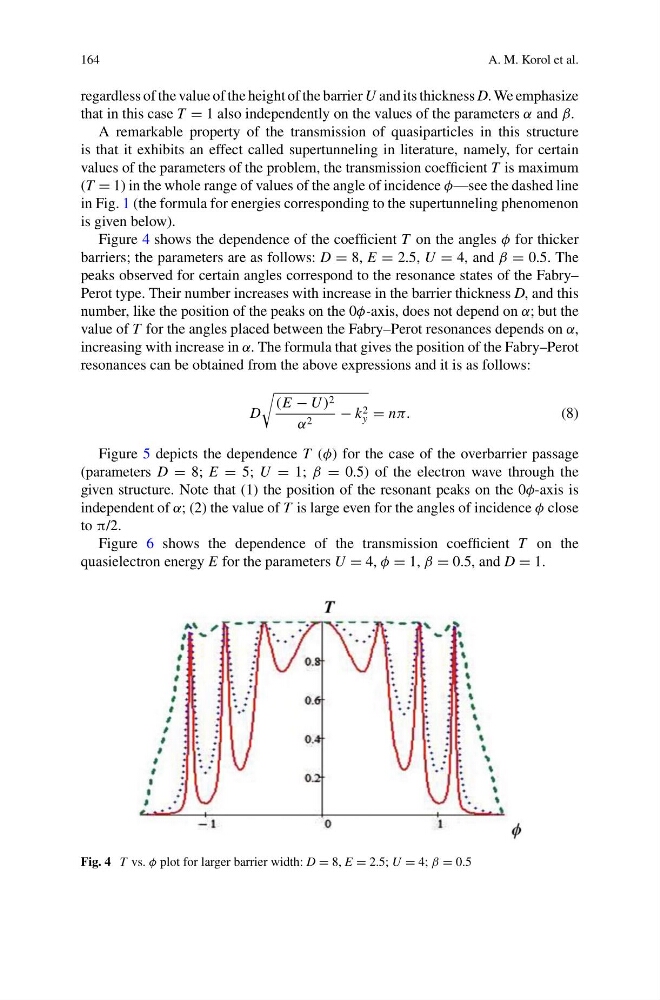
Figure 4 shows the dependence of the coefficient T on the angles φ for thicker
barriers; the parameters are as follows: D = 8, E = 2.5, U = 4, and β = 0.5. The
peaks observed for certain angles correspond to the resonance states of the Fabry–
Perot type. Their number increases with increase in the barrier thickness D, and this
number, like the position of the peaks on the 0φ-axis, does not depend on α; but the
value of T for the angles placed between the Fabry–Perot resonances depends on α,
increasing with increase in α. The formula that gives the position of the Fabry–Perot
resonances can be obtained from the above expressions and it is as follows:
D
(E − U ) 2
α 2
− k 2
y = nπ.
(8)
Figure 5 depicts the dependence T (φ) for the case of the overbarrier passage
(parameters D = 8; E = 5; U = 1; β = 0.5) of the electron wave through the
given structure. Note that (1) the position of the resonant peaks on the 0φ-axis is
independent of α; (2) the value of T is large even for the angles of incidence φ close
to π/2.
Figure 6 shows the dependence of the transmission coefficient T on the
quasielectron energy E for the parameters U = 4, φ = 1, β = 0.5, and D = 1.
Fig. 4 T vs. φ plot for larger barrier width: D = 8, E = 2.5; U = 4; β = 0.5
A. M. Korol et al.
regardless of the value of the height of the barrier U and its thickness D. We emphasize
that in this case T = 1 also independently on the values of the parameters α and β.
A remarkable property of the transmission of quasiparticles in this structure
is that it exhibits an effect called supertunneling in literature, namely, for certain
values of the parameters of the problem, the transmission coefficient T is maximum
(T = 1) in the whole range of values of the angle of incidence φ—see the dashed line
in Fig. 1 (the formula for energies corresponding to the supertunneling phenomenon
is given below).
Figure 4 shows the dependence of the coefficient T on the angles φ for thicker
barriers; the parameters are as follows: D = 8, E = 2.5, U = 4, and β = 0.5. The
peaks observed for certain angles correspond to the resonance states of the Fabry–
Perot type. Their number increases with increase in the barrier thickness D, and this
number, like the position of the peaks on the 0φ-axis, does not depend on α; but the
value of T for the angles placed between the Fabry–Perot resonances depends on α,
increasing with increase in α. The formula that gives the position of the Fabry–Perot
resonances can be obtained from the above expressions and it is as follows:
D
(E − U ) 2
α 2
− k 2
y = nπ.
(8)
Figure 5 depicts the dependence T (φ) for the case of the overbarrier passage
(parameters D = 8; E = 5; U = 1; β = 0.5) of the electron wave through the
given structure. Note that (1) the position of the resonant peaks on the 0φ-axis is
independent of α; (2) the value of T is large even for the angles of incidence φ close
to π/2.
Figure 6 shows the dependence of the transmission coefficient T on the
quasielectron energy E for the parameters U = 4, φ = 1, β = 0.5, and D = 1.
Fig. 4 T vs. φ plot for larger barrier width: D = 8, E = 2.5; U = 4; β = 0.5