

154
I. Gudyma and A. Maksymov
The impact of size effects on the system behavior is shown in Fig. 3b–f. The
panels (b) and (c) in Fig. 3 correspond to fluctuationless and to the system with fluctuations of strength value ε = 300, respectively, in which the surface is considered
ferromagnetic. The results of similar analysis but for the system with antiferromagnetic surface are given in Fig. 3e (fluctuationless) and in Fig. 3f (for ε = 300). As
one can expect for the system with sizes L ≤ 5 and ferromagnetic order of surface’s
molecules, there is no hysteretic behavior. For system sizes bigger than mentioned
one, the hysteresis is clearly seen; however, its width has a tendency to become
saturated. This one can be observed from the comparison of hysteresis width for
L = 8 and L = 15 in Fig. 2b, e. We notice about uniform influence of system size on
hysteresis width for both types of order of surface’s molecules: ferromagnetic and
antiferromagnetic one.
In the system with fluctuations, the appearance of hysteresis takes place for bigger system’s sizes L > 8. From a detailed analysis between Fig. 3c, f, we found that
difference in shape of hysteresis loops is much smaller than for other cases with
weaker fluctuations. We suppose that this interesting feature is related to action of
fluctuations that could randomly flip the spin over all lattice inclusively the surface of
nanocrystal. Since the coupling of surface’s molecules is weaker than the bulk ones,
the action of fluctuations can become dominant on the surface of nanocrystal. Therefore, they may reduce the effects related to ferro- and antiferromagnetic coupling on
the surface, i.e., are able to mimic the antiferromagnetic behavior for ferromagnetic
surface and can create homogeneous LS and HS domains with sufficiently large
lifetime on the surface with antiferromagnetic order.
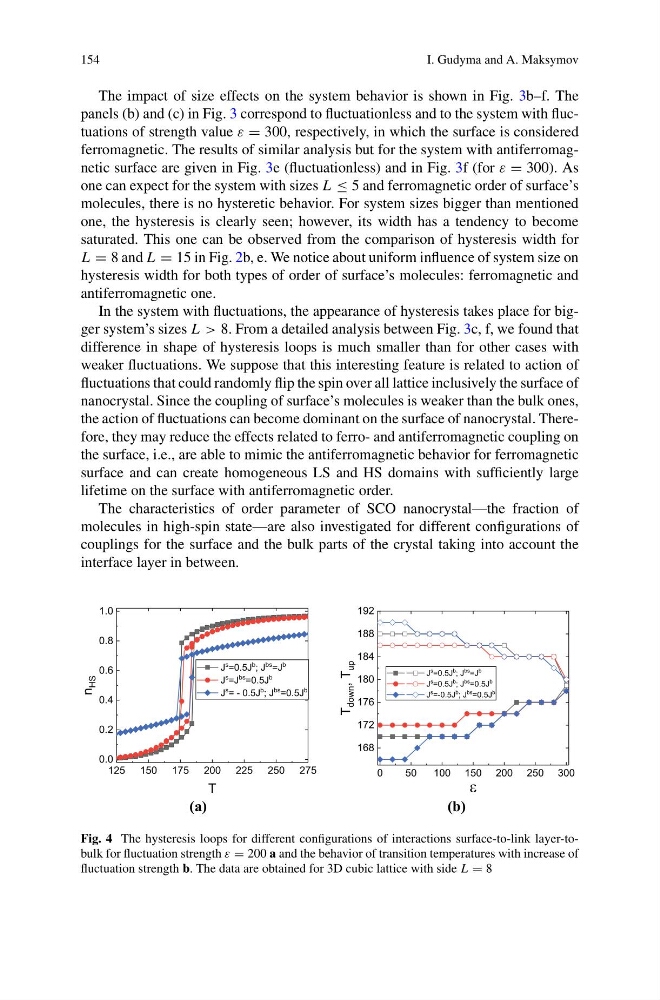
The characteristics of order parameter of SCO nanocrystal—the fraction of
molecules in high-spin state—are also investigated for different configurations of
couplings for the surface and the bulk parts of the crystal taking into account the
interface layer in between.
(a)
(b)
Fig. 4 The hysteresis loops for different configurations of interactions surface-to-link layer-tobulk for fluctuation strength ε = 200 a and the behavior of transition temperatures with increase of
fluctuation strength b. The data are obtained for 3D cubic lattice with side L = 8
I. Gudyma and A. Maksymov
The impact of size effects on the system behavior is shown in Fig. 3b–f. The
panels (b) and (c) in Fig. 3 correspond to fluctuationless and to the system with fluctuations of strength value ε = 300, respectively, in which the surface is considered
ferromagnetic. The results of similar analysis but for the system with antiferromagnetic surface are given in Fig. 3e (fluctuationless) and in Fig. 3f (for ε = 300). As
one can expect for the system with sizes L ≤ 5 and ferromagnetic order of surface’s
molecules, there is no hysteretic behavior. For system sizes bigger than mentioned
one, the hysteresis is clearly seen; however, its width has a tendency to become
saturated. This one can be observed from the comparison of hysteresis width for
L = 8 and L = 15 in Fig. 2b, e. We notice about uniform influence of system size on
hysteresis width for both types of order of surface’s molecules: ferromagnetic and
antiferromagnetic one.
In the system with fluctuations, the appearance of hysteresis takes place for bigger system’s sizes L > 8. From a detailed analysis between Fig. 3c, f, we found that
difference in shape of hysteresis loops is much smaller than for other cases with
weaker fluctuations. We suppose that this interesting feature is related to action of
fluctuations that could randomly flip the spin over all lattice inclusively the surface of
nanocrystal. Since the coupling of surface’s molecules is weaker than the bulk ones,
the action of fluctuations can become dominant on the surface of nanocrystal. Therefore, they may reduce the effects related to ferro- and antiferromagnetic coupling on
the surface, i.e., are able to mimic the antiferromagnetic behavior for ferromagnetic
surface and can create homogeneous LS and HS domains with sufficiently large
lifetime on the surface with antiferromagnetic order.
The characteristics of order parameter of SCO nanocrystal—the fraction of
molecules in high-spin state—are also investigated for different configurations of
couplings for the surface and the bulk parts of the crystal taking into account the
interface layer in between.
(a)
(b)
Fig. 4 The hysteresis loops for different configurations of interactions surface-to-link layer-tobulk for fluctuation strength ε = 200 a and the behavior of transition temperatures with increase of
fluctuation strength b. The data are obtained for 3D cubic lattice with side L = 8