

Ising-Like Model of Nanosize Spin-Crossover Molecular Crystals
153
(a)
(d)
(b)
(e)
(c)
(f)
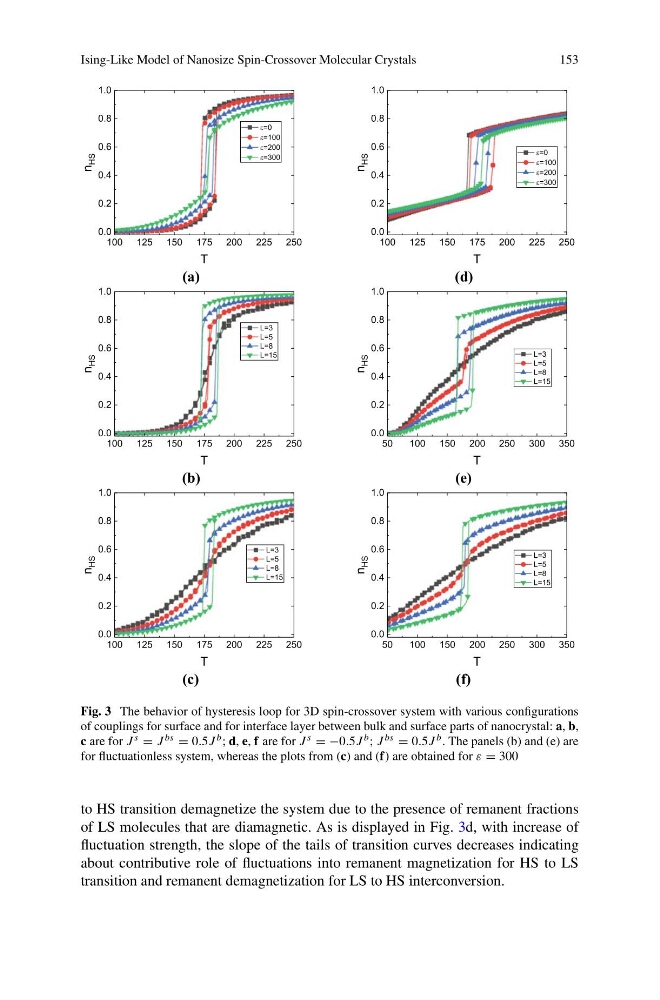
Fig. 3 The behavior of hysteresis loop for 3D spin-crossover system with various configurations
of couplings for surface and for interface layer between bulk and surface parts of nanocrystal: a, b,
c are for J s = J bs = 0.5J b ; d, e, f are for J s = −0.5J b ; J bs = 0.5J b . The panels (b) and (e) are
for fluctuationless system, whereas the plots from (c) and (f) are obtained for ε = 300
to HS transition demagnetize the system due to the presence of remanent fractions
of LS molecules that are diamagnetic. As is displayed in Fig. 3d, with increase of
fluctuation strength, the slope of the tails of transition curves decreases indicating
about contributive role of fluctuations into remanent magnetization for HS to LS
transition and remanent demagnetization for LS to HS interconversion.
153
(a)
(d)
(b)
(e)
(c)
(f)
Fig. 3 The behavior of hysteresis loop for 3D spin-crossover system with various configurations
of couplings for surface and for interface layer between bulk and surface parts of nanocrystal: a, b,
c are for J s = J bs = 0.5J b ; d, e, f are for J s = −0.5J b ; J bs = 0.5J b . The panels (b) and (e) are
for fluctuationless system, whereas the plots from (c) and (f) are obtained for ε = 300
to HS transition demagnetize the system due to the presence of remanent fractions
of LS molecules that are diamagnetic. As is displayed in Fig. 3d, with increase of
fluctuation strength, the slope of the tails of transition curves decreases indicating
about contributive role of fluctuations into remanent magnetization for HS to LS
transition and remanent demagnetization for LS to HS interconversion.