

Ising-Like Model of Nanosize Spin-Crossover Molecular Crystals
145
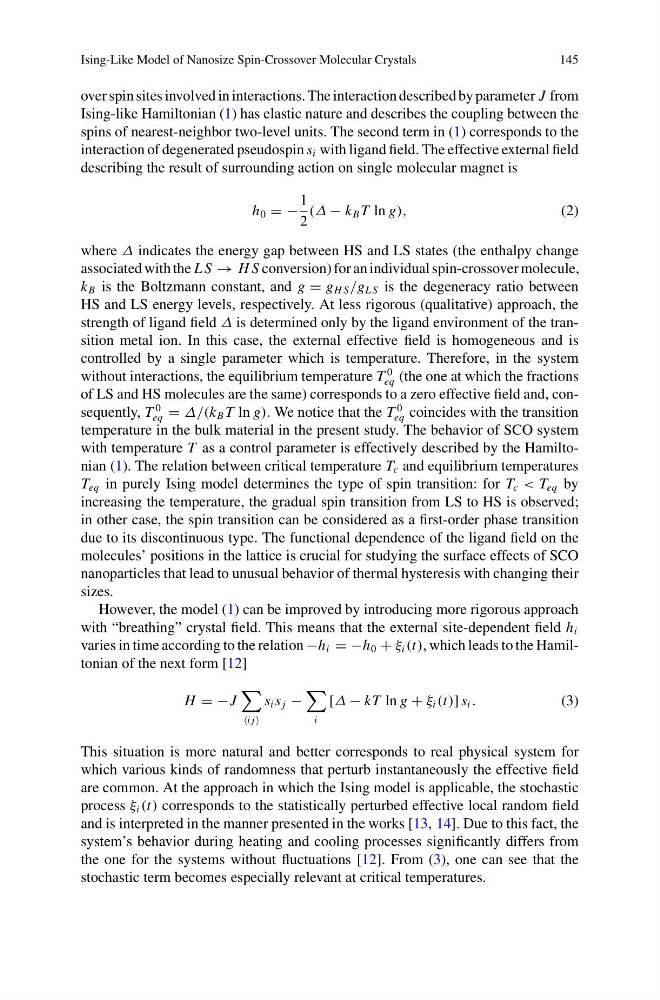
over spin sites involved in interactions. The interaction described by parameter J from
Ising-like Hamiltonian (1) has elastic nature and describes the coupling between the
spins of nearest-neighbor two-level units. The second term in (1) corresponds to the
interaction of degenerated pseudospin s i with ligand field. The effective external field
describing the result of surrounding action on single molecular magnet is
h 0 = −
1
2
(Δ − k B T ln g),
(2)
where Δ indicates the energy gap between HS and LS states (the enthalpy change
associated with the L S → H S conversion) for an individual spin-crossover molecule,
k B is the Boltzmann constant, and g = g H S /g L S is the degeneracy ratio between
HS and LS energy levels, respectively. At less rigorous (qualitative) approach, the
strength of ligand field Δ is determined only by the ligand environment of the transition metal ion. In this case, the external effective field is homogeneous and is
controlled by a single parameter which is temperature. Therefore, in the system
without interactions, the equilibrium temperature T
0
eq (the one at which the fractions
of LS and HS molecules are the same) corresponds to a zero effective field and, consequently, T
0
eq = Δ/(k B T ln g). We notice that the T
0
eq coincides with the transition
temperature in the bulk material in the present study. The behavior of SCO system
with temperature T as a control parameter is effectively described by the Hamiltonian (1). The relation between critical temperature T c and equilibrium temperatures
T eq in purely Ising model determines the type of spin transition: for T c < T eq by
increasing the temperature, the gradual spin transition from LS to HS is observed;
in other case, the spin transition can be considered as a first-order phase transition
due to its discontinuous type. The functional dependence of the ligand field on the
molecules’ positions in the lattice is crucial for studying the surface effects of SCO
nanoparticles that lead to unusual behavior of thermal hysteresis with changing their
sizes.
However, the model (1) can be improved by introducing more rigorous approach
with “breathing” crystal field. This means that the external site-dependent field h i
varies in time according to the relation −h i = −h 0 + ξ i (t), which leads to the Hamiltonian of the next form [12]
H = −J
i j
s i s j −
i
[Δ − kT ln g + ξ i (t)] s i .
(3)
This situation is more natural and better corresponds to real physical system for
which various kinds of randomness that perturb instantaneously the effective field
are common. At the approach in which the Ising model is applicable, the stochastic
process ξ i (t) corresponds to the statistically perturbed effective local random field
and is interpreted in the manner presented in the works [13, 14]. Due to this fact, the
system’s behavior during heating and cooling processes significantly differs from
the one for the systems without fluctuations [12]. From (3), one can see that the
stochastic term becomes especially relevant at critical temperatures.
145
over spin sites involved in interactions. The interaction described by parameter J from
Ising-like Hamiltonian (1) has elastic nature and describes the coupling between the
spins of nearest-neighbor two-level units. The second term in (1) corresponds to the
interaction of degenerated pseudospin s i with ligand field. The effective external field
describing the result of surrounding action on single molecular magnet is
h 0 = −
1
2
(Δ − k B T ln g),
(2)
where Δ indicates the energy gap between HS and LS states (the enthalpy change
associated with the L S → H S conversion) for an individual spin-crossover molecule,
k B is the Boltzmann constant, and g = g H S /g L S is the degeneracy ratio between
HS and LS energy levels, respectively. At less rigorous (qualitative) approach, the
strength of ligand field Δ is determined only by the ligand environment of the transition metal ion. In this case, the external effective field is homogeneous and is
controlled by a single parameter which is temperature. Therefore, in the system
without interactions, the equilibrium temperature T
0
eq (the one at which the fractions
of LS and HS molecules are the same) corresponds to a zero effective field and, consequently, T
0
eq = Δ/(k B T ln g). We notice that the T
0
eq coincides with the transition
temperature in the bulk material in the present study. The behavior of SCO system
with temperature T as a control parameter is effectively described by the Hamiltonian (1). The relation between critical temperature T c and equilibrium temperatures
T eq in purely Ising model determines the type of spin transition: for T c < T eq by
increasing the temperature, the gradual spin transition from LS to HS is observed;
in other case, the spin transition can be considered as a first-order phase transition
due to its discontinuous type. The functional dependence of the ligand field on the
molecules’ positions in the lattice is crucial for studying the surface effects of SCO
nanoparticles that lead to unusual behavior of thermal hysteresis with changing their
sizes.
However, the model (1) can be improved by introducing more rigorous approach
with “breathing” crystal field. This means that the external site-dependent field h i
varies in time according to the relation −h i = −h 0 + ξ i (t), which leads to the Hamiltonian of the next form [12]
H = −J
i j
s i s j −
i
[Δ − kT ln g + ξ i (t)] s i .
(3)
This situation is more natural and better corresponds to real physical system for
which various kinds of randomness that perturb instantaneously the effective field
are common. At the approach in which the Ising model is applicable, the stochastic
process ξ i (t) corresponds to the statistically perturbed effective local random field
and is interpreted in the manner presented in the works [13, 14]. Due to this fact, the
system’s behavior during heating and cooling processes significantly differs from
the one for the systems without fluctuations [12]. From (3), one can see that the
stochastic term becomes especially relevant at critical temperatures.