

144
I. Gudyma and A. Maksymov
respectively. If the SCO sample is exposed to controllable varying fields, the effective long-range elastic interaction may induce first-order phase transition which, in
turn, can interconvert the initially LS system into metastable HS state and leads to
hysteresis [2, 3]. These crucial properties have a big potential to be applied as a base
for a new generation of SCO-based nanodevices. For scientific studies, the most
interesting are the SCO complexes based on 3d
6 iron(II) ions due to pronounced
difference in magnetic response for LS and HS states. In these compounds, the SCO
transition occurs between the diamagnetic LS and paramagnetic HS states that are
characterized by the total spin number S = 0 and S = 2, respectively.
The general trend toward miniaturization of electronic and magnetic devices has
shifted the focus of interest of scientific community from the macroscopic bulk compounds to the nanomaterials [4–9]. In this context, it becomes especially important to
the relationship between size effects and cooperativity, which in most of the cases is
studied on SCO nanoparticles incorporated into coordination networks. Other important and unique features that are observed by increasing their surface-to-volume ratio
are the vanishing of hysteresis because of decreasing the cooperativity in the lattice,
the incompleteness of the spin-state switching, and the downshift of the transition
temperature. These effects are induced by peculiar features of nanoparticle’s surface
(strains, energies) and consequently by its interfaces with external environment. A
particular property of surface-to-volume ratio effects is the vanishing of hysteresis
loop below a critical value of a particle size.
The theoretical researches of transition metal complexes at microscopic approach
widely involve the Ising-like model which was introduced for SCO compounds by
Wajnflasz and Pick in 1971 [10] and is one of the most useful tools for studying
the magnetic phenomena in these complexes. In the original formulation given by
Wajnflasz and Pick, the SCO Ising-like model considers only the short-range interaction between the two-state sites. In the present paper, the SCO Ising-like model
is completed by the different interaction energies in a bulk and on a surface of a
nanocrystal that could play crucial role in explaining the experimental results. We
believe that the main reason of size effects in SCO nanocrystals is related to the difference in intermolecular interaction. Our results demonstrate good agreement with
the experimental data.
2 Ising-Like Model of Spin-Crossover Nanocrystal
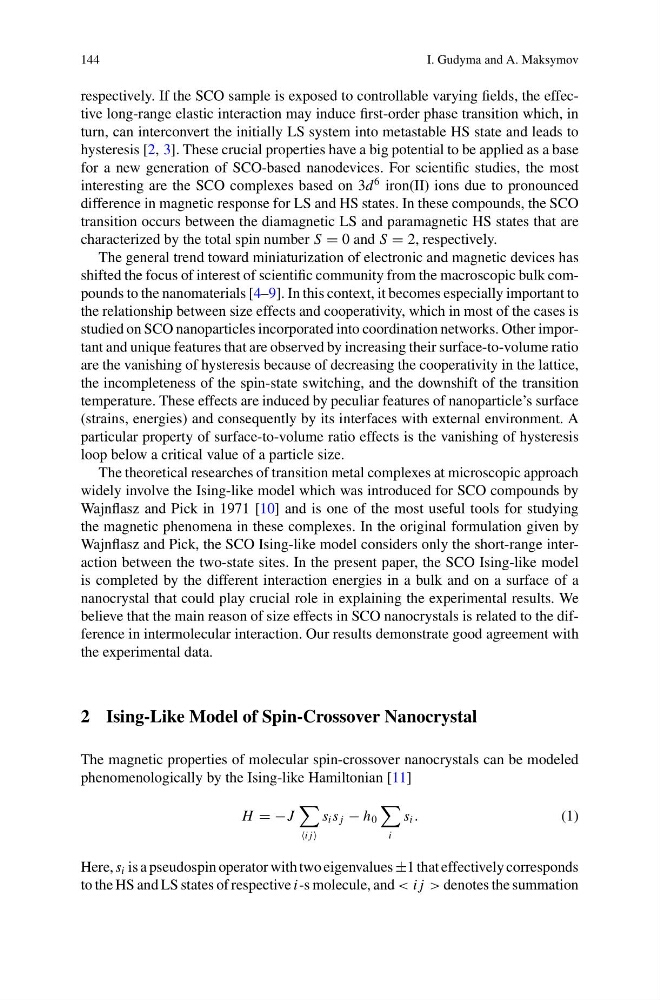
The magnetic properties of molecular spin-crossover nanocrystals can be modeled
phenomenologically by the Ising-like Hamiltonian [11]
H = −J
i j
s i s j − h 0
i
s i .
(1)
Here, s i is a pseudospin operator with two eigenvalues ±1 that effectively corresponds
to the HS and LS states of respective i-s molecule, and < i j > denotes the summation
I. Gudyma and A. Maksymov
respectively. If the SCO sample is exposed to controllable varying fields, the effective long-range elastic interaction may induce first-order phase transition which, in
turn, can interconvert the initially LS system into metastable HS state and leads to
hysteresis [2, 3]. These crucial properties have a big potential to be applied as a base
for a new generation of SCO-based nanodevices. For scientific studies, the most
interesting are the SCO complexes based on 3d
6 iron(II) ions due to pronounced
difference in magnetic response for LS and HS states. In these compounds, the SCO
transition occurs between the diamagnetic LS and paramagnetic HS states that are
characterized by the total spin number S = 0 and S = 2, respectively.
The general trend toward miniaturization of electronic and magnetic devices has
shifted the focus of interest of scientific community from the macroscopic bulk compounds to the nanomaterials [4–9]. In this context, it becomes especially important to
the relationship between size effects and cooperativity, which in most of the cases is
studied on SCO nanoparticles incorporated into coordination networks. Other important and unique features that are observed by increasing their surface-to-volume ratio
are the vanishing of hysteresis because of decreasing the cooperativity in the lattice,
the incompleteness of the spin-state switching, and the downshift of the transition
temperature. These effects are induced by peculiar features of nanoparticle’s surface
(strains, energies) and consequently by its interfaces with external environment. A
particular property of surface-to-volume ratio effects is the vanishing of hysteresis
loop below a critical value of a particle size.
The theoretical researches of transition metal complexes at microscopic approach
widely involve the Ising-like model which was introduced for SCO compounds by
Wajnflasz and Pick in 1971 [10] and is one of the most useful tools for studying
the magnetic phenomena in these complexes. In the original formulation given by
Wajnflasz and Pick, the SCO Ising-like model considers only the short-range interaction between the two-state sites. In the present paper, the SCO Ising-like model
is completed by the different interaction energies in a bulk and on a surface of a
nanocrystal that could play crucial role in explaining the experimental results. We
believe that the main reason of size effects in SCO nanocrystals is related to the difference in intermolecular interaction. Our results demonstrate good agreement with
the experimental data.
2 Ising-Like Model of Spin-Crossover Nanocrystal
The magnetic properties of molecular spin-crossover nanocrystals can be modeled
phenomenologically by the Ising-like Hamiltonian [11]
H = −J
i j
s i s j − h 0
i
s i .
(1)
Here, s i is a pseudospin operator with two eigenvalues ±1 that effectively corresponds
to the HS and LS states of respective i-s molecule, and < i j > denotes the summation