

Modified Two-Pole Approximation for Systems with Strong Electron Correlations …
139
ε
↑
1 = −n ↓
w
2
6U
, ε
↑
2 = n ↑
w
2
6U
,
(36)
and for spin-down electrons
ε
↓
1 = −n ↑
w
2
6U
, ε
↓
2 = n ↓
w
2
6U
.
(37)
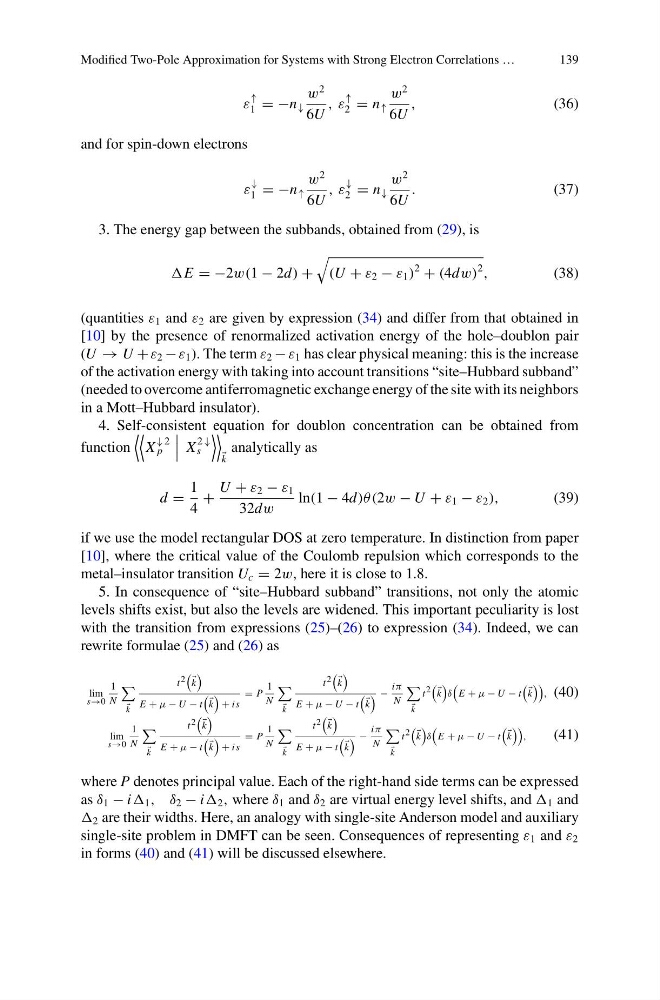
3. The energy gap between the subbands, obtained from (29), is
E = −2w(1 − 2d) +
(U + ε 2 − ε 1 )
2
+ (4dw)
2
,
(38)
(quantities ε 1 and ε 2 are given by expression (34) and differ from that obtained in
[10] by the presence of renormalized activation energy of the hole–doublon pair
(U → U + ε 2 − ε 1 ). The term ε 2 − ε 1 has clear physical meaning: this is the increase
of the activation energy with taking into account transitions “site–Hubbard subband”
(needed to overcome antiferromagnetic exchange energy of the site with its neighbors
in a Mott–Hubbard insulator).
4. Self-consistent equation for doublon concentration can be obtained from
function
X
↓ 2
p
X
2 ↓
s
k
analytically as
d =
1
4
+
U + ε 2 − ε 1
32dw
ln(1 − 4d)θ (2w − U + ε 1 − ε 2 ),
(39)
if we use the model rectangular DOS at zero temperature. In distinction from paper
[10], where the critical value of the Coulomb repulsion which corresponds to the
metal–insulator transition U c = 2w, here it is close to 1.8.
5. In consequence of “site–Hubbard subband” transitions, not only the atomic
levels shifts exist, but also the levels are widened. This important peculiarity is lost
with the transition from expressions (25)–(26) to expression (34). Indeed, we can
rewrite formulae (25) and (26) as
lim
s→0
1
N
k
t 2
k
E + μ − U − t
k
+ is
= P
1
N
k
t 2
k
E + μ − U − t
k
−
iπ
N
k
t 2
k
δ
E + μ − U − t
k
, (40)
lim
s→0
1
N
k
t 2
k
E + μ − t
k
+ is
= P
1
N
k
t 2
k
E + μ − t
k
−
iπ
N
k
t 2
k
δ
E + μ − U − t
k
,
(41)
where P denotes principal value. Each of the right-hand side terms can be expressed
as δ 1 − i 1 , δ 2 − i 2 , where δ 1 and δ 2 are virtual energy level shifts, and 1 and
2 are their widths. Here, an analogy with single-site Anderson model and auxiliary
single-site problem in DMFT can be seen. Consequences of representing ε 1 and ε 2
in forms (40) and (41) will be discussed elsewhere.
139
ε
↑
1 = −n ↓
w
2
6U
, ε
↑
2 = n ↑
w
2
6U
,
(36)
and for spin-down electrons
ε
↓
1 = −n ↑
w
2
6U
, ε
↓
2 = n ↓
w
2
6U
.
(37)
3. The energy gap between the subbands, obtained from (29), is
E = −2w(1 − 2d) +
(U + ε 2 − ε 1 )
2
+ (4dw)
2
,
(38)
(quantities ε 1 and ε 2 are given by expression (34) and differ from that obtained in
[10] by the presence of renormalized activation energy of the hole–doublon pair
(U → U + ε 2 − ε 1 ). The term ε 2 − ε 1 has clear physical meaning: this is the increase
of the activation energy with taking into account transitions “site–Hubbard subband”
(needed to overcome antiferromagnetic exchange energy of the site with its neighbors
in a Mott–Hubbard insulator).
4. Self-consistent equation for doublon concentration can be obtained from
function
X
↓ 2
p
X
2 ↓
s
k
analytically as
d =
1
4
+
U + ε 2 − ε 1
32dw
ln(1 − 4d)θ (2w − U + ε 1 − ε 2 ),
(39)
if we use the model rectangular DOS at zero temperature. In distinction from paper
[10], where the critical value of the Coulomb repulsion which corresponds to the
metal–insulator transition U c = 2w, here it is close to 1.8.
5. In consequence of “site–Hubbard subband” transitions, not only the atomic
levels shifts exist, but also the levels are widened. This important peculiarity is lost
with the transition from expressions (25)–(26) to expression (34). Indeed, we can
rewrite formulae (25) and (26) as
lim
s→0
1
N
k
t 2
k
E + μ − U − t
k
+ is
= P
1
N
k
t 2
k
E + μ − U − t
k
−
iπ
N
k
t 2
k
δ
E + μ − U − t
k
, (40)
lim
s→0
1
N
k
t 2
k
E + μ − t
k
+ is
= P
1
N
k
t 2
k
E + μ − t
k
−
iπ
N
k
t 2
k
δ
E + μ − U − t
k
,
(41)
where P denotes principal value. Each of the right-hand side terms can be expressed
as δ 1 − i 1 , δ 2 − i 2 , where δ 1 and δ 2 are virtual energy level shifts, and 1 and
2 are their widths. Here, an analogy with single-site Anderson model and auxiliary
single-site problem in DMFT can be seen. Consequences of representing ε 1 and ε 2
in forms (40) and (41) will be discussed elsewhere.