

138
L. Didukh et al.
E 2
k
= −μ + U + ε 2 + (1 − 2d)t
k
,
(32)
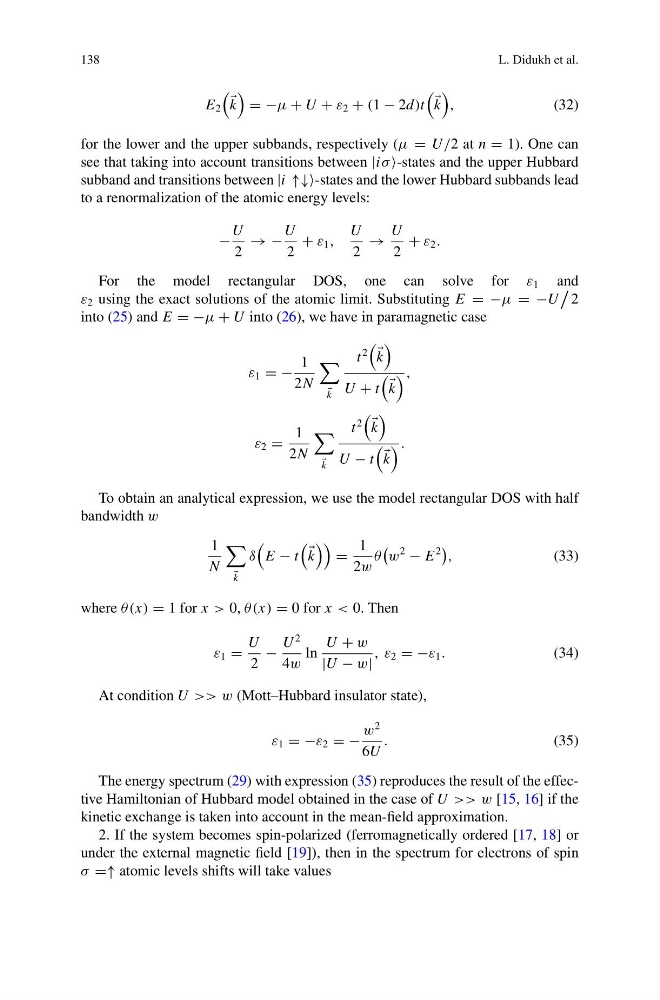
for the lower and the upper subbands, respectively (μ = U/2 at n = 1). One can
see that taking into account transitions between |iσ -states and the upper Hubbard
subband and transitions between |i ↑↓-states and the lower Hubbard subbands lead
to a renormalization of the atomic energy levels:
−
U
2
→ −
U
2
+ ε 1 ,
U
2
→
U
2
+ ε 2 .
For the model rectangular DOS, one can solve for ε 1 and
ε 2 using the exact solutions of the atomic limit. Substituting E = −μ = −U
2
into (25) and E = −μ + U into (26), we have in paramagnetic case
ε 1 = −
1
2N
k
t
2
k
U + t
k
,
ε 2 =
1
2N
k
t
2
k
U − t
k
.
To obtain an analytical expression, we use the model rectangular DOS with half
bandwidth w
1
N
k
δ
E − t
k
=
1
2w
θ
w
2
− E
2
,
(33)
where θ (x) = 1 for x > 0, θ (x) = 0 for x < 0. Then
ε 1 =
U
2
−
U
2
4w
ln
U + w
|U − w|
, ε 2 = −ε 1 .
(34)
At condition U >> w (Mott–Hubbard insulator state),
ε 1 = −ε 2 = −
w
2
6U
.
(35)
The energy spectrum (29) with expression (35) reproduces the result of the effective Hamiltonian of Hubbard model obtained in the case of U >> w [15, 16] if the
kinetic exchange is taken into account in the mean-field approximation.
2. If the system becomes spin-polarized (ferromagnetically ordered [17, 18] or
under the external magnetic field [19]), then in the spectrum for electrons of spin
σ =↑ atomic levels shifts will take values
L. Didukh et al.
E 2
k
= −μ + U + ε 2 + (1 − 2d)t
k
,
(32)
for the lower and the upper subbands, respectively (μ = U/2 at n = 1). One can
see that taking into account transitions between |iσ -states and the upper Hubbard
subband and transitions between |i ↑↓-states and the lower Hubbard subbands lead
to a renormalization of the atomic energy levels:
−
U
2
→ −
U
2
+ ε 1 ,
U
2
→
U
2
+ ε 2 .
For the model rectangular DOS, one can solve for ε 1 and
ε 2 using the exact solutions of the atomic limit. Substituting E = −μ = −U
2
into (25) and E = −μ + U into (26), we have in paramagnetic case
ε 1 = −
1
2N
k
t
2
k
U + t
k
,
ε 2 =
1
2N
k
t
2
k
U − t
k
.
To obtain an analytical expression, we use the model rectangular DOS with half
bandwidth w
1
N
k
δ
E − t
k
=
1
2w
θ
w
2
− E
2
,
(33)
where θ (x) = 1 for x > 0, θ (x) = 0 for x < 0. Then
ε 1 =
U
2
−
U
2
4w
ln
U + w
|U − w|
, ε 2 = −ε 1 .
(34)
At condition U >> w (Mott–Hubbard insulator state),
ε 1 = −ε 2 = −
w
2
6U
.
(35)
The energy spectrum (29) with expression (35) reproduces the result of the effective Hamiltonian of Hubbard model obtained in the case of U >> w [15, 16] if the
kinetic exchange is taken into account in the mean-field approximation.
2. If the system becomes spin-polarized (ferromagnetically ordered [17, 18] or
under the external magnetic field [19]), then in the spectrum for electrons of spin
σ =↑ atomic levels shifts will take values