

Composites Containing Inorganic Ion Exchangers …
97
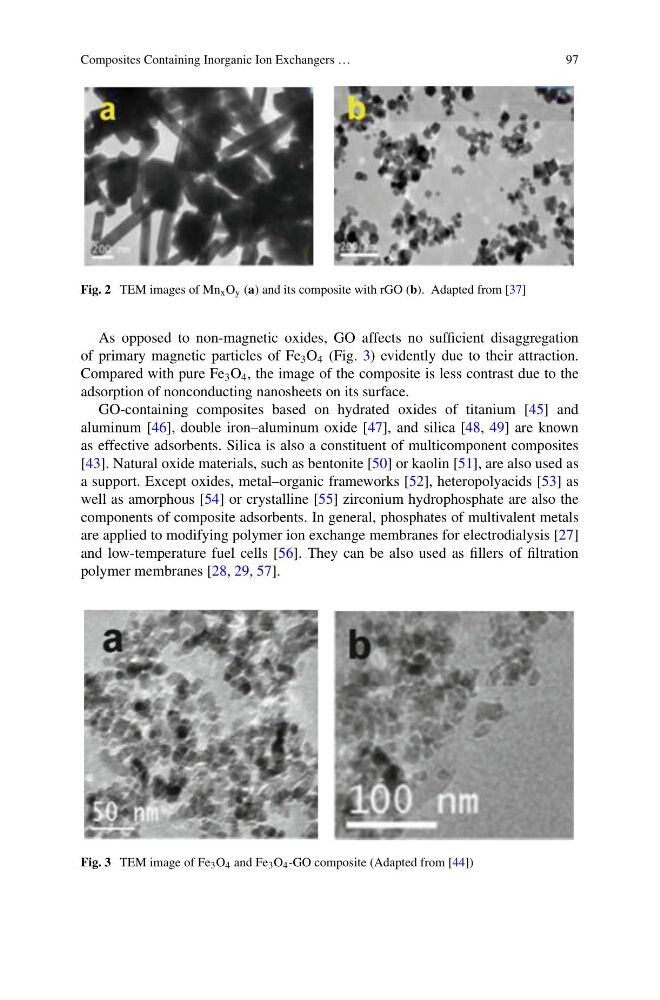
Fig. 2 TEM images of Mn x O y (a) and its composite with rGO (b). Adapted from [37]
As opposed to non-magnetic oxides, GO affects no sufficient disaggregation
of primary magnetic particles of Fe 3 O 4 (Fig. 3) evidently due to their attraction.
Compared with pure Fe 3 O 4 , the image of the composite is less contrast due to the
adsorption of nonconducting nanosheets on its surface.
GO-containing composites based on hydrated oxides of titanium [45] and
aluminum [46], double iron–aluminum oxide [47], and silica [48, 49] are known
as effective adsorbents. Silica is also a constituent of multicomponent composites
[43]. Natural oxide materials, such as bentonite [50] or kaolin [51], are also used as
a support. Except oxides, metal–organic frameworks [52], heteropolyacids [53] as
well as amorphous [54] or crystalline [55] zirconium hydrophosphate are also the
components of composite adsorbents. In general, phosphates of multivalent metals
are applied to modifying polymer ion exchange membranes for electrodialysis [27]
and low-temperature fuel cells [56]. They can be also used as fillers of filtration
polymer membranes [28, 29, 57].
Fig. 3 TEM image of Fe 3 O 4 and Fe 3 O 4 -GO composite (Adapted from [44])
97
Fig. 2 TEM images of Mn x O y (a) and its composite with rGO (b). Adapted from [37]
As opposed to non-magnetic oxides, GO affects no sufficient disaggregation
of primary magnetic particles of Fe 3 O 4 (Fig. 3) evidently due to their attraction.
Compared with pure Fe 3 O 4 , the image of the composite is less contrast due to the
adsorption of nonconducting nanosheets on its surface.
GO-containing composites based on hydrated oxides of titanium [45] and
aluminum [46], double iron–aluminum oxide [47], and silica [48, 49] are known
as effective adsorbents. Silica is also a constituent of multicomponent composites
[43]. Natural oxide materials, such as bentonite [50] or kaolin [51], are also used as
a support. Except oxides, metal–organic frameworks [52], heteropolyacids [53] as
well as amorphous [54] or crystalline [55] zirconium hydrophosphate are also the
components of composite adsorbents. In general, phosphates of multivalent metals
are applied to modifying polymer ion exchange membranes for electrodialysis [27]
and low-temperature fuel cells [56]. They can be also used as fillers of filtration
polymer membranes [28, 29, 57].
Fig. 3 TEM image of Fe 3 O 4 and Fe 3 O 4 -GO composite (Adapted from [44])