

Electrostatics of the Nanowires with Radial …
85
In accordance with data from [23], in this case ΔE c = 4.13 eV–4.07 eV = 0.06 eV.
Corresponding value of ΔE v = E g2 − E g1 − ΔE c =(1.42–0.66) eV– 0.06 eV = 0.7 eV.
The densities of states for Ge and GaAs (as well as values of the energy gaps) are
taken from [21].
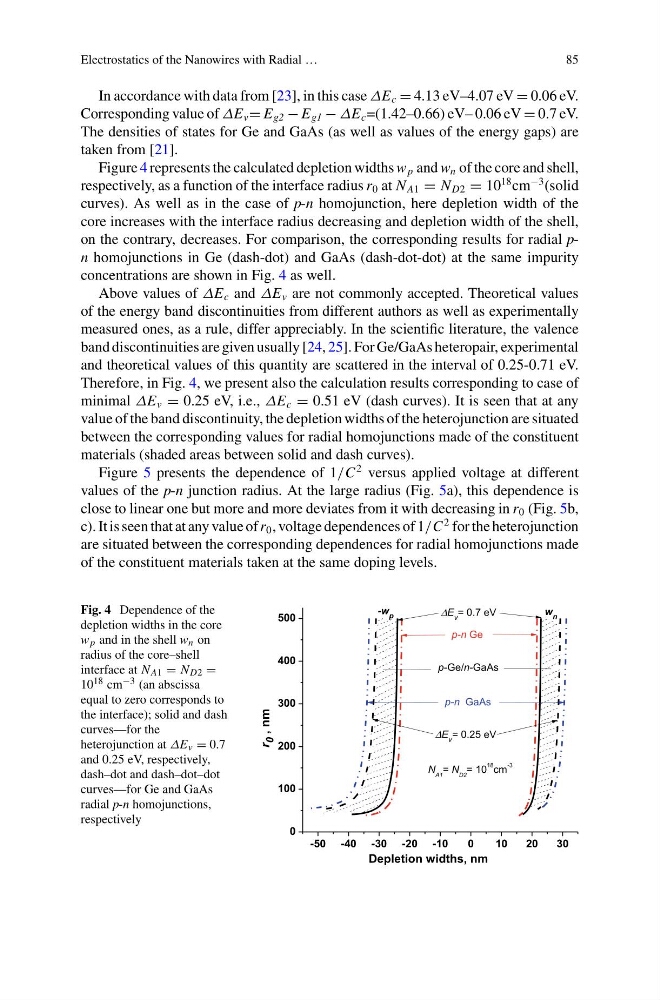
Figure 4 represents the calculated depletion widths w p and w n of the core and shell,
respectively, as a function of the interface radius r 0 at N A1 = N D2 = 10
18 cm
−3 (solid
curves). As well as in the case of p-n homojunction, here depletion width of the
core increases with the interface radius decreasing and depletion width of the shell,
on the contrary, decreases. For comparison, the corresponding results for radial pn homojunctions in Ge (dash-dot) and GaAs (dash-dot-dot) at the same impurity
concentrations are shown in Fig. 4 as well.
Above values of ΔE c and ΔE v are not commonly accepted. Theoretical values
of the energy band discontinuities from different authors as well as experimentally
measured ones, as a rule, differ appreciably. In the scientific literature, the valence
band discontinuities are given usually [24, 25]. For Ge/GaAs heteropair, experimental
and theoretical values of this quantity are scattered in the interval of 0.25-0.71 eV.
Therefore, in Fig. 4, we present also the calculation results corresponding to case of
minimal ΔE v = 0.25 eV, i.e., ΔE c = 0.51 eV (dash curves). It is seen that at any
value of the band discontinuity, the depletion widths of the heterojunction are situated
between the corresponding values for radial homojunctions made of the constituent
materials (shaded areas between solid and dash curves).
Figure 5 presents the dependence of 1/C
2 versus applied voltage at different
values of the p-n junction radius. At the large radius (Fig. 5a), this dependence is
close to linear one but more and more deviates from it with decreasing in r 0 (Fig. 5b,
c). It is seen that at any value of r 0 , voltage dependences of 1/C
2 for the heterojunction
are situated between the corresponding dependences for radial homojunctions made
of the constituent materials taken at the same doping levels.
Fig. 4 Dependence of the
depletion widths in the core
w p and in the shell w n on
radius of the core–shell
interface at N A1 = N D2 =
10 18 cm −3 (an abscissa
equal to zero corresponds to
the interface); solid and dash
curves—for the
heterojunction at ΔE v = 0.7
and 0.25 eV, respectively,
dash–dot and dash–dot–dot
curves—for Ge and GaAs
radial p-n homojunctions,
respectively
0
100
200
300
400
500
-50 -40 -30 -20 -10
0
10
20
30
E v = 0.25 eV
N A1 = N D2 = 10
18
cm
-3
Depletion widths, nm
r
0 ,
nm
p-n Ge
p-n GaAs
p-Ge/n-GaAs
-w p
w n
E v = 0.7 eV
Δ
Δ
85
In accordance with data from [23], in this case ΔE c = 4.13 eV–4.07 eV = 0.06 eV.
Corresponding value of ΔE v = E g2 − E g1 − ΔE c =(1.42–0.66) eV– 0.06 eV = 0.7 eV.
The densities of states for Ge and GaAs (as well as values of the energy gaps) are
taken from [21].
Figure 4 represents the calculated depletion widths w p and w n of the core and shell,
respectively, as a function of the interface radius r 0 at N A1 = N D2 = 10
18 cm
−3 (solid
curves). As well as in the case of p-n homojunction, here depletion width of the
core increases with the interface radius decreasing and depletion width of the shell,
on the contrary, decreases. For comparison, the corresponding results for radial pn homojunctions in Ge (dash-dot) and GaAs (dash-dot-dot) at the same impurity
concentrations are shown in Fig. 4 as well.
Above values of ΔE c and ΔE v are not commonly accepted. Theoretical values
of the energy band discontinuities from different authors as well as experimentally
measured ones, as a rule, differ appreciably. In the scientific literature, the valence
band discontinuities are given usually [24, 25]. For Ge/GaAs heteropair, experimental
and theoretical values of this quantity are scattered in the interval of 0.25-0.71 eV.
Therefore, in Fig. 4, we present also the calculation results corresponding to case of
minimal ΔE v = 0.25 eV, i.e., ΔE c = 0.51 eV (dash curves). It is seen that at any
value of the band discontinuity, the depletion widths of the heterojunction are situated
between the corresponding values for radial homojunctions made of the constituent
materials (shaded areas between solid and dash curves).
Figure 5 presents the dependence of 1/C
2 versus applied voltage at different
values of the p-n junction radius. At the large radius (Fig. 5a), this dependence is
close to linear one but more and more deviates from it with decreasing in r 0 (Fig. 5b,
c). It is seen that at any value of r 0 , voltage dependences of 1/C
2 for the heterojunction
are situated between the corresponding dependences for radial homojunctions made
of the constituent materials taken at the same doping levels.
Fig. 4 Dependence of the
depletion widths in the core
w p and in the shell w n on
radius of the core–shell
interface at N A1 = N D2 =
10 18 cm −3 (an abscissa
equal to zero corresponds to
the interface); solid and dash
curves—for the
heterojunction at ΔE v = 0.7
and 0.25 eV, respectively,
dash–dot and dash–dot–dot
curves—for Ge and GaAs
radial p-n homojunctions,
respectively
0
100
200
300
400
500
-50 -40 -30 -20 -10
0
10
20
30
E v = 0.25 eV
N A1 = N D2 = 10
18
cm
-3
Depletion widths, nm
r
0 ,
nm
p-n Ge
p-n GaAs
p-Ge/n-GaAs
-w p
w n
E v = 0.7 eV
Δ
Δ