

Electrostatics of the Nanowires with Radial …
81
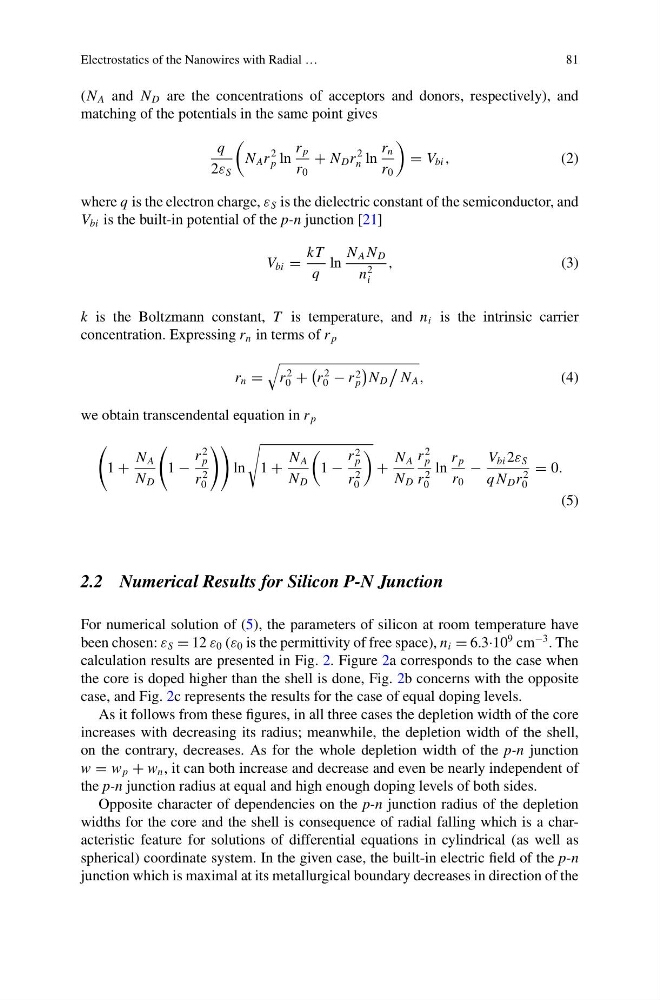
(N A and N D are the concentrations of acceptors and donors, respectively), and
matching of the potentials in the same point gives
q
2ε S
N A r
2
p ln
r p
r 0
+ N D r
2
n ln
r n
r 0
= V bi ,
(2)
where q is the electron charge, ε S is the dielectric constant of the semiconductor, and
V bi is the built-in potential of the p-n junction [21]
V bi =
kT
q
ln
N A N D
n
2
i
,
(3)
k is the Boltzmann constant, T is temperature, and n i is the intrinsic carrier
concentration. Expressing r n in terms of r p
r n =
r
2
0 +
r
2
0 − r 2
p
N D
N A ,
(4)
we obtain transcendental equation in r p
1 +
N A
N D
1 −
r
2
p
r
2
0
ln
1 +
N A
N D
1 −
r 2
p
r
2
0
+
N A
N D
r
2
p
r
2
0
ln
r p
r 0
−
V bi 2ε S
q N D r
2
0
= 0.
(5)
2.2 Numerical Results for Silicon P-N Junction
For numerical solution of (5), the parameters of silicon at room temperature have
been chosen: ε S = 12 ε 0 (ε 0 is the permittivity of free space), n i = 6.3·10
9 cm
−3 . The
calculation results are presented in Fig. 2. Figure 2a corresponds to the case when
the core is doped higher than the shell is done, Fig. 2b concerns with the opposite
case, and Fig. 2c represents the results for the case of equal doping levels.
As it follows from these figures, in all three cases the depletion width of the core
increases with decreasing its radius; meanwhile, the depletion width of the shell,
on the contrary, decreases. As for the whole depletion width of the p-n junction
w = w p + w n , it can both increase and decrease and even be nearly independent of
the p-n junction radius at equal and high enough doping levels of both sides.
Opposite character of dependencies on the p-n junction radius of the depletion
widths for the core and the shell is consequence of radial falling which is a characteristic feature for solutions of differential equations in cylindrical (as well as
spherical) coordinate system. In the given case, the built-in electric field of the p-n
junction which is maximal at its metallurgical boundary decreases in direction of the
81
(N A and N D are the concentrations of acceptors and donors, respectively), and
matching of the potentials in the same point gives
q
2ε S
N A r
2
p ln
r p
r 0
+ N D r
2
n ln
r n
r 0
= V bi ,
(2)
where q is the electron charge, ε S is the dielectric constant of the semiconductor, and
V bi is the built-in potential of the p-n junction [21]
V bi =
kT
q
ln
N A N D
n
2
i
,
(3)
k is the Boltzmann constant, T is temperature, and n i is the intrinsic carrier
concentration. Expressing r n in terms of r p
r n =
r
2
0 +
r
2
0 − r 2
p
N D
N A ,
(4)
we obtain transcendental equation in r p
1 +
N A
N D
1 −
r
2
p
r
2
0
ln
1 +
N A
N D
1 −
r 2
p
r
2
0
+
N A
N D
r
2
p
r
2
0
ln
r p
r 0
−
V bi 2ε S
q N D r
2
0
= 0.
(5)
2.2 Numerical Results for Silicon P-N Junction
For numerical solution of (5), the parameters of silicon at room temperature have
been chosen: ε S = 12 ε 0 (ε 0 is the permittivity of free space), n i = 6.3·10
9 cm
−3 . The
calculation results are presented in Fig. 2. Figure 2a corresponds to the case when
the core is doped higher than the shell is done, Fig. 2b concerns with the opposite
case, and Fig. 2c represents the results for the case of equal doping levels.
As it follows from these figures, in all three cases the depletion width of the core
increases with decreasing its radius; meanwhile, the depletion width of the shell,
on the contrary, decreases. As for the whole depletion width of the p-n junction
w = w p + w n , it can both increase and decrease and even be nearly independent of
the p-n junction radius at equal and high enough doping levels of both sides.
Opposite character of dependencies on the p-n junction radius of the depletion
widths for the core and the shell is consequence of radial falling which is a characteristic feature for solutions of differential equations in cylindrical (as well as
spherical) coordinate system. In the given case, the built-in electric field of the p-n
junction which is maximal at its metallurgical boundary decreases in direction of the