

4.4 Time Domain Analysis: Proportional Damping
93
m ¨
x + k x = −m 1 sin(ν t),
(4.65)
where 1 denotes the n-dimensional unit column vector. Considerations as those used
to obtain Eq. 4.25 give
¨
q i (t) + ω
2
i q i (t) = −
T m 1
i
˜
m i
sin(ν t), i = 1, . . . , n,
(4.66)
so that the particular solution is (see Sect. 2.4.5 on SDOF systems)
q i (t) =
β i / ˜
k i
1 − (ν/ω i ) 2
sin(ν t) −
ν
ω i
sin(ω i t)
, ν = ω i , i = 1, . . . , n,
(4.67)
where β i =
T m 1
i
. The displacement vector has the expression
x(t) =
n
i=1
i q i (t) =
n
i=1
i
β i / ˜
k i
1 − (ν/ω i ) 2
sin(ν t) −
ν
ω i
sin(ω i t)
.
(4.68)
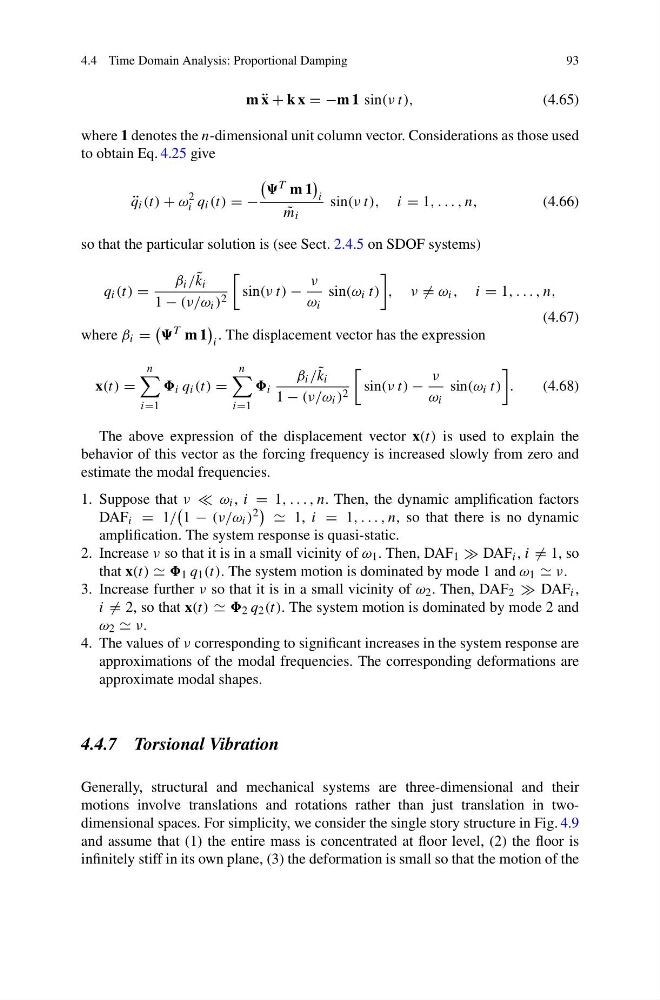
The above expression of the displacement vector x(t) is used to explain the
behavior of this vector as the forcing frequency is increased slowly from zero and
estimate the modal frequencies.
1. Suppose that ν ω i , i = 1, . . . , n. Then, the dynamic amplification factors
DAF i = 1/
1 − (ν/ω i ) 2 1, i = 1, . . . , n, so that there is no dynamic
amplification. The system response is quasi-static.
2. Increase ν so that it is in a small vicinity of ω 1 . Then, DAF 1 DAF i , i = 1, so
that x(t) 1 q 1 (t). The system motion is dominated by mode 1 and ω 1 ν.
3. Increase further ν so that it is in a small vicinity of ω 2 . Then, DAF 2 DAF i ,
i = 2, so that x(t) 2 q 2 (t). The system motion is dominated by mode 2 and
ω 2 ν.
4. The values of ν corresponding to significant increases in the system response are
approximations of the modal frequencies. The corresponding deformations are
approximate modal shapes.
4.4.7 Torsional Vibration
Generally, structural and mechanical systems are three-dimensional and their
motions involve translations and rotations rather than just translation in twodimensional spaces. For simplicity, we consider the single story structure in Fig. 4.9
and assume that (1) the entire mass is concentrated at floor level, (2) the floor is
infinitely stiff in its own plane, (3) the deformation is small so that the motion of the
93
m ¨
x + k x = −m 1 sin(ν t),
(4.65)
where 1 denotes the n-dimensional unit column vector. Considerations as those used
to obtain Eq. 4.25 give
¨
q i (t) + ω
2
i q i (t) = −
T m 1
i
˜
m i
sin(ν t), i = 1, . . . , n,
(4.66)
so that the particular solution is (see Sect. 2.4.5 on SDOF systems)
q i (t) =
β i / ˜
k i
1 − (ν/ω i ) 2
sin(ν t) −
ν
ω i
sin(ω i t)
, ν = ω i , i = 1, . . . , n,
(4.67)
where β i =
T m 1
i
. The displacement vector has the expression
x(t) =
n
i=1
i q i (t) =
n
i=1
i
β i / ˜
k i
1 − (ν/ω i ) 2
sin(ν t) −
ν
ω i
sin(ω i t)
.
(4.68)
The above expression of the displacement vector x(t) is used to explain the
behavior of this vector as the forcing frequency is increased slowly from zero and
estimate the modal frequencies.
1. Suppose that ν ω i , i = 1, . . . , n. Then, the dynamic amplification factors
DAF i = 1/
1 − (ν/ω i ) 2 1, i = 1, . . . , n, so that there is no dynamic
amplification. The system response is quasi-static.
2. Increase ν so that it is in a small vicinity of ω 1 . Then, DAF 1 DAF i , i = 1, so
that x(t) 1 q 1 (t). The system motion is dominated by mode 1 and ω 1 ν.
3. Increase further ν so that it is in a small vicinity of ω 2 . Then, DAF 2 DAF i ,
i = 2, so that x(t) 2 q 2 (t). The system motion is dominated by mode 2 and
ω 2 ν.
4. The values of ν corresponding to significant increases in the system response are
approximations of the modal frequencies. The corresponding deformations are
approximate modal shapes.
4.4.7 Torsional Vibration
Generally, structural and mechanical systems are three-dimensional and their
motions involve translations and rotations rather than just translation in twodimensional spaces. For simplicity, we consider the single story structure in Fig. 4.9
and assume that (1) the entire mass is concentrated at floor level, (2) the floor is
infinitely stiff in its own plane, (3) the deformation is small so that the motion of the