

84
4 Multi-Degree of Freedom (MDOF) Systems
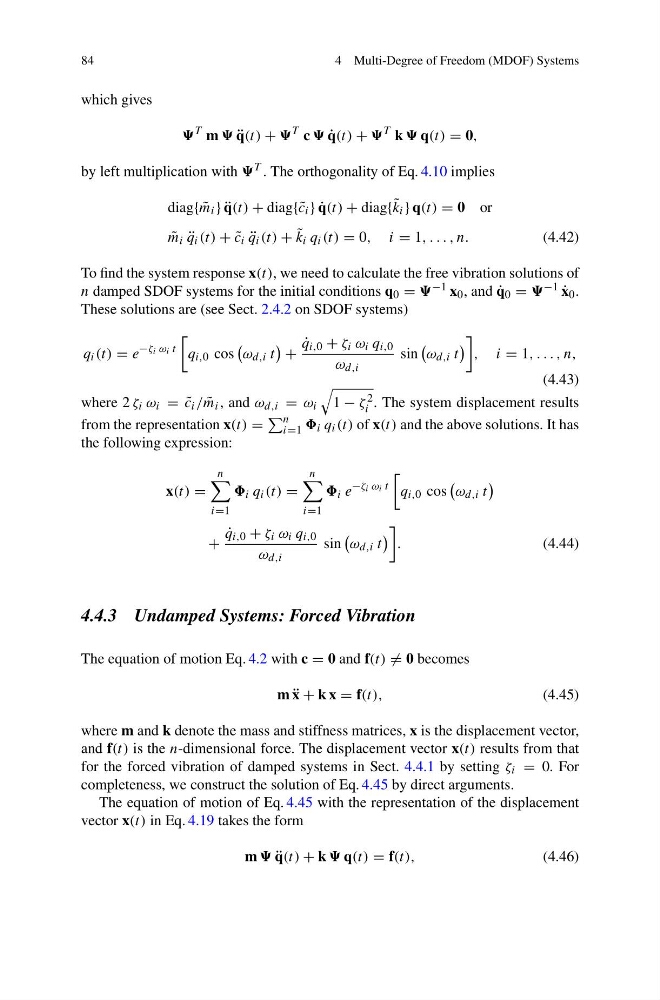
which gives
T m ¨
q(t) +
T c ˙
q(t) +
T k q(t) = 0,
by left multiplication with T . The orthogonality of Eq. 4.10 implies
diag{ ˜
m i } ¨
q(t) + diag{ ˜
c i } ˙
q(t) + diag{ ˜
k i } q(t) = 0 or
˜
m i ¨
q i (t) + ˜
c i ¨
q i (t) + ˜
k i q i (t) = 0, i = 1, . . . , n.
(4.42)
To find the system response x(t), we need to calculate the free vibration solutions of
n damped SDOF systems for the initial conditions q 0 = −1 x 0 , and ˙
q 0 = −1 ˙
x 0 .
These solutions are (see Sect. 2.4.2 on SDOF systems)
q i (t) = e
−ζ i ω i t
q i,0 cos
ω d,i t
+
˙
q i,0 + ζ i ω i q i,0
ω d,i
sin
ω d,i t
, i = 1, . . . , n,
(4.43)
where 2 ζ i ω i = ˜
c i / ˜
m i , and ω d,i = ω i
1 − ζ 2
i . The system displacement results
from the representation x(t) =
n
i=1 i q i (t) of x(t) and the above solutions. It has
the following expression:
x(t) =
n
i=1
i q i (t) =
n
i=1
i e
−ζ i ω i t
q i,0 cos
ω d,i t
+
˙
q i,0 + ζ i ω i q i,0
ω d,i
sin
ω d,i t
.
(4.44)
4.4.3 Undamped Systems: Forced Vibration
The equation of motion Eq. 4.2 with c = 0 and f(t) = 0 becomes
m ¨
x + k x = f(t),
(4.45)
where m and k denote the mass and stiffness matrices, x is the displacement vector,
and f(t) is the n-dimensional force. The displacement vector x(t) results from that
for the forced vibration of damped systems in Sect. 4.4.1 by setting ζ i = 0. For
completeness, we construct the solution of Eq. 4.45 by direct arguments.
The equation of motion of Eq. 4.45 with the representation of the displacement
vector x(t) in Eq. 4.19 takes the form
m ¨
q(t) + k q(t) = f(t),
(4.46)
4 Multi-Degree of Freedom (MDOF) Systems
which gives
T m ¨
q(t) +
T c ˙
q(t) +
T k q(t) = 0,
by left multiplication with T . The orthogonality of Eq. 4.10 implies
diag{ ˜
m i } ¨
q(t) + diag{ ˜
c i } ˙
q(t) + diag{ ˜
k i } q(t) = 0 or
˜
m i ¨
q i (t) + ˜
c i ¨
q i (t) + ˜
k i q i (t) = 0, i = 1, . . . , n.
(4.42)
To find the system response x(t), we need to calculate the free vibration solutions of
n damped SDOF systems for the initial conditions q 0 = −1 x 0 , and ˙
q 0 = −1 ˙
x 0 .
These solutions are (see Sect. 2.4.2 on SDOF systems)
q i (t) = e
−ζ i ω i t
q i,0 cos
ω d,i t
+
˙
q i,0 + ζ i ω i q i,0
ω d,i
sin
ω d,i t
, i = 1, . . . , n,
(4.43)
where 2 ζ i ω i = ˜
c i / ˜
m i , and ω d,i = ω i
1 − ζ 2
i . The system displacement results
from the representation x(t) =
n
i=1 i q i (t) of x(t) and the above solutions. It has
the following expression:
x(t) =
n
i=1
i q i (t) =
n
i=1
i e
−ζ i ω i t
q i,0 cos
ω d,i t
+
˙
q i,0 + ζ i ω i q i,0
ω d,i
sin
ω d,i t
.
(4.44)
4.4.3 Undamped Systems: Forced Vibration
The equation of motion Eq. 4.2 with c = 0 and f(t) = 0 becomes
m ¨
x + k x = f(t),
(4.45)
where m and k denote the mass and stiffness matrices, x is the displacement vector,
and f(t) is the n-dimensional force. The displacement vector x(t) results from that
for the forced vibration of damped systems in Sect. 4.4.1 by setting ζ i = 0. For
completeness, we construct the solution of Eq. 4.45 by direct arguments.
The equation of motion of Eq. 4.45 with the representation of the displacement
vector x(t) in Eq. 4.19 takes the form
m ¨
q(t) + k q(t) = f(t),
(4.46)