

4.4 Time Domain Analysis: Proportional Damping
79
i.e., the set of n independent equations
˜
m i ¨
q i (t) + ˜
c i ¨
q i (t) + ˜
k i q i (t) =
T f(t)
i
, i = 1, . . . , n,
(4.25)
for the modal coordinates {q i (t)}, which can be given in the form
¨
q i (t) + 2 ζ i ω i ¨
q i (t) + ω
2
i q i (t) = f i (t)/ ˜
m i , i = 1, . . . , n,
(4.26)
where f i (t) =
T f(t)
i
denotes the ith component of the n-dimensional vector
T f(t), ˜
c i / ˜
m i = 2 ζ i ω i , ζ i is called modal damping ratio, and ˜
k i / ˜
m i = ω 2
i (see
Eq. 4.9).
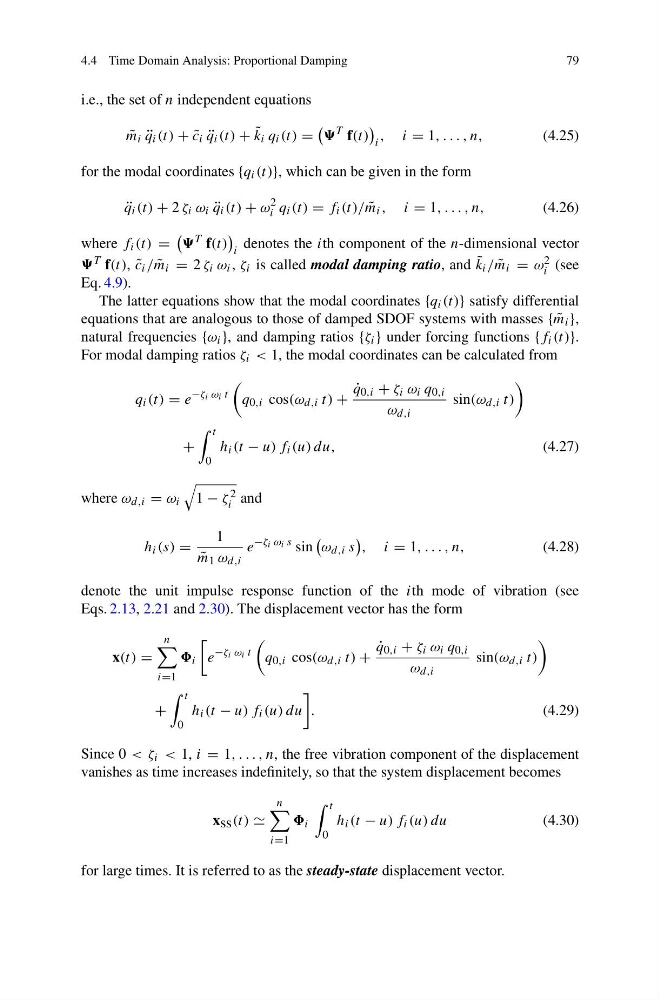
The latter equations show that the modal coordinates {q i (t)} satisfy differential
equations that are analogous to those of damped SDOF systems with masses { ˜
m i },
natural frequencies {ω i }, and damping ratios {ζ i } under forcing functions {f i (t)}.
For modal damping ratios ζ i < 1, the modal coordinates can be calculated from
q i (t) = e
−ζ i ω i t
q 0,i cos(ω d,i t) +
˙
q 0,i + ζ i ω i q 0,i
ω d,i
sin(ω d,i t)
+
t
0
h i (t − u) f i (u) du,
(4.27)
where ω d,i = ω i
1 − ζ 2
i and
h i (s) =
1
˜
m 1 ω d,i
e
−ζ i ω i s sin
ω d,i s
, i = 1, . . . , n,
(4.28)
denote the unit impulse response function of the ith mode of vibration (see
Eqs. 2.13, 2.21 and 2.30). The displacement vector has the form
x(t) =
n
i=1
i
e
−ζ i ω i t
q 0,i cos(ω d,i t) +
˙
q 0,i + ζ i ω i q 0,i
ω d,i
sin(ω d,i t)
+
t
0
h i (t − u) f i (u) du
.
(4.29)
Since 0 < ζ i < 1, i = 1, . . . , n, the free vibration component of the displacement
vanishes as time increases indefinitely, so that the system displacement becomes
x ss (t)
n
i=1
i
t
0
h i (t − u) f i (u) du
(4.30)
for large times. It is referred to as the steady-state displacement vector.
79
i.e., the set of n independent equations
˜
m i ¨
q i (t) + ˜
c i ¨
q i (t) + ˜
k i q i (t) =
T f(t)
i
, i = 1, . . . , n,
(4.25)
for the modal coordinates {q i (t)}, which can be given in the form
¨
q i (t) + 2 ζ i ω i ¨
q i (t) + ω
2
i q i (t) = f i (t)/ ˜
m i , i = 1, . . . , n,
(4.26)
where f i (t) =
T f(t)
i
denotes the ith component of the n-dimensional vector
T f(t), ˜
c i / ˜
m i = 2 ζ i ω i , ζ i is called modal damping ratio, and ˜
k i / ˜
m i = ω 2
i (see
Eq. 4.9).
The latter equations show that the modal coordinates {q i (t)} satisfy differential
equations that are analogous to those of damped SDOF systems with masses { ˜
m i },
natural frequencies {ω i }, and damping ratios {ζ i } under forcing functions {f i (t)}.
For modal damping ratios ζ i < 1, the modal coordinates can be calculated from
q i (t) = e
−ζ i ω i t
q 0,i cos(ω d,i t) +
˙
q 0,i + ζ i ω i q 0,i
ω d,i
sin(ω d,i t)
+
t
0
h i (t − u) f i (u) du,
(4.27)
where ω d,i = ω i
1 − ζ 2
i and
h i (s) =
1
˜
m 1 ω d,i
e
−ζ i ω i s sin
ω d,i s
, i = 1, . . . , n,
(4.28)
denote the unit impulse response function of the ith mode of vibration (see
Eqs. 2.13, 2.21 and 2.30). The displacement vector has the form
x(t) =
n
i=1
i
e
−ζ i ω i t
q 0,i cos(ω d,i t) +
˙
q 0,i + ζ i ω i q 0,i
ω d,i
sin(ω d,i t)
+
t
0
h i (t − u) f i (u) du
.
(4.29)
Since 0 < ζ i < 1, i = 1, . . . , n, the free vibration component of the displacement
vanishes as time increases indefinitely, so that the system displacement becomes
x ss (t)
n
i=1
i
t
0
h i (t − u) f i (u) du
(4.30)
for large times. It is referred to as the steady-state displacement vector.