

50
2 Single Degree of Freedom (SDOF) Systems
of Eq. 2.8 is a linear function of ˙
x. The methods of this chapter cannot be applied
directly to solve Eq. 2.90 since the operator of this equation is nonlinear. However,
we can use these methods to solve Eq. 2.49 by working on time intervals during
which the motion is described by linear differential equations.
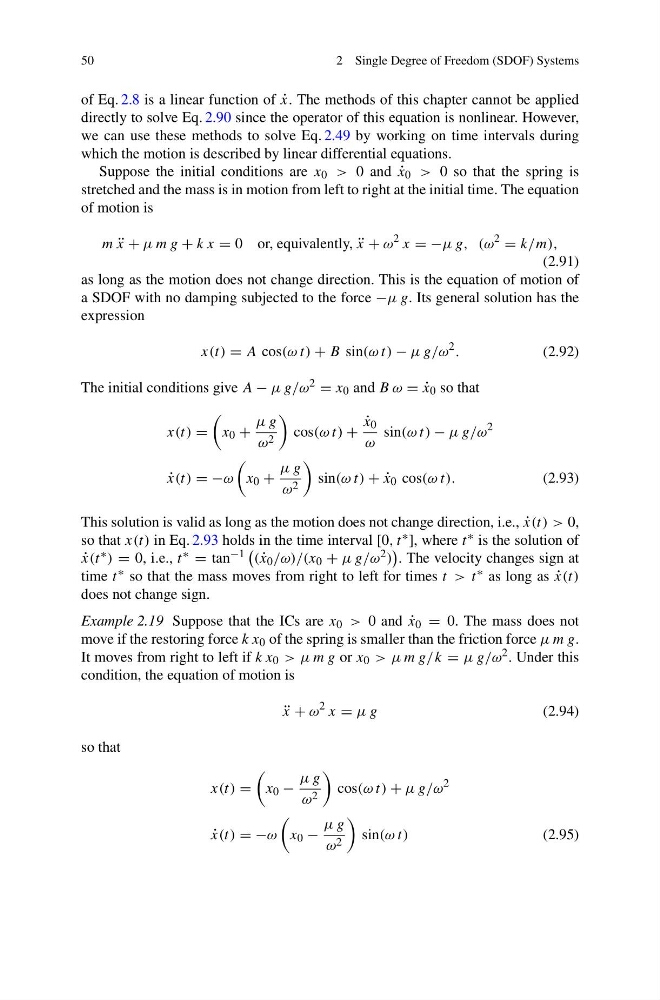
Suppose the initial conditions are x 0 > 0 and ˙
x 0 > 0 so that the spring is
stretched and the mass is in motion from left to right at the initial time. The equation
of motion is
m ¨
x + μ m g + k x = 0 or, equivalently, ¨
x + ω
2 x = −μ g, (ω
2
= k/m),
(2.91)
as long as the motion does not change direction. This is the equation of motion of
a SDOF with no damping subjected to the force −μ g. Its general solution has the
expression
x(t) = A cos(ω t) + B sin(ω t) − μ g/ω
2 .
(2.92)
The initial conditions give A − μ g/ω 2 = x 0 and B ω = ˙
x 0 so that
x(t) =
x 0 +
μ g
ω 2
cos(ω t) +
˙
x 0
ω
sin(ω t) − μ g/ω
2
˙
x(t) = −ω
x 0 +
μ g
ω 2
sin(ω t) + ˙
x 0 cos(ω t).
(2.93)
This solution is valid as long as the motion does not change direction, i.e., ˙
x(t) > 0,
so that x(t) in Eq. 2.93 holds in the time interval [0, t ∗ ], where t ∗ is the solution of
˙
x(t ∗ ) = 0, i.e., t ∗ = tan −1
( ˙
x 0 /ω)/(x 0 + μ g/ω 2 )
. The velocity changes sign at
time t ∗ so that the mass moves from right to left for times t > t ∗ as long as ˙
x(t)
does not change sign.
Example 2.19 Suppose that the ICs are x 0 > 0 and ˙
x 0 = 0. The mass does not
move if the restoring force k x 0 of the spring is smaller than the friction force μ m g.
It moves from right to left if k x 0 > μ m g or x 0 > μ m g/k = μ g/ω 2 . Under this
condition, the equation of motion is
¨
x + ω
2 x = μ g
(2.94)
so that
x(t) =
x 0 −
μ g
ω 2
cos(ω t) + μ g/ω
2
˙
x(t) = −ω
x 0 −
μ g
ω 2
sin(ω t)
(2.95)
2 Single Degree of Freedom (SDOF) Systems
of Eq. 2.8 is a linear function of ˙
x. The methods of this chapter cannot be applied
directly to solve Eq. 2.90 since the operator of this equation is nonlinear. However,
we can use these methods to solve Eq. 2.49 by working on time intervals during
which the motion is described by linear differential equations.
Suppose the initial conditions are x 0 > 0 and ˙
x 0 > 0 so that the spring is
stretched and the mass is in motion from left to right at the initial time. The equation
of motion is
m ¨
x + μ m g + k x = 0 or, equivalently, ¨
x + ω
2 x = −μ g, (ω
2
= k/m),
(2.91)
as long as the motion does not change direction. This is the equation of motion of
a SDOF with no damping subjected to the force −μ g. Its general solution has the
expression
x(t) = A cos(ω t) + B sin(ω t) − μ g/ω
2 .
(2.92)
The initial conditions give A − μ g/ω 2 = x 0 and B ω = ˙
x 0 so that
x(t) =
x 0 +
μ g
ω 2
cos(ω t) +
˙
x 0
ω
sin(ω t) − μ g/ω
2
˙
x(t) = −ω
x 0 +
μ g
ω 2
sin(ω t) + ˙
x 0 cos(ω t).
(2.93)
This solution is valid as long as the motion does not change direction, i.e., ˙
x(t) > 0,
so that x(t) in Eq. 2.93 holds in the time interval [0, t ∗ ], where t ∗ is the solution of
˙
x(t ∗ ) = 0, i.e., t ∗ = tan −1
( ˙
x 0 /ω)/(x 0 + μ g/ω 2 )
. The velocity changes sign at
time t ∗ so that the mass moves from right to left for times t > t ∗ as long as ˙
x(t)
does not change sign.
Example 2.19 Suppose that the ICs are x 0 > 0 and ˙
x 0 = 0. The mass does not
move if the restoring force k x 0 of the spring is smaller than the friction force μ m g.
It moves from right to left if k x 0 > μ m g or x 0 > μ m g/k = μ g/ω 2 . Under this
condition, the equation of motion is
¨
x + ω
2 x = μ g
(2.94)
so that
x(t) =
x 0 −
μ g
ω 2
cos(ω t) + μ g/ω
2
˙
x(t) = −ω
x 0 −
μ g
ω 2
sin(ω t)
(2.95)