

2.7 Applications
49
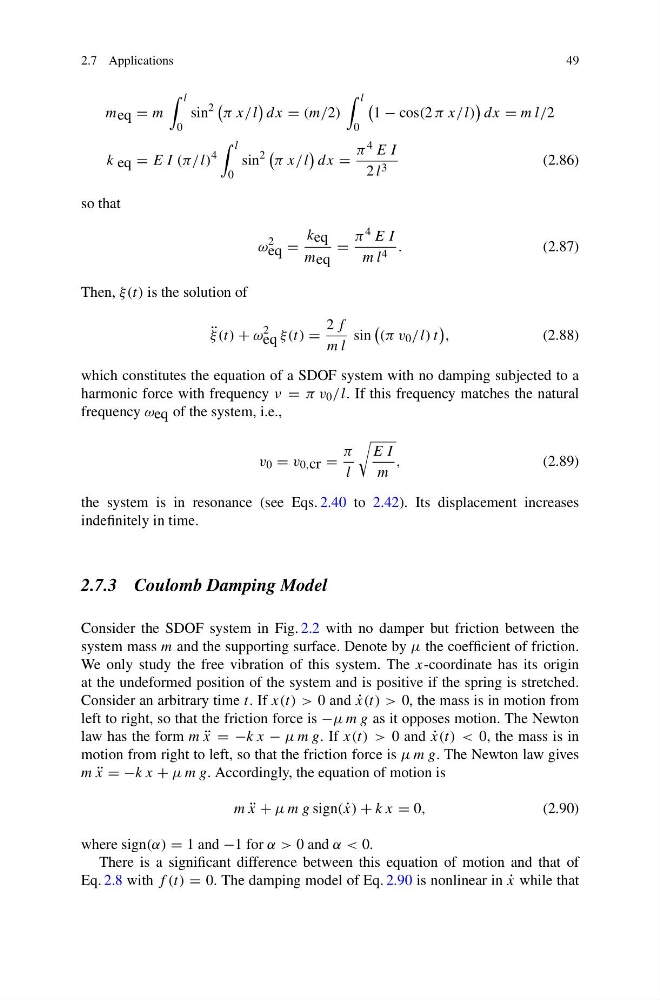
m eq = m
l
0
sin
2
π x/l
dx = (m/2)
l
0
1 − cos(2 π x/l)
dx = m l/2
k eq = E I (π/l)
4
l
0
sin
2
π x/l
dx =
π 4 E I
2 l 3
(2.86)
so that
ω
2
eq =
k eq
m eq
=
π 4 E I
m l 4 .
(2.87)
Then, ξ(t) is the solution of
¨
ξ(t) + ω
2
eq ξ(t) =
2 f
m l
sin
(π v 0 /l) t
,
(2.88)
which constitutes the equation of a SDOF system with no damping subjected to a
harmonic force with frequency ν = π v 0 /l. If this frequency matches the natural
frequency ω eq of the system, i.e.,
v 0 = v 0,cr =
π
l
E I
m
,
(2.89)
the system is in resonance (see Eqs. 2.40 to 2.42). Its displacement increases
indefinitely in time.
2.7.3 Coulomb Damping Model
Consider the SDOF system in Fig. 2.2 with no damper but friction between the
system mass m and the supporting surface. Denote by μ the coefficient of friction.
We only study the free vibration of this system. The x-coordinate has its origin
at the undeformed position of the system and is positive if the spring is stretched.
Consider an arbitrary time t. If x(t) > 0 and ˙
x(t) > 0, the mass is in motion from
left to right, so that the friction force is −μ m g as it opposes motion. The Newton
law has the form m ¨
x = −k x − μ m g. If x(t) > 0 and ˙
x(t) < 0, the mass is in
motion from right to left, so that the friction force is μ m g. The Newton law gives
m ¨
x = −k x + μ m g. Accordingly, the equation of motion is
m ¨
x + μ m g sign( ˙
x) + k x = 0,
(2.90)
where sign(α) = 1 and −1 for α > 0 and α < 0.
There is a significant difference between this equation of motion and that of
Eq. 2.8 with f (t) = 0. The damping model of Eq. 2.90 is nonlinear in ˙
x while that
49
m eq = m
l
0
sin
2
π x/l
dx = (m/2)
l
0
1 − cos(2 π x/l)
dx = m l/2
k eq = E I (π/l)
4
l
0
sin
2
π x/l
dx =
π 4 E I
2 l 3
(2.86)
so that
ω
2
eq =
k eq
m eq
=
π 4 E I
m l 4 .
(2.87)
Then, ξ(t) is the solution of
¨
ξ(t) + ω
2
eq ξ(t) =
2 f
m l
sin
(π v 0 /l) t
,
(2.88)
which constitutes the equation of a SDOF system with no damping subjected to a
harmonic force with frequency ν = π v 0 /l. If this frequency matches the natural
frequency ω eq of the system, i.e.,
v 0 = v 0,cr =
π
l
E I
m
,
(2.89)
the system is in resonance (see Eqs. 2.40 to 2.42). Its displacement increases
indefinitely in time.
2.7.3 Coulomb Damping Model
Consider the SDOF system in Fig. 2.2 with no damper but friction between the
system mass m and the supporting surface. Denote by μ the coefficient of friction.
We only study the free vibration of this system. The x-coordinate has its origin
at the undeformed position of the system and is positive if the spring is stretched.
Consider an arbitrary time t. If x(t) > 0 and ˙
x(t) > 0, the mass is in motion from
left to right, so that the friction force is −μ m g as it opposes motion. The Newton
law has the form m ¨
x = −k x − μ m g. If x(t) > 0 and ˙
x(t) < 0, the mass is in
motion from right to left, so that the friction force is μ m g. The Newton law gives
m ¨
x = −k x + μ m g. Accordingly, the equation of motion is
m ¨
x + μ m g sign( ˙
x) + k x = 0,
(2.90)
where sign(α) = 1 and −1 for α > 0 and α < 0.
There is a significant difference between this equation of motion and that of
Eq. 2.8 with f (t) = 0. The damping model of Eq. 2.90 is nonlinear in ˙
x while that