

2.5 Frequency Domain Analysis
37
(b i /m) sin(ν i t) ⇒ (b i /m)
r d (ν i )/ω
2
sin(ν i t − ϕ i )
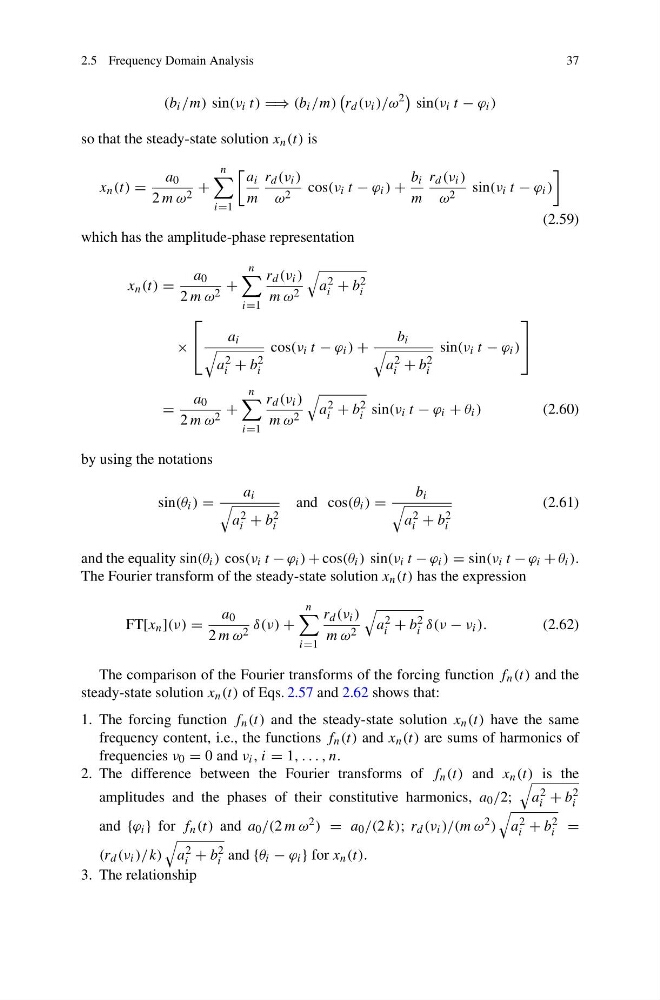
so that the steady-state solution x n (t) is
x n (t) =
a 0
2 m ω 2 +
n
i=1
a i
m
r d (ν i )
ω 2 cos(ν i t − ϕ i ) +
b i
m
r d (ν i )
ω 2 sin(ν i t − ϕ i )
(2.59)
which has the amplitude-phase representation
x n (t) =
a 0
2 m ω 2 +
n
i=1
r d (ν i )
m ω 2
a 2
i + b 2
i
×
⎡
⎣
a i
a 2
i + b 2
i
cos(ν i t − ϕ i ) +
b i
a 2
i + b 2
i
sin(ν i t − ϕ i )
⎤
⎦
=
a 0
2 m ω 2 +
n
i=1
r d (ν i )
m ω 2
a 2
i + b 2
i sin(ν i t − ϕ i + θ i )
(2.60)
by using the notations
sin(θ i ) =
a i
a 2
i + b 2
i
and cos(θ i ) =
b i
a 2
i + b 2
i
(2.61)
and the equality sin(θ i ) cos(ν i t − ϕ i ) + cos(θ i ) sin(ν i t − ϕ i ) = sin(ν i t − ϕ i + θ i ).
The Fourier transform of the steady-state solution x n (t) has the expression
FT[x n ](ν) =
a 0
2 m ω 2 δ(ν) +
n
i=1
r d (ν i )
m ω 2
a 2
i + b 2
i δ(ν − ν i ).
(2.62)
The comparison of the Fourier transforms of the forcing function f n (t) and the
steady-state solution x n (t) of Eqs. 2.57 and 2.62 shows that:
1. The forcing function f n (t) and the steady-state solution x n (t) have the same
frequency content, i.e., the functions f n (t) and x n (t) are sums of harmonics of
frequencies ν 0 = 0 and ν i , i = 1, . . . , n.
2. The difference between the Fourier transforms of f n (t) and x n (t) is the
amplitudes and the phases of their constitutive harmonics, a 0 /2;
a 2
i + b 2
i
and {ϕ i } for f n (t) and a 0 /(2 m ω 2 ) = a 0 /(2 k); r d (ν i )/(m ω 2 )
a 2
i + b 2
i =
(r d (ν i )/k)
a 2
i + b 2
i and {θ i − ϕ i } for x n (t).
3. The relationship
37
(b i /m) sin(ν i t) ⇒ (b i /m)
r d (ν i )/ω
2
sin(ν i t − ϕ i )
so that the steady-state solution x n (t) is
x n (t) =
a 0
2 m ω 2 +
n
i=1
a i
m
r d (ν i )
ω 2 cos(ν i t − ϕ i ) +
b i
m
r d (ν i )
ω 2 sin(ν i t − ϕ i )
(2.59)
which has the amplitude-phase representation
x n (t) =
a 0
2 m ω 2 +
n
i=1
r d (ν i )
m ω 2
a 2
i + b 2
i
×
⎡
⎣
a i
a 2
i + b 2
i
cos(ν i t − ϕ i ) +
b i
a 2
i + b 2
i
sin(ν i t − ϕ i )
⎤
⎦
=
a 0
2 m ω 2 +
n
i=1
r d (ν i )
m ω 2
a 2
i + b 2
i sin(ν i t − ϕ i + θ i )
(2.60)
by using the notations
sin(θ i ) =
a i
a 2
i + b 2
i
and cos(θ i ) =
b i
a 2
i + b 2
i
(2.61)
and the equality sin(θ i ) cos(ν i t − ϕ i ) + cos(θ i ) sin(ν i t − ϕ i ) = sin(ν i t − ϕ i + θ i ).
The Fourier transform of the steady-state solution x n (t) has the expression
FT[x n ](ν) =
a 0
2 m ω 2 δ(ν) +
n
i=1
r d (ν i )
m ω 2
a 2
i + b 2
i δ(ν − ν i ).
(2.62)
The comparison of the Fourier transforms of the forcing function f n (t) and the
steady-state solution x n (t) of Eqs. 2.57 and 2.62 shows that:
1. The forcing function f n (t) and the steady-state solution x n (t) have the same
frequency content, i.e., the functions f n (t) and x n (t) are sums of harmonics of
frequencies ν 0 = 0 and ν i , i = 1, . . . , n.
2. The difference between the Fourier transforms of f n (t) and x n (t) is the
amplitudes and the phases of their constitutive harmonics, a 0 /2;
a 2
i + b 2
i
and {ϕ i } for f n (t) and a 0 /(2 m ω 2 ) = a 0 /(2 k); r d (ν i )/(m ω 2 )
a 2
i + b 2
i =
(r d (ν i )/k)
a 2
i + b 2
i and {θ i − ϕ i } for x n (t).
3. The relationship