

26
2 Single Degree of Freedom (SDOF) Systems
is called dynamic amplification factor (DAF). It converges to 1 and 0 as ν/ω → 0
and ν/ω → ∞. Physically, there is no dynamic amplification for forcing functions
with ν ω and there is virtually no response for ν ω. The response becomes
unbounded in time as ν/ω → 1, a phenomenon referred to as resonance.
2.4.5.1 Resonance Phenomenon
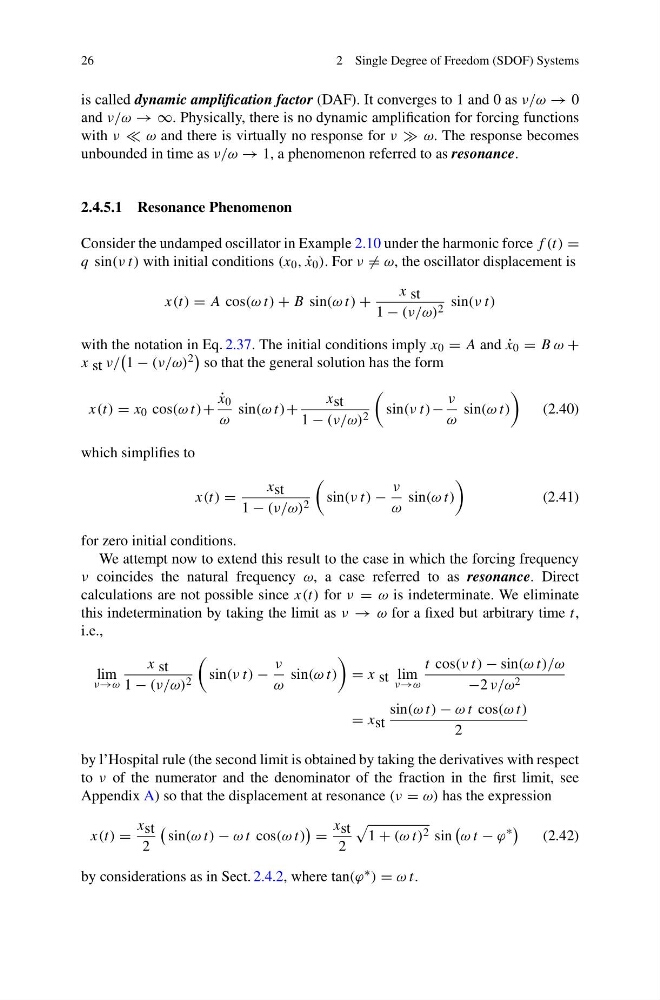
Consider the undamped oscillator in Example 2.10 under the harmonic force f (t) =
q sin(ν t) with initial conditions (x 0 , ˙
x 0 ). For ν = ω, the oscillator displacement is
x(t) = A cos(ω t) + B sin(ω t) +
x st
1 − (ν/ω) 2 sin(ν t)
with the notation in Eq. 2.37. The initial conditions imply x 0 = A and ˙
x 0 = B ω +
x st ν/
1 − (ν/ω) 2
so that the general solution has the form
x(t) = x 0 cos(ω t)+
˙
x 0
ω
sin(ω t)+
x st
1 − (ν/ω) 2
sin(ν t)−
ν
ω
sin(ω t)
(2.40)
which simplifies to
x(t) =
x st
1 − (ν/ω) 2
sin(ν t) −
ν
ω
sin(ω t)
(2.41)
for zero initial conditions.
We attempt now to extend this result to the case in which the forcing frequency
ν coincides the natural frequency ω, a case referred to as resonance. Direct
calculations are not possible since x(t) for ν = ω is indeterminate. We eliminate
this indetermination by taking the limit as ν → ω for a fixed but arbitrary time t,
i.e.,
lim
ν→ω
x st
1 − (ν/ω) 2
sin(ν t) −
ν
ω
sin(ω t)
= x st lim
ν→ω
t cos(ν t) − sin(ω t)/ω
−2 ν/ω 2
= x st
sin(ω t) − ω t cos(ω t)
2
by l’Hospital rule (the second limit is obtained by taking the derivatives with respect
to ν of the numerator and the denominator of the fraction in the first limit, see
Appendix A) so that the displacement at resonance (ν = ω) has the expression
x(t) =
x st
2
sin(ω t) − ω t cos(ω t)
=
x st
2
1 + (ω t) 2 sin
ω t − ϕ
∗
(2.42)
by considerations as in Sect. 2.4.2, where tan(ϕ ∗ ) = ω t.
2 Single Degree of Freedom (SDOF) Systems
is called dynamic amplification factor (DAF). It converges to 1 and 0 as ν/ω → 0
and ν/ω → ∞. Physically, there is no dynamic amplification for forcing functions
with ν ω and there is virtually no response for ν ω. The response becomes
unbounded in time as ν/ω → 1, a phenomenon referred to as resonance.
2.4.5.1 Resonance Phenomenon
Consider the undamped oscillator in Example 2.10 under the harmonic force f (t) =
q sin(ν t) with initial conditions (x 0 , ˙
x 0 ). For ν = ω, the oscillator displacement is
x(t) = A cos(ω t) + B sin(ω t) +
x st
1 − (ν/ω) 2 sin(ν t)
with the notation in Eq. 2.37. The initial conditions imply x 0 = A and ˙
x 0 = B ω +
x st ν/
1 − (ν/ω) 2
so that the general solution has the form
x(t) = x 0 cos(ω t)+
˙
x 0
ω
sin(ω t)+
x st
1 − (ν/ω) 2
sin(ν t)−
ν
ω
sin(ω t)
(2.40)
which simplifies to
x(t) =
x st
1 − (ν/ω) 2
sin(ν t) −
ν
ω
sin(ω t)
(2.41)
for zero initial conditions.
We attempt now to extend this result to the case in which the forcing frequency
ν coincides the natural frequency ω, a case referred to as resonance. Direct
calculations are not possible since x(t) for ν = ω is indeterminate. We eliminate
this indetermination by taking the limit as ν → ω for a fixed but arbitrary time t,
i.e.,
lim
ν→ω
x st
1 − (ν/ω) 2
sin(ν t) −
ν
ω
sin(ω t)
= x st lim
ν→ω
t cos(ν t) − sin(ω t)/ω
−2 ν/ω 2
= x st
sin(ω t) − ω t cos(ω t)
2
by l’Hospital rule (the second limit is obtained by taking the derivatives with respect
to ν of the numerator and the denominator of the fraction in the first limit, see
Appendix A) so that the displacement at resonance (ν = ω) has the expression
x(t) =
x st
2
sin(ω t) − ω t cos(ω t)
=
x st
2
1 + (ω t) 2 sin
ω t − ϕ
∗
(2.42)
by considerations as in Sect. 2.4.2, where tan(ϕ ∗ ) = ω t.