

2.4 Time Domain Analysis
25
˙
x(t) = B e
−ζ ω t
− ζ ω sin(ω d t) + ω d sin(ω d t)
−
d
dt
t
0
h a (t − u) a(u) du
= B e
−ζ ω t
− ζ ω sin(ω d t) + ω d sin(ω d t)
−
d
dt
t
0
∂h a (t − u) a(u)
∂t
du + h a (0) a(t)
so that ˙
x(0) = B ω d . The expression of the time derivative of the integral I (t) =
t
0 h a (t −u) a(u) du results by taking the limit of [I (t + (t)]//t as t → 0,
see the Leibniz integral rule, see Appendix B.
2.4.5 Harmonic Force, Undamped System
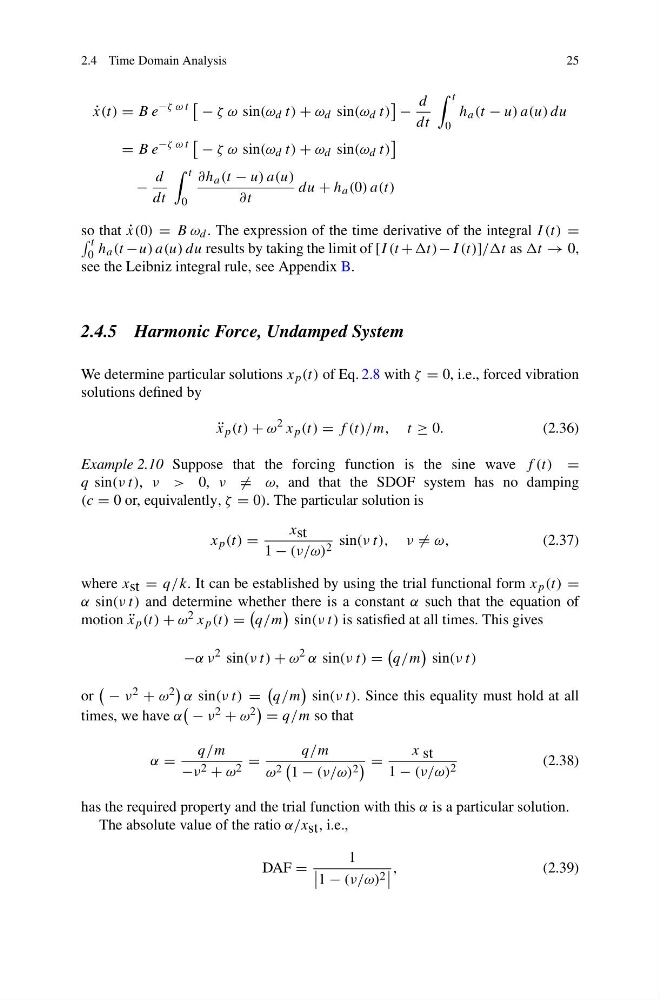
We determine particular solutions x p (t) of Eq. 2.8 with ζ = 0, i.e., forced vibration
solutions defined by
¨
x p (t) + ω
2 x p (t) = f (t)/m, t ≥ 0.
(2.36)
Example 2.10 Suppose that the forcing function is the sine wave f (t) =
q sin(ν t), ν > 0, ν = ω, and that the SDOF system has no damping
(c = 0 or, equivalently, ζ = 0). The particular solution is
x p (t) =
x st
1 − (ν/ω) 2 sin(ν t), ν = ω,
(2.37)
where x st = q/k. It can be established by using the trial functional form x p (t) =
α sin(ν t) and determine whether there is a constant α such that the equation of
motion ¨
x p (t) + ω 2 x p (t) =
q/m
sin(ν t) is satisfied at all times. This gives
−α ν
2 sin(ν t) + ω
2 α sin(ν t) =
q/m
sin(ν t)
or
− ν 2 + ω 2
α sin(ν t) =
q/m
sin(ν t). Since this equality must hold at all
times, we have α
− ν 2 + ω 2 = q/m so that
α =
q/m
−ν 2 + ω 2 =
q/m
ω 2
1 − (ν/ω) 2
=
x st
1 − (ν/ω) 2
(2.38)
has the required property and the trial function with this α is a particular solution.
The absolute value of the ratio α/x st , i.e.,
DAF =
1
1 − (ν/ω) 2
,
(2.39)
25
˙
x(t) = B e
−ζ ω t
− ζ ω sin(ω d t) + ω d sin(ω d t)
−
d
dt
t
0
h a (t − u) a(u) du
= B e
−ζ ω t
− ζ ω sin(ω d t) + ω d sin(ω d t)
−
d
dt
t
0
∂h a (t − u) a(u)
∂t
du + h a (0) a(t)
so that ˙
x(0) = B ω d . The expression of the time derivative of the integral I (t) =
t
0 h a (t −u) a(u) du results by taking the limit of [I (t + (t)]//t as t → 0,
see the Leibniz integral rule, see Appendix B.
2.4.5 Harmonic Force, Undamped System
We determine particular solutions x p (t) of Eq. 2.8 with ζ = 0, i.e., forced vibration
solutions defined by
¨
x p (t) + ω
2 x p (t) = f (t)/m, t ≥ 0.
(2.36)
Example 2.10 Suppose that the forcing function is the sine wave f (t) =
q sin(ν t), ν > 0, ν = ω, and that the SDOF system has no damping
(c = 0 or, equivalently, ζ = 0). The particular solution is
x p (t) =
x st
1 − (ν/ω) 2 sin(ν t), ν = ω,
(2.37)
where x st = q/k. It can be established by using the trial functional form x p (t) =
α sin(ν t) and determine whether there is a constant α such that the equation of
motion ¨
x p (t) + ω 2 x p (t) =
q/m
sin(ν t) is satisfied at all times. This gives
−α ν
2 sin(ν t) + ω
2 α sin(ν t) =
q/m
sin(ν t)
or
− ν 2 + ω 2
α sin(ν t) =
q/m
sin(ν t). Since this equality must hold at all
times, we have α
− ν 2 + ω 2 = q/m so that
α =
q/m
−ν 2 + ω 2 =
q/m
ω 2
1 − (ν/ω) 2
=
x st
1 − (ν/ω) 2
(2.38)
has the required property and the trial function with this α is a particular solution.
The absolute value of the ratio α/x st , i.e.,
DAF =
1
1 − (ν/ω) 2
,
(2.39)