

22
2 Single Degree of Freedom (SDOF) Systems
Fig. 2.7 Discretization of an
arbitrary forcing function
f (t)
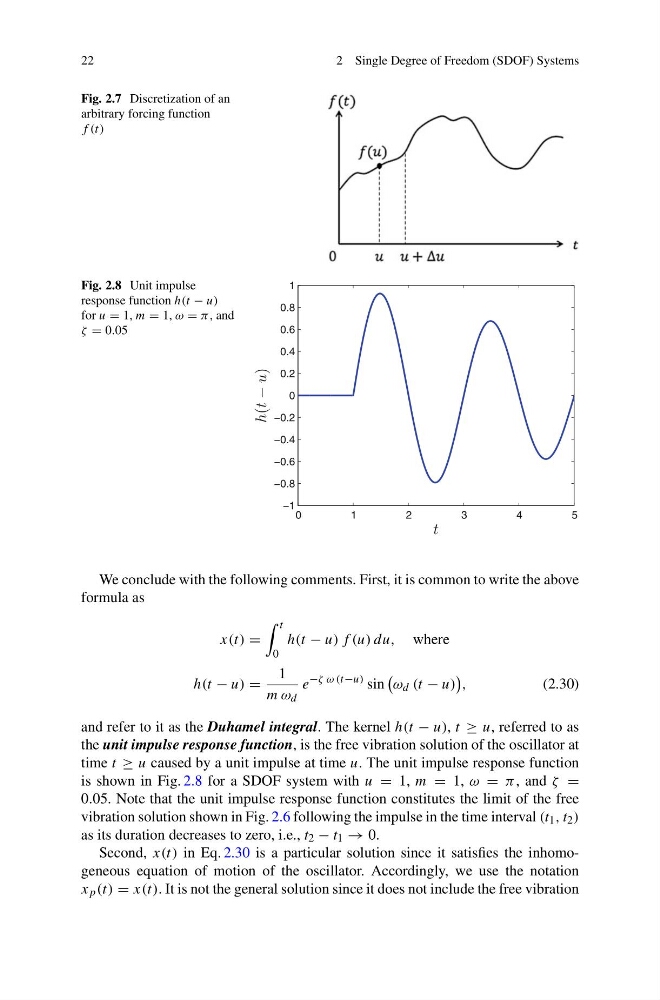
Fig. 2.8 Unit impulse
response function h(t − u)
for u = 1, m = 1, ω = π , and
ζ = 0.05
0
1
2
3
4
5
−1
−0.8
−0.6
−0.4
−0.2
0
0.2
0.4
0.6
0.8
1
t
h(t − u)
We conclude with the following comments. First, it is common to write the above
formula as
x(t) =
t
0
h(t − u) f (u) du, where
h(t − u) =
1
m ω d
e
−ζ ω (t−u) sin
ω d (t − u)
,
(2.30)
and refer to it as the Duhamel integral. The kernel h(t − u), t ≥ u, referred to as
the unit impulse response function, is the free vibration solution of the oscillator at
time t ≥ u caused by a unit impulse at time u. The unit impulse response function
is shown in Fig. 2.8 for a SDOF system with u = 1, m = 1, ω = π , and ζ =
0.05. Note that the unit impulse response function constitutes the limit of the free
vibration solution shown in Fig. 2.6 following the impulse in the time interval (t 1 , t 2 )
as its duration decreases to zero, i.e., t 2 − t 1 → 0.
Second, x(t) in Eq. 2.30 is a particular solution since it satisfies the inhomogeneous equation of motion of the oscillator. Accordingly, we use the notation
x p (t) = x(t). It is not the general solution since it does not include the free vibration
2 Single Degree of Freedom (SDOF) Systems
Fig. 2.7 Discretization of an
arbitrary forcing function
f (t)
Fig. 2.8 Unit impulse
response function h(t − u)
for u = 1, m = 1, ω = π , and
ζ = 0.05
0
1
2
3
4
5
−1
−0.8
−0.6
−0.4
−0.2
0
0.2
0.4
0.6
0.8
1
t
h(t − u)
We conclude with the following comments. First, it is common to write the above
formula as
x(t) =
t
0
h(t − u) f (u) du, where
h(t − u) =
1
m ω d
e
−ζ ω (t−u) sin
ω d (t − u)
,
(2.30)
and refer to it as the Duhamel integral. The kernel h(t − u), t ≥ u, referred to as
the unit impulse response function, is the free vibration solution of the oscillator at
time t ≥ u caused by a unit impulse at time u. The unit impulse response function
is shown in Fig. 2.8 for a SDOF system with u = 1, m = 1, ω = π , and ζ =
0.05. Note that the unit impulse response function constitutes the limit of the free
vibration solution shown in Fig. 2.6 following the impulse in the time interval (t 1 , t 2 )
as its duration decreases to zero, i.e., t 2 − t 1 → 0.
Second, x(t) in Eq. 2.30 is a particular solution since it satisfies the inhomogeneous equation of motion of the oscillator. Accordingly, we use the notation
x p (t) = x(t). It is not the general solution since it does not include the free vibration