

100
4 Multi-Degree of Freedom (MDOF) Systems
4.5.3 Properties of Eigenvalues and Right/Left Eigenvectors
We limit our discussion to properties of the eigenvalues and the right/left eigenvectors, which is relevant to our discussion. As stated, we assume distinct eigenvalues
for simplicity.
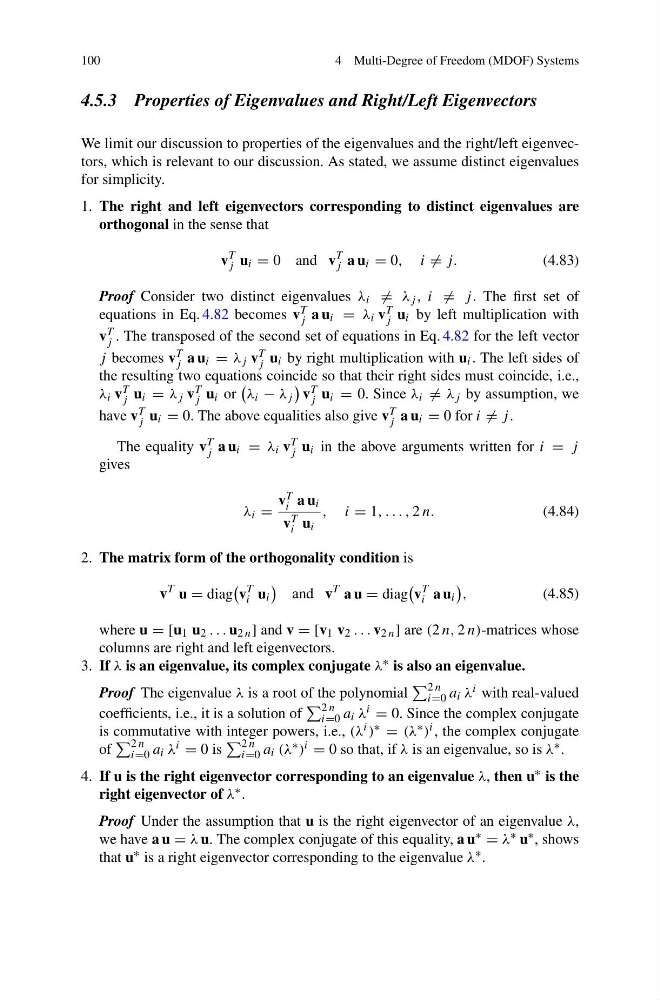
1. The right and left eigenvectors corresponding to distinct eigenvalues are
orthogonal in the sense that
v
T
j u i = 0 and v
T
j a u i = 0, i = j.
(4.83)
Proof Consider two distinct eigenvalues λ i = λ j , i = j . The first set of
equations in Eq. 4.82 becomes v T
j a u i = λ i v T
j u i by left multiplication with
v T
j . The transposed of the second set of equations in Eq. 4.82 for the left vector
j becomes v T
j a u i = λ j v T
j u i by right multiplication with u i . The left sides of
the resulting two equations coincide so that their right sides must coincide, i.e.,
λ i v T
j u i = λ j v T
j u i or
λ i − λ j
v T
j u i = 0. Since λ i = λ j by assumption, we
have v T
j u i = 0. The above equalities also give v T
j a u i = 0 for i = j .
The equality v T
j a u i = λ i v T
j u i in the above arguments written for i = j
gives
λ i =
v T
i a u i
v T
i u i
, i = 1, . . . , 2 n.
(4.84)
2. The matrix form of the orthogonality condition is
v
T u = diag
v
T
i u i
and v
T a u = diag
v
T
i a u i
,
(4.85)
where u = [u 1 u 2 . . . u 2 n ] and v = [v 1 v 2 . . . v 2 n ] are (2 n, 2 n)-matrices whose
columns are right and left eigenvectors.
3. If λ is an eigenvalue, its complex conjugate λ ∗ is also an eigenvalue.
Proof The eigenvalue λ is a root of the polynomial
2 n
i=0 a i λ i with real-valued
coefficients, i.e., it is a solution of
2 n
i=0 a i λ i = 0. Since the complex conjugate
is commutative with integer powers, i.e., (λ i ) ∗ = (λ ∗ ) i , the complex conjugate
of
2 n
i=0 a i λ i = 0 is
2 n
i=0 a i (λ ∗ ) i = 0 so that, if λ is an eigenvalue, so is λ ∗ .
4. If u is the right eigenvector corresponding to an eigenvalue λ, then u ∗ is the
right eigenvector of λ ∗ .
Proof Under the assumption that u is the right eigenvector of an eigenvalue λ,
we have a u = λ u. The complex conjugate of this equality, a u ∗ = λ ∗ u ∗ , shows
that u ∗ is a right eigenvector corresponding to the eigenvalue λ ∗ .
4 Multi-Degree of Freedom (MDOF) Systems
4.5.3 Properties of Eigenvalues and Right/Left Eigenvectors
We limit our discussion to properties of the eigenvalues and the right/left eigenvectors, which is relevant to our discussion. As stated, we assume distinct eigenvalues
for simplicity.
1. The right and left eigenvectors corresponding to distinct eigenvalues are
orthogonal in the sense that
v
T
j u i = 0 and v
T
j a u i = 0, i = j.
(4.83)
Proof Consider two distinct eigenvalues λ i = λ j , i = j . The first set of
equations in Eq. 4.82 becomes v T
j a u i = λ i v T
j u i by left multiplication with
v T
j . The transposed of the second set of equations in Eq. 4.82 for the left vector
j becomes v T
j a u i = λ j v T
j u i by right multiplication with u i . The left sides of
the resulting two equations coincide so that their right sides must coincide, i.e.,
λ i v T
j u i = λ j v T
j u i or
λ i − λ j
v T
j u i = 0. Since λ i = λ j by assumption, we
have v T
j u i = 0. The above equalities also give v T
j a u i = 0 for i = j .
The equality v T
j a u i = λ i v T
j u i in the above arguments written for i = j
gives
λ i =
v T
i a u i
v T
i u i
, i = 1, . . . , 2 n.
(4.84)
2. The matrix form of the orthogonality condition is
v
T u = diag
v
T
i u i
and v
T a u = diag
v
T
i a u i
,
(4.85)
where u = [u 1 u 2 . . . u 2 n ] and v = [v 1 v 2 . . . v 2 n ] are (2 n, 2 n)-matrices whose
columns are right and left eigenvectors.
3. If λ is an eigenvalue, its complex conjugate λ ∗ is also an eigenvalue.
Proof The eigenvalue λ is a root of the polynomial
2 n
i=0 a i λ i with real-valued
coefficients, i.e., it is a solution of
2 n
i=0 a i λ i = 0. Since the complex conjugate
is commutative with integer powers, i.e., (λ i ) ∗ = (λ ∗ ) i , the complex conjugate
of
2 n
i=0 a i λ i = 0 is
2 n
i=0 a i (λ ∗ ) i = 0 so that, if λ is an eigenvalue, so is λ ∗ .
4. If u is the right eigenvector corresponding to an eigenvalue λ, then u ∗ is the
right eigenvector of λ ∗ .
Proof Under the assumption that u is the right eigenvector of an eigenvalue λ,
we have a u = λ u. The complex conjugate of this equality, a u ∗ = λ ∗ u ∗ , shows
that u ∗ is a right eigenvector corresponding to the eigenvalue λ ∗ .