

98
4 Multi-Degree of Freedom (MDOF) Systems
4.5 Time Domain Analysis: Non-proportional Damping
We consider non-proportional damping matrices c, i.e., damping matrices for which
T c is not diagonal, where denotes the matrix of classical modes of vibration.
This means that the previous method for solving the equation of motion cannot be
used since Eqs. 4.22 and 4.23 remain coupled. We develop an alternative method
that is conceptually similar to that based on classical modes of vibration.
4.5.1 State-Space Representation
Consider a damped MDOF system subjected to a forcing function whose displacement x(t) is the solution of Eq. 4.2 with the initial conditions (x 0 , ˙
x 0 ). This equation,
written here for convenience with a different number, has the form
m ¨
x + c ˙
x + k x = f(t),
(4.76)
where m, c, and k denote the mass, damping, and stiffness matrices, x is the
displacement vector, and f(t) is an n-dimensional forcing function.
The state-space representation of the equation of motion has the form
˙
z(t) = a z(t) + b f(t),
(4.77)
where
z(t) =
x(t)
˙
x(t)
, a =
0
I
−m −1 k −m −1 c
and b =
0
m −1
.
(4.78)
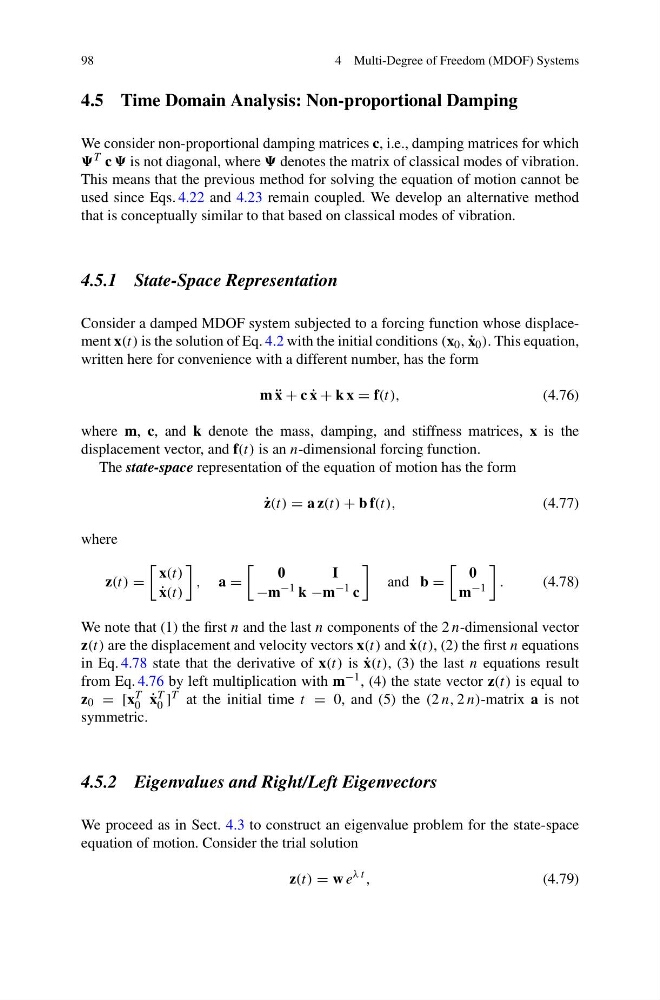
We note that (1) the first n and the last n components of the 2 n-dimensional vector
z(t) are the displacement and velocity vectors x(t) and ˙
x(t), (2) the first n equations
in Eq. 4.78 state that the derivative of x(t) is ˙
x(t), (3) the last n equations result
from Eq. 4.76 by left multiplication with m −1 , (4) the state vector z(t) is equal to
z 0 = [x T
0 ˙
x T
0 ] T at the initial time t = 0, and (5) the (2 n, 2 n)-matrix a is not
symmetric.
4.5.2 Eigenvalues and Right/Left Eigenvectors
We proceed as in Sect. 4.3 to construct an eigenvalue problem for the state-space
equation of motion. Consider the trial solution
z(t) = w e
λ t ,
(4.79)
4 Multi-Degree of Freedom (MDOF) Systems
4.5 Time Domain Analysis: Non-proportional Damping
We consider non-proportional damping matrices c, i.e., damping matrices for which
T c is not diagonal, where denotes the matrix of classical modes of vibration.
This means that the previous method for solving the equation of motion cannot be
used since Eqs. 4.22 and 4.23 remain coupled. We develop an alternative method
that is conceptually similar to that based on classical modes of vibration.
4.5.1 State-Space Representation
Consider a damped MDOF system subjected to a forcing function whose displacement x(t) is the solution of Eq. 4.2 with the initial conditions (x 0 , ˙
x 0 ). This equation,
written here for convenience with a different number, has the form
m ¨
x + c ˙
x + k x = f(t),
(4.76)
where m, c, and k denote the mass, damping, and stiffness matrices, x is the
displacement vector, and f(t) is an n-dimensional forcing function.
The state-space representation of the equation of motion has the form
˙
z(t) = a z(t) + b f(t),
(4.77)
where
z(t) =
x(t)
˙
x(t)
, a =
0
I
−m −1 k −m −1 c
and b =
0
m −1
.
(4.78)
We note that (1) the first n and the last n components of the 2 n-dimensional vector
z(t) are the displacement and velocity vectors x(t) and ˙
x(t), (2) the first n equations
in Eq. 4.78 state that the derivative of x(t) is ˙
x(t), (3) the last n equations result
from Eq. 4.76 by left multiplication with m −1 , (4) the state vector z(t) is equal to
z 0 = [x T
0 ˙
x T
0 ] T at the initial time t = 0, and (5) the (2 n, 2 n)-matrix a is not
symmetric.
4.5.2 Eigenvalues and Right/Left Eigenvectors
We proceed as in Sect. 4.3 to construct an eigenvalue problem for the state-space
equation of motion. Consider the trial solution
z(t) = w e
λ t ,
(4.79)