

4.4 Time Domain Analysis: Proportional Damping
95
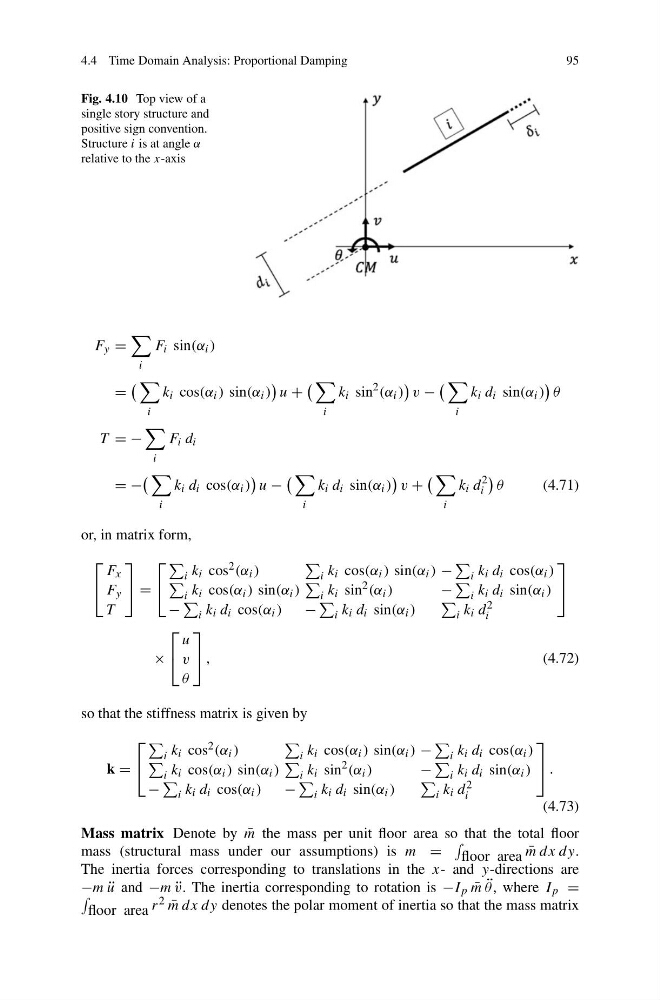
Fig. 4.10 Top view of a
single story structure and
positive sign convention.
Structure i is at angle α
relative to the x-axis
F y =
i
F i sin(α i )
=
i
k i cos(α i ) sin(α i )
u +
i
k i sin
2 (α i )
v −
i
k i d i sin(α i )
θ
T = −
i
F i d i
= −
i
k i d i cos(α i )
u −
i
k i d i sin(α i )
v +
i
k i d
2
i
θ
(4.71)
or, in matrix form,
⎡
⎣
F x
F y
T
⎤
⎦ =
⎡
⎣
i k i cos 2 (α i )
i k i cos(α i ) sin(α i ) −
i k i d i cos(α i )
i k i cos(α i ) sin(α i )
i k i sin
2 (α i )
−
i k i d i sin(α i )
−
i k i d i cos(α i )
−
i k i d i sin(α i )
i k i d 2
i
⎤
⎦
×
⎡
⎣
u
v
θ
⎤
⎦ ,
(4.72)
so that the stiffness matrix is given by
k =
⎡
⎣
i k i cos 2 (α i )
i k i cos(α i ) sin(α i ) −
i k i d i cos(α i )
i k i cos(α i ) sin(α i )
i k i sin
2 (α i )
−
i k i d i sin(α i )
−
i k i d i cos(α i )
−
i k i d i sin(α i )
i k i d 2
i
⎤
⎦ .
(4.73)
Mass matrix Denote by ¯
m the mass per unit floor area so that the total floor
mass (structural mass under our assumptions) is m =
floor area ¯
m dx dy.
The inertia forces corresponding to translations in the x- and y-directions are
−m ¨
u and −m ¨
v. The inertia corresponding to rotation is −I p ¯
m ¨
θ , where I p =
floor area r 2 ¯
m dx dy denotes the polar moment of inertia so that the mass matrix
95
Fig. 4.10 Top view of a
single story structure and
positive sign convention.
Structure i is at angle α
relative to the x-axis
F y =
i
F i sin(α i )
=
i
k i cos(α i ) sin(α i )
u +
i
k i sin
2 (α i )
v −
i
k i d i sin(α i )
θ
T = −
i
F i d i
= −
i
k i d i cos(α i )
u −
i
k i d i sin(α i )
v +
i
k i d
2
i
θ
(4.71)
or, in matrix form,
⎡
⎣
F x
F y
T
⎤
⎦ =
⎡
⎣
i k i cos 2 (α i )
i k i cos(α i ) sin(α i ) −
i k i d i cos(α i )
i k i cos(α i ) sin(α i )
i k i sin
2 (α i )
−
i k i d i sin(α i )
−
i k i d i cos(α i )
−
i k i d i sin(α i )
i k i d 2
i
⎤
⎦
×
⎡
⎣
u
v
θ
⎤
⎦ ,
(4.72)
so that the stiffness matrix is given by
k =
⎡
⎣
i k i cos 2 (α i )
i k i cos(α i ) sin(α i ) −
i k i d i cos(α i )
i k i cos(α i ) sin(α i )
i k i sin
2 (α i )
−
i k i d i sin(α i )
−
i k i d i cos(α i )
−
i k i d i sin(α i )
i k i d 2
i
⎤
⎦ .
(4.73)
Mass matrix Denote by ¯
m the mass per unit floor area so that the total floor
mass (structural mass under our assumptions) is m =
floor area ¯
m dx dy.
The inertia forces corresponding to translations in the x- and y-directions are
−m ¨
u and −m ¨
v. The inertia corresponding to rotation is −I p ¯
m ¨
θ , where I p =
floor area r 2 ¯
m dx dy denotes the polar moment of inertia so that the mass matrix