

41
Step 3: Searching for Themes
During this stage, codes were reviewed and
sorted into potential themes by using mind maps,
tables and word clouds of frequency. The codes
were sorted into themes, sub-themes and outliers.
The theme presented a coding of initial codes
(Clarke and Braun 2013). Some themes emerged
with a substantial incidence of codes from participants’ transcripts, whereas some emerged as
sub-themes, relevant to the overarching themes.
Other themes and sub-themes emerged from a
combination of both, i.e. some emerged from
participants’ work while some created by the
researcher. As these themes emerged, descriptions were added to define distinct themes and
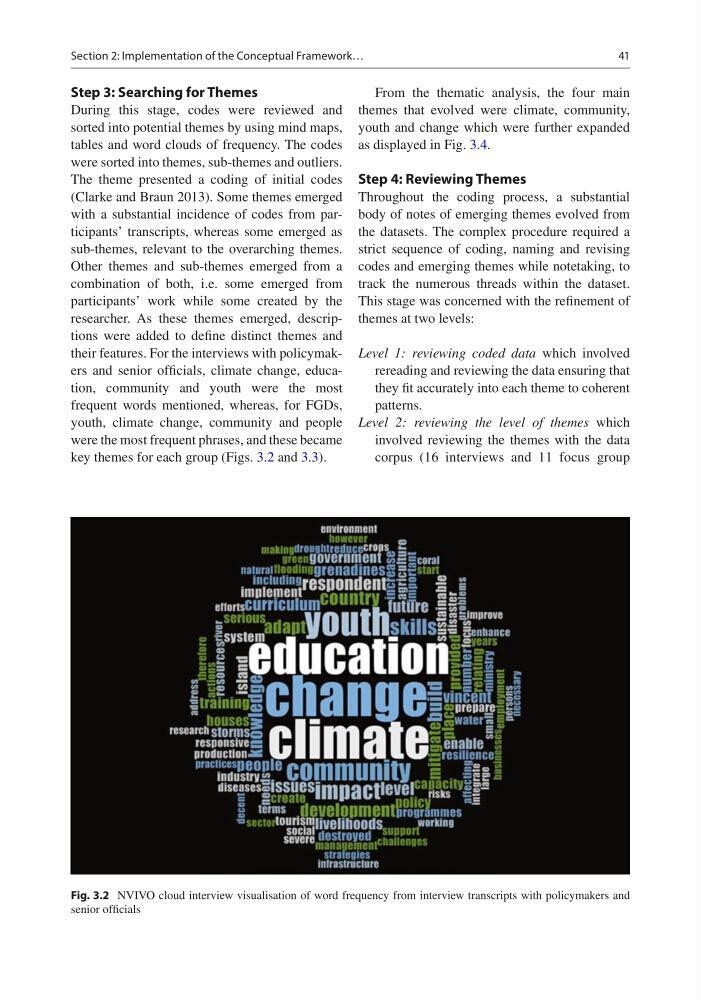
their features. For the interviews with policymakers and senior officials, climate change, education, community and youth were the most
frequent words mentioned, whereas, for FGDs,
youth, climate change, community and people
were the most frequent phrases, and these became
key themes for each group (Figs. 3.2 and 3.3).
From the thematic analysis, the four main
themes that evolved were climate, community,
youth and change which were further expanded
as displayed in Fig. 3.4.
Step 4: Reviewing Themes
Throughout the coding process, a substantial
body of notes of emerging themes evolved from
the datasets. The complex procedure required a
strict sequence of coding, naming and revising
codes and emerging themes while notetaking, to
track the numerous threads within the dataset.
This stage was concerned with the refinement of
themes at two levels:
Level 1: reviewing coded data which involved
rereading and reviewing the data ensuring that
they fit accurately into each theme to coherent
patterns.
Level 2: reviewing the level of themes which
involved reviewing the themes with the data
corpus (16 interviews and 11 focus group
Fig. 3.2 NVIVO cloud interview visualisation of word frequency from interview transcripts with policymakers and
senior officials
Section 2: Implementation of the Conceptual Framework…
Step 3: Searching for Themes
During this stage, codes were reviewed and
sorted into potential themes by using mind maps,
tables and word clouds of frequency. The codes
were sorted into themes, sub-themes and outliers.
The theme presented a coding of initial codes
(Clarke and Braun 2013). Some themes emerged
with a substantial incidence of codes from participants’ transcripts, whereas some emerged as
sub-themes, relevant to the overarching themes.
Other themes and sub-themes emerged from a
combination of both, i.e. some emerged from
participants’ work while some created by the
researcher. As these themes emerged, descriptions were added to define distinct themes and
their features. For the interviews with policymakers and senior officials, climate change, education, community and youth were the most
frequent words mentioned, whereas, for FGDs,
youth, climate change, community and people
were the most frequent phrases, and these became
key themes for each group (Figs. 3.2 and 3.3).
From the thematic analysis, the four main
themes that evolved were climate, community,
youth and change which were further expanded
as displayed in Fig. 3.4.
Step 4: Reviewing Themes
Throughout the coding process, a substantial
body of notes of emerging themes evolved from
the datasets. The complex procedure required a
strict sequence of coding, naming and revising
codes and emerging themes while notetaking, to
track the numerous threads within the dataset.
This stage was concerned with the refinement of
themes at two levels:
Level 1: reviewing coded data which involved
rereading and reviewing the data ensuring that
they fit accurately into each theme to coherent
patterns.
Level 2: reviewing the level of themes which
involved reviewing the themes with the data
corpus (16 interviews and 11 focus group
Fig. 3.2 NVIVO cloud interview visualisation of word frequency from interview transcripts with policymakers and
senior officials
Section 2: Implementation of the Conceptual Framework…