

40
The steps below summarise the coding process
The initial codes were put into a coding framework
which included a definition of each code and quotes
that reflected the specific code. The descriptions given
for each code were created, combining the word as
used by participants with a dictionary definition of the
phrase. The actual definition of the word along with
the participants’ interpretation of the words/codes was
taken into consideration
Once the initial coding framework was established and
the definitions of the code completed, these were
applied to the rest of the data using NVivo 11. Data
fitting into codes were categorised; data that did not fit
into code were deemed outliers
The section below provides more details on
the steps taken to analyse the data from the topdown interviews with policymakers and bottomup FGDs with youth.
Step 1: Familiarisation with the Data
Familiarisation and transcription of data to search
for and identify meanings and patterns in the data
source. Notes of general data patterns were taken
without any attempt at analysing the data.
Step 2: Generating the Initial Codes
NVivo 11-assisted analysis of the data by working through the body of data line by line of a template source. One transcript for interviews and
one for FGDs were chosen to undergo a baseline
summary to identify key themes emerging
(Crawley et al. 2001; Marshall 2011). The main
limitation of the NVivo is that it does not make
decisions on the data, i.e. what to do or what is
meant by the data (Marshall 2011), and therefore,
it is the responsibility of the researcher to decide
what meaning should be extracted from it. The
software instead organises and stores data into
self-allocated themes by a process called coding
for ease of access and to present visual representations of said data through word clouts. The initial themes from the review provided a basis for
coding, complemented with emerging themes
evolving from the coding process. The process
identified all the possible codes appearing within
the individual dataset to be applied to all sources.
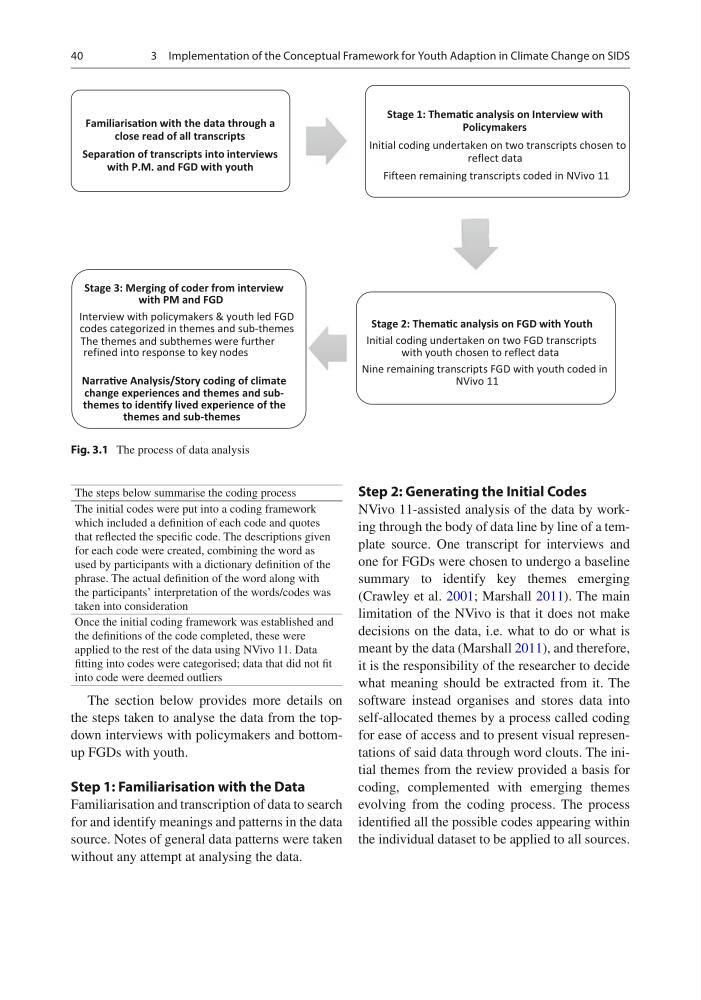
FamiliarisaƟon with the data through a
close read of all transcripts
SeparaƟon of transcripts into interviews
with P.M. and FGD with youth
Stage 1: ThemaƟc analysis on Interview with
Policymakers
Initial coding undertaken on two transcripts chosen to
reflect data
Fifteen remaining transcripts coded in NVivo 11
Stage 2: ThemaƟc analysis on FGD with Youth
Initial coding undertaken on two FGD transcripts
with youth chosen to reflect data
Nine remaining transcripts FGD with youth coded in
NVivo 11
Stage 3: Merging of coder from interview
with PM and FGD
Interview with policymakers & youth led FGD
codes categorized in themes and sub-themes
The themes and subthemes were further
refined into response to key nodes
NarraƟve Analysis/Story coding of climate
change experiences and themes and subthemes to idenƟfy lived experience of the
themes and sub-themes
Fig. 3.1 The process of data analysis
3 Implementation of the Conceptual Framework for Youth Adaption in Climate Change on SIDS
The steps below summarise the coding process
The initial codes were put into a coding framework
which included a definition of each code and quotes
that reflected the specific code. The descriptions given
for each code were created, combining the word as
used by participants with a dictionary definition of the
phrase. The actual definition of the word along with
the participants’ interpretation of the words/codes was
taken into consideration
Once the initial coding framework was established and
the definitions of the code completed, these were
applied to the rest of the data using NVivo 11. Data
fitting into codes were categorised; data that did not fit
into code were deemed outliers
The section below provides more details on
the steps taken to analyse the data from the topdown interviews with policymakers and bottomup FGDs with youth.
Step 1: Familiarisation with the Data
Familiarisation and transcription of data to search
for and identify meanings and patterns in the data
source. Notes of general data patterns were taken
without any attempt at analysing the data.
Step 2: Generating the Initial Codes
NVivo 11-assisted analysis of the data by working through the body of data line by line of a template source. One transcript for interviews and
one for FGDs were chosen to undergo a baseline
summary to identify key themes emerging
(Crawley et al. 2001; Marshall 2011). The main
limitation of the NVivo is that it does not make
decisions on the data, i.e. what to do or what is
meant by the data (Marshall 2011), and therefore,
it is the responsibility of the researcher to decide
what meaning should be extracted from it. The
software instead organises and stores data into
self-allocated themes by a process called coding
for ease of access and to present visual representations of said data through word clouts. The initial themes from the review provided a basis for
coding, complemented with emerging themes
evolving from the coding process. The process
identified all the possible codes appearing within
the individual dataset to be applied to all sources.
FamiliarisaƟon with the data through a
close read of all transcripts
SeparaƟon of transcripts into interviews
with P.M. and FGD with youth
Stage 1: ThemaƟc analysis on Interview with
Policymakers
Initial coding undertaken on two transcripts chosen to
reflect data
Fifteen remaining transcripts coded in NVivo 11
Stage 2: ThemaƟc analysis on FGD with Youth
Initial coding undertaken on two FGD transcripts
with youth chosen to reflect data
Nine remaining transcripts FGD with youth coded in
NVivo 11
Stage 3: Merging of coder from interview
with PM and FGD
Interview with policymakers & youth led FGD
codes categorized in themes and sub-themes
The themes and subthemes were further
refined into response to key nodes
NarraƟve Analysis/Story coding of climate
change experiences and themes and subthemes to idenƟfy lived experience of the
themes and sub-themes
Fig. 3.1 The process of data analysis
3 Implementation of the Conceptual Framework for Youth Adaption in Climate Change on SIDS