

115
Author
Year
Method/data source
Scope/focus (main features of key
relevance)
Weaknesses and limitations
DFID
Framework
2011
Archival data
Review of
literature
Peer-to-peer
participatory
method
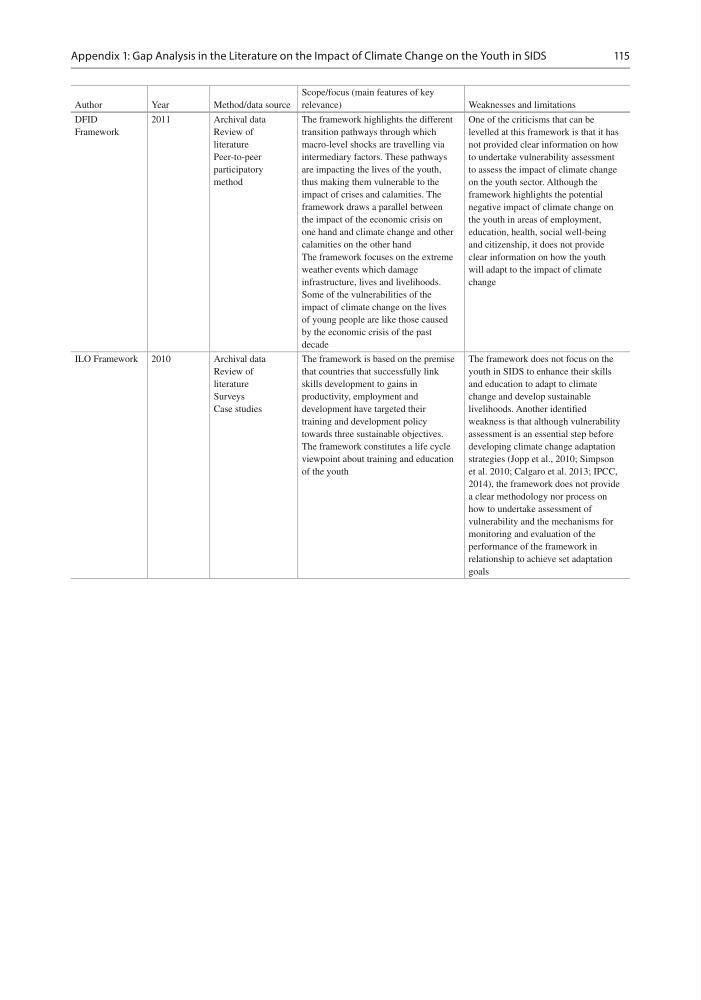
The framework highlights the different
transition pathways through which
macro-level shocks are travelling via
intermediary factors. These pathways
are impacting the lives of the youth,
thus making them vulnerable to the
impact of crises and calamities. The
framework draws a parallel between
the impact of the economic crisis on
one hand and climate change and other
calamities on the other hand
The framework focuses on the extreme
weather events which damage
infrastructure, lives and livelihoods.
Some of the vulnerabilities of the
impact of climate change on the lives
of young people are like those caused
by the economic crisis of the past
decade
One of the criticisms that can be
levelled at this framework is that it has
not provided clear information on how
to undertake vulnerability assessment
to assess the impact of climate change
on the youth sector. Although the
framework highlights the potential
negative impact of climate change on
the youth in areas of employment,
education, health, social well-being
and citizenship, it does not provide
clear information on how the youth
will adapt to the impact of climate
change
ILO Framework 2010
Archival data
Review of
literature
Surveys
Case studies
The framework is based on the premise
that countries that successfully link
skills development to gains in
productivity, employment and
development have targeted their
training and development policy
towards three sustainable objectives.
The framework constitutes a life cycle
viewpoint about training and education
of the youth
The framework does not focus on the
youth in SIDS to enhance their skills
and education to adapt to climate
change and develop sustainable
livelihoods. Another identified
weakness is that although vulnerability
assessment is an essential step before
developing climate change adaptation
strategies (Jopp et al., 2010; Simpson
et al. 2010; Calgaro et al. 2013; IPCC,
2014), the framework does not provide
a clear methodology nor process on
how to undertake assessment of
vulnerability and the mechanisms for
monitoring and evaluation of the
performance of the framework in
relationship to achieve set adaptation
goals
Appendix 1: Gap Analysis in the Literature on the Impact of Climate Change on the Youth in SIDS
Author
Year
Method/data source
Scope/focus (main features of key
relevance)
Weaknesses and limitations
DFID
Framework
2011
Archival data
Review of
literature
Peer-to-peer
participatory
method
The framework highlights the different
transition pathways through which
macro-level shocks are travelling via
intermediary factors. These pathways
are impacting the lives of the youth,
thus making them vulnerable to the
impact of crises and calamities. The
framework draws a parallel between
the impact of the economic crisis on
one hand and climate change and other
calamities on the other hand
The framework focuses on the extreme
weather events which damage
infrastructure, lives and livelihoods.
Some of the vulnerabilities of the
impact of climate change on the lives
of young people are like those caused
by the economic crisis of the past
decade
One of the criticisms that can be
levelled at this framework is that it has
not provided clear information on how
to undertake vulnerability assessment
to assess the impact of climate change
on the youth sector. Although the
framework highlights the potential
negative impact of climate change on
the youth in areas of employment,
education, health, social well-being
and citizenship, it does not provide
clear information on how the youth
will adapt to the impact of climate
change
ILO Framework 2010
Archival data
Review of
literature
Surveys
Case studies
The framework is based on the premise
that countries that successfully link
skills development to gains in
productivity, employment and
development have targeted their
training and development policy
towards three sustainable objectives.
The framework constitutes a life cycle
viewpoint about training and education
of the youth
The framework does not focus on the
youth in SIDS to enhance their skills
and education to adapt to climate
change and develop sustainable
livelihoods. Another identified
weakness is that although vulnerability
assessment is an essential step before
developing climate change adaptation
strategies (Jopp et al., 2010; Simpson
et al. 2010; Calgaro et al. 2013; IPCC,
2014), the framework does not provide
a clear methodology nor process on
how to undertake assessment of
vulnerability and the mechanisms for
monitoring and evaluation of the
performance of the framework in
relationship to achieve set adaptation
goals
Appendix 1: Gap Analysis in the Literature on the Impact of Climate Change on the Youth in SIDS