

114
Author
Year
Method/data source
Scope/focus (main features of key
relevance)
Weaknesses and limitations
Ogarro and
Speek Warney
2009
Archival data
Review of
literature
The paper presents a gap analysis on
the impact of climate change on
children (youth) in the Eastern
Caribbean conducted by the Business
Development Office of the University
of the West Indies, sponsored by
UNICEF
Due to lack of data, the researchers
argued that they are not able to identify
the environmental health hazards
associated with climate change that is
impacting on children (youth) in the
Eastern Caribbean. The researchers
claimed that the gap analysis could
benefit from better tracking system
through the improved data collection
system
UNDP
2015
Archival data
Review of
literature
Surveys
The report entitled “Human
Development Report: Work for Human
Development” prepared by the United
Nations Development Programme
highlights the current challenges in
employment and underemployment
across the globe. It also highlights the
mismatch between the demand for
knowledge and skills provided by the
education system and those skills and
knowledge required by the market
Although the report recognised the
impact of climate change on human
being now and in the future and put
forward a set of strategies to enhance
the capacity of the workforce including
the youth to develop sustainable
livelihoods, the report is global in
scope and does not focus on the
specific development challenges facing
the youth in SIDS and strategies to
address these development issues
DFID
Sustainable
Livelihoods
Framework
2000 in
Angelsen
et al. (2011)
Archival data
Household surveys
Interviews
Questionnaires
Participatory
method
The underlying message conveyed
through the sustainable livelihoods
framework is that society is influenced
by a variety of forces including shocks,
trends and seasonality and factors
which transform structures and
processes. It is also important to note
that these processes and elements are
always changing. The SLF consists of
five interacting components, namely,
the vulnerability context, livelihoods
assets, transforming structures and
processes, livelihoods strategies and
livelihoods outcomes. The assessment
of livelihoods necessitates a continuous
assessment of the five assets/capitals
available within the community, the
livelihoods outcomes that the
community is hoping to accomplish
and the livelihoods strategies which the
community is adapting with the hope
of achieving the designated results at a
later stage in the development process
The framework is generic in its
structure and is not specifically
focused on youth adaptation to climate
change in small island communities.
While the SLF deals with five assets/
capitals, the research will explore one
of the five assets (human capital). This
is because it has relevance when
dealing with issues about climate
change impact, i.e. shocks and
vulnerabilities. The first component of
the framework focused on addressing
the vulnerability, which is caused by
forces such as shocks, which include
health shocks, economic shocks, crops
and livestocks failure shocks and
others
Although SLF did not specifically
focus on climate change, youth
development and adaptation, it has
relevance for addressing the
vulnerabilities caused by climate
change and reducing the severity of its
impact on the youth in SIDS. It also
has similarities to an area of the
research, which focused on capital, i.e.
human capital
(continued)
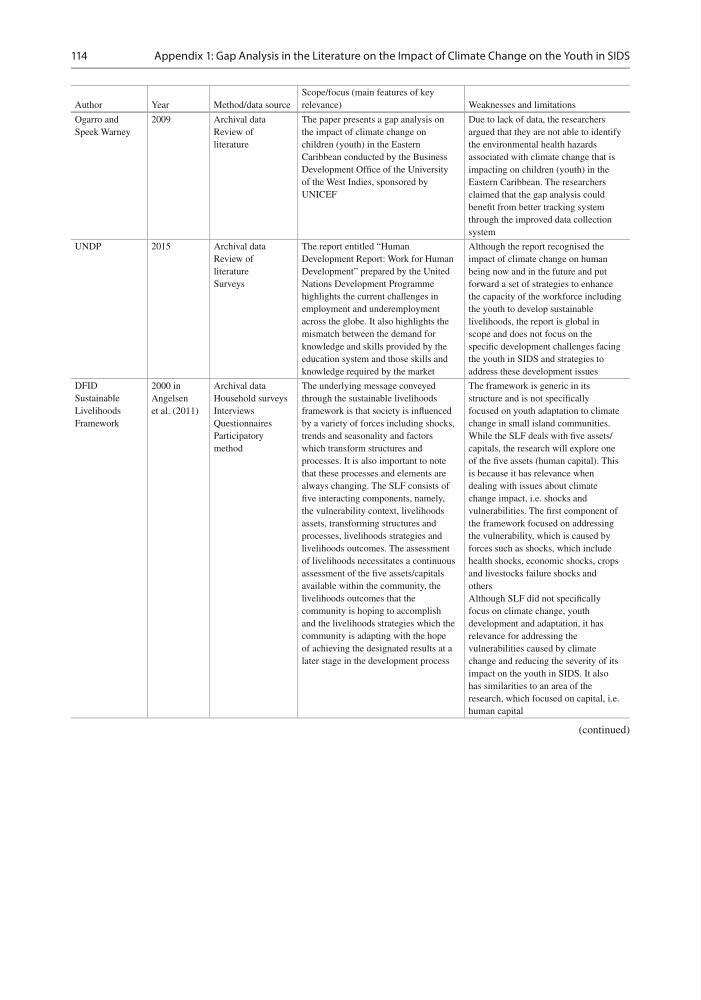
Appendix 1: Gap Analysis in the Literature on the Impact of Climate Change on the Youth in SIDS
Author
Year
Method/data source
Scope/focus (main features of key
relevance)
Weaknesses and limitations
Ogarro and
Speek Warney
2009
Archival data
Review of
literature
The paper presents a gap analysis on
the impact of climate change on
children (youth) in the Eastern
Caribbean conducted by the Business
Development Office of the University
of the West Indies, sponsored by
UNICEF
Due to lack of data, the researchers
argued that they are not able to identify
the environmental health hazards
associated with climate change that is
impacting on children (youth) in the
Eastern Caribbean. The researchers
claimed that the gap analysis could
benefit from better tracking system
through the improved data collection
system
UNDP
2015
Archival data
Review of
literature
Surveys
The report entitled “Human
Development Report: Work for Human
Development” prepared by the United
Nations Development Programme
highlights the current challenges in
employment and underemployment
across the globe. It also highlights the
mismatch between the demand for
knowledge and skills provided by the
education system and those skills and
knowledge required by the market
Although the report recognised the
impact of climate change on human
being now and in the future and put
forward a set of strategies to enhance
the capacity of the workforce including
the youth to develop sustainable
livelihoods, the report is global in
scope and does not focus on the
specific development challenges facing
the youth in SIDS and strategies to
address these development issues
DFID
Sustainable
Livelihoods
Framework
2000 in
Angelsen
et al. (2011)
Archival data
Household surveys
Interviews
Questionnaires
Participatory
method
The underlying message conveyed
through the sustainable livelihoods
framework is that society is influenced
by a variety of forces including shocks,
trends and seasonality and factors
which transform structures and
processes. It is also important to note
that these processes and elements are
always changing. The SLF consists of
five interacting components, namely,
the vulnerability context, livelihoods
assets, transforming structures and
processes, livelihoods strategies and
livelihoods outcomes. The assessment
of livelihoods necessitates a continuous
assessment of the five assets/capitals
available within the community, the
livelihoods outcomes that the
community is hoping to accomplish
and the livelihoods strategies which the
community is adapting with the hope
of achieving the designated results at a
later stage in the development process
The framework is generic in its
structure and is not specifically
focused on youth adaptation to climate
change in small island communities.
While the SLF deals with five assets/
capitals, the research will explore one
of the five assets (human capital). This
is because it has relevance when
dealing with issues about climate
change impact, i.e. shocks and
vulnerabilities. The first component of
the framework focused on addressing
the vulnerability, which is caused by
forces such as shocks, which include
health shocks, economic shocks, crops
and livestocks failure shocks and
others
Although SLF did not specifically
focus on climate change, youth
development and adaptation, it has
relevance for addressing the
vulnerabilities caused by climate
change and reducing the severity of its
impact on the youth in SIDS. It also
has similarities to an area of the
research, which focused on capital, i.e.
human capital
(continued)
Appendix 1: Gap Analysis in the Literature on the Impact of Climate Change on the Youth in SIDS