

74
S. Goto and H. Hino
4.5 Geometric Description of Master Equations
There have been several attempts to geometrically describe the time-development
of probability distribution functions [34–39]. In addition to these, any theoretical
development of geometric description of master equations will be expected to yield
several benefits. In this section, a geometrization of the solvable master equations
is proposed. This is accomplished by the use of contact (metric) geometry. Before
showing this, a geometrization of equilibrium states is focused.
4.5.1 Geometry of Equilibrium States
Equilibrium state is identified with the Legendre submanifold generated by a function
on a contact manifold, as the standard contact geometric description of equilibrium
thermodynamics [12]. In this subsection this aspect of the equilibrium state of the
solvable master equations is explicitly shown. To this end the equilibrium distribution
function p
eq
θ is identified with (4.12), where p
eq
θ ( j) > 0, ( j ∈ Γ ) holds due to (4.13).
Choose an appropriate contact manifold. If a convex function on it exists, then
it follows from Proposition 1 that the corresponding dually flat space is induced.
As will be explained below, since a function defining the contact Hamiltonian
discussed earlier is not convex on a Legendre submanifold in Darboux coordinates,
such a dually flat space is not induced for the master equations. However still a
Legendre submanifold for expressing the equilibrium state can be defined. To do
so, one introduces a contact manifold as an ambient manifold. After this, a possible
dually flat space is discussed in another set of coordinates.
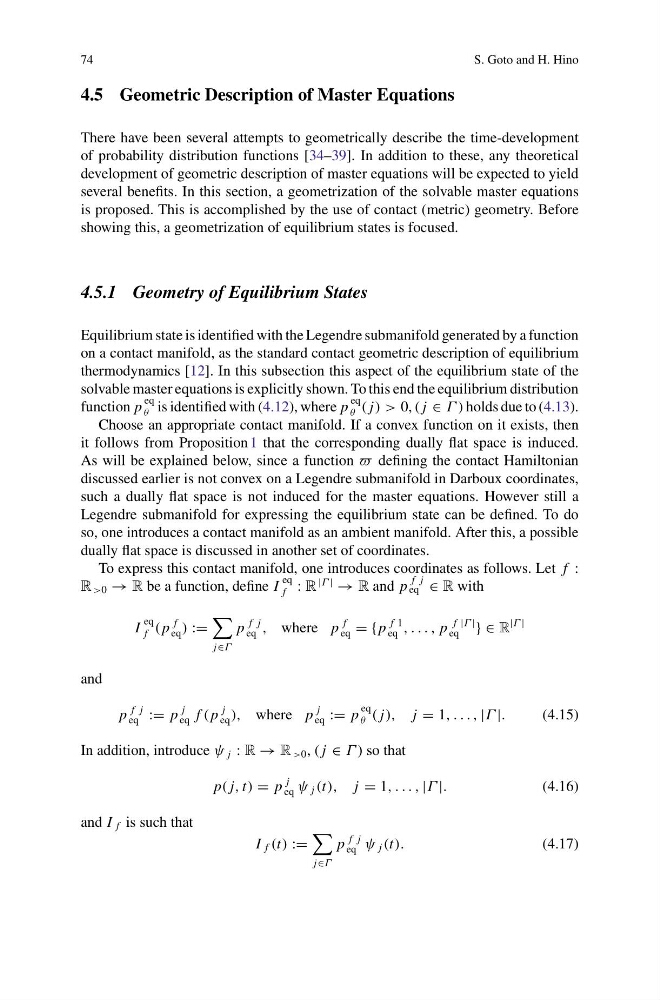
To express this contact manifold, one introduces coordinates as follows. Let f :
R >0 → R be a function, define I
eq
f : R
|Γ |
→ R and p
f j
eq ∈ R with
I
eq
f ( p
f
eq ) :=
j∈Γ
p
f j
eq , where p
f
eq = {p
f 1
eq , . . . , p
f |Γ |
eq
} ∈ R
|Γ |
and
p
f j
eq := p
j
eq f ( p
j
eq ), where p
j
eq := p
eq
θ ( j), j = 1, . . . , |Γ |.
(4.15)
In addition, introduce ψ j : R → R >0 , ( j ∈ Γ ) so that
p( j, t) = p
j
eq ψ j (t), j = 1, . . . , |Γ |.
(4.16)
and I f is such that
I f (t) :=
j∈Γ
p
f j
eq ψ j (t).
(4.17)
S. Goto and H. Hino
4.5 Geometric Description of Master Equations
There have been several attempts to geometrically describe the time-development
of probability distribution functions [34–39]. In addition to these, any theoretical
development of geometric description of master equations will be expected to yield
several benefits. In this section, a geometrization of the solvable master equations
is proposed. This is accomplished by the use of contact (metric) geometry. Before
showing this, a geometrization of equilibrium states is focused.
4.5.1 Geometry of Equilibrium States
Equilibrium state is identified with the Legendre submanifold generated by a function
on a contact manifold, as the standard contact geometric description of equilibrium
thermodynamics [12]. In this subsection this aspect of the equilibrium state of the
solvable master equations is explicitly shown. To this end the equilibrium distribution
function p
eq
θ is identified with (4.12), where p
eq
θ ( j) > 0, ( j ∈ Γ ) holds due to (4.13).
Choose an appropriate contact manifold. If a convex function on it exists, then
it follows from Proposition 1 that the corresponding dually flat space is induced.
As will be explained below, since a function defining the contact Hamiltonian
discussed earlier is not convex on a Legendre submanifold in Darboux coordinates,
such a dually flat space is not induced for the master equations. However still a
Legendre submanifold for expressing the equilibrium state can be defined. To do
so, one introduces a contact manifold as an ambient manifold. After this, a possible
dually flat space is discussed in another set of coordinates.
To express this contact manifold, one introduces coordinates as follows. Let f :
R >0 → R be a function, define I
eq
f : R
|Γ |
→ R and p
f j
eq ∈ R with
I
eq
f ( p
f
eq ) :=
j∈Γ
p
f j
eq , where p
f
eq = {p
f 1
eq , . . . , p
f |Γ |
eq
} ∈ R
|Γ |
and
p
f j
eq := p
j
eq f ( p
j
eq ), where p
j
eq := p
eq
θ ( j), j = 1, . . . , |Γ |.
(4.15)
In addition, introduce ψ j : R → R >0 , ( j ∈ Γ ) so that
p( j, t) = p
j
eq ψ j (t), j = 1, . . . , |Γ |.
(4.16)
and I f is such that
I f (t) :=
j∈Γ
p
f j
eq ψ j (t).
(4.17)