

72
S. Goto and H. Hino
4.4 Observables with Solvable Master Equations
In this section differential equations describing time-development of observables
are derived with the solvable master equations under some assumptions. Then, the
time-asymptotic limit of such observables is stated. Here observable in this paper
is defined as a function that depend on neither a random variable nor a state. Thus
expectation values with respect to a probability distribution function are observables.
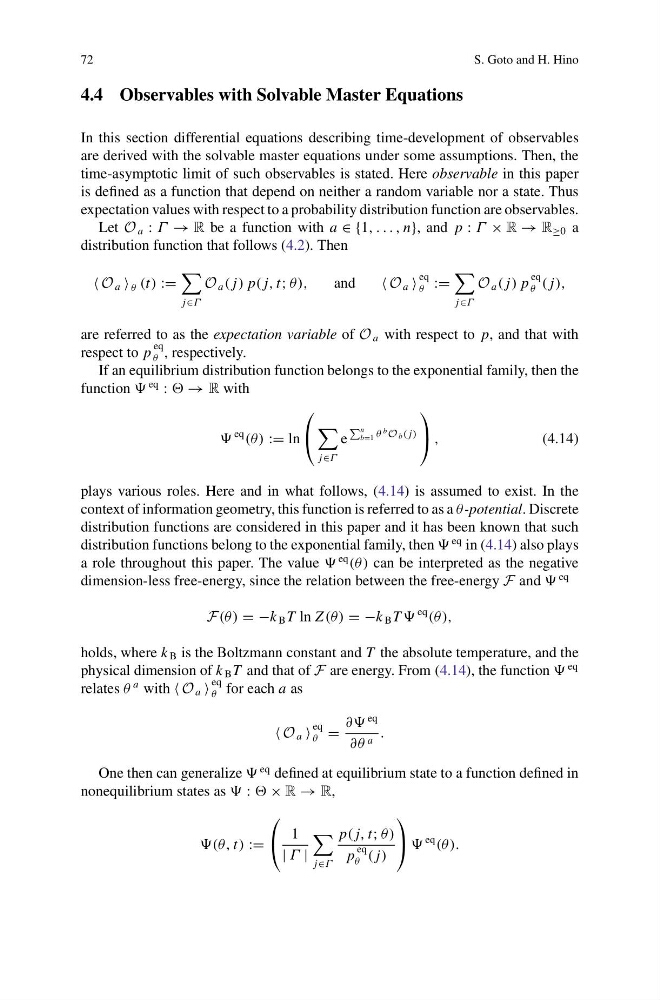
Let O a : Γ → R be a function with a ∈ {1, . . . , n}, and p : Γ × R → R ≥0 a
distribution function that follows (4.2). Then
O a θ (t) :=
j∈Γ
O a ( j) p( j, t; θ),
and
O a
eq
θ :=
j∈Γ
O a ( j) p
eq
θ ( j),
are referred to as the expectation variable of O a with respect to p, and that with
respect to p
eq
θ , respectively.
If an equilibrium distribution function belongs to the exponential family, then the
function
eq
: → R with
eq
(θ ) := ln
⎛
⎝
j∈Γ
e
n
b=1 θ
b O b ( j)
⎞
⎠ ,
(4.14)
plays various roles. Here and in what follows, (4.14) is assumed to exist. In the
context of information geometry, this function is referred to as a θ -potential. Discrete
distribution functions are considered in this paper and it has been known that such
distribution functions belong to the exponential family, then
eq in (4.14) also plays
a role throughout this paper. The value
eq
(θ ) can be interpreted as the negative
dimension-less free-energy, since the relation between the free-energy F and
eq
F(θ ) = −k B T ln Z (θ ) = −k B T
eq
(θ ),
holds, where k B is the Boltzmann constant and T the absolute temperature, and the
physical dimension of k B T and that of F are energy. From (4.14), the function
eq
relates θ
a with O a
eq
θ for each a as
O a
eq
θ =
∂∂
eq
∂θ a .
One then can generalize
eq defined at equilibrium state to a function defined in
nonequilibrium states as : × R → R,
t) :=
⎛
⎝ 1
| Γ |
j∈Γ
p( j, t; θ)
p
eq
θ ( j)
⎞
⎠
eq
(θ ).
S. Goto and H. Hino
4.4 Observables with Solvable Master Equations
In this section differential equations describing time-development of observables
are derived with the solvable master equations under some assumptions. Then, the
time-asymptotic limit of such observables is stated. Here observable in this paper
is defined as a function that depend on neither a random variable nor a state. Thus
expectation values with respect to a probability distribution function are observables.
Let O a : Γ → R be a function with a ∈ {1, . . . , n}, and p : Γ × R → R ≥0 a
distribution function that follows (4.2). Then
O a θ (t) :=
j∈Γ
O a ( j) p( j, t; θ),
and
O a
eq
θ :=
j∈Γ
O a ( j) p
eq
θ ( j),
are referred to as the expectation variable of O a with respect to p, and that with
respect to p
eq
θ , respectively.
If an equilibrium distribution function belongs to the exponential family, then the
function
eq
: → R with
eq
(θ ) := ln
⎛
⎝
j∈Γ
e
n
b=1 θ
b O b ( j)
⎞
⎠ ,
(4.14)
plays various roles. Here and in what follows, (4.14) is assumed to exist. In the
context of information geometry, this function is referred to as a θ -potential. Discrete
distribution functions are considered in this paper and it has been known that such
distribution functions belong to the exponential family, then
eq in (4.14) also plays
a role throughout this paper. The value
eq
(θ ) can be interpreted as the negative
dimension-less free-energy, since the relation between the free-energy F and
eq
F(θ ) = −k B T ln Z (θ ) = −k B T
eq
(θ ),
holds, where k B is the Boltzmann constant and T the absolute temperature, and the
physical dimension of k B T and that of F are energy. From (4.14), the function
eq
relates θ
a with O a
eq
θ for each a as
O a
eq
θ =
∂∂
eq
∂θ a .
One then can generalize
eq defined at equilibrium state to a function defined in
nonequilibrium states as : × R → R,
t) :=
⎛
⎝ 1
| Γ |
j∈Γ
p( j, t; θ)
p
eq
θ ( j)
⎞
⎠
eq
(θ ).