

4 Contact Hamiltonian Systems for Probability Distribution Functions …
63
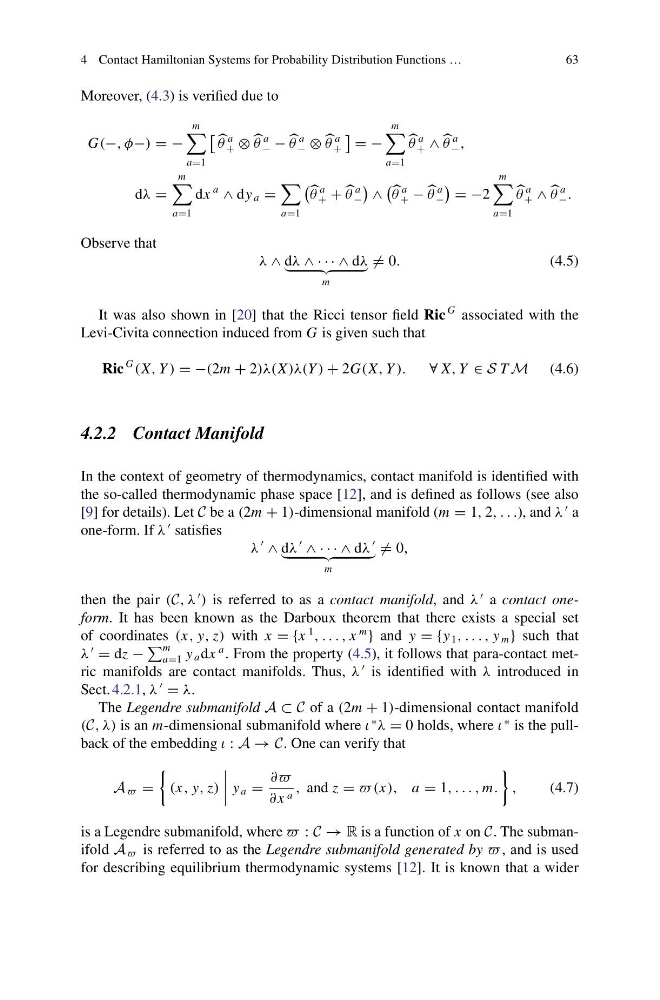
Moreover, (4.3) is verified due to
G(−, φ−) = −
m
a=1
θ
a
+ ⊗ θ
a
− − θ
a
− ⊗ θ
a
+
= −
m
a=1
θ
a
+ ∧ θ
a
− ,
dλ =
m
a=1
dx
a
∧ dy a =
a=1
θ
a
+ + θ
a
−
∧
θ
a
+ − θ
a
−
= −2
m
a=1
θ
a
+ ∧ θ
a
− .
Observe that
λ ∧ dλ ∧ · · · ∧ dλ
m
= 0.
(4.5)
It was also shown in [20] that the Ricci tensor field Ric
G associated with the
Levi-Civita connection induced from G is given such that
Ric
G
(X, Y ) = −(2m + 2)λ(X )λ(Y ) + 2G(X, Y ).
∀ X, Y ∈ S T M (4.6)
4.2.2 Contact Manifold
In the context of geometry of thermodynamics, contact manifold is identified with
the so-called thermodynamic phase space [12], and is defined as follows (see also
[9] for details). Let C be a (2m + 1)-dimensional manifold (m = 1, 2, . . .), and λ
a
one-form. If λ
satisfies
λ
∧ dλ
∧ · · · ∧ dλ
m
= 0,
then the pair (C, λ
) is referred to as a contact manifold, and λ
a contact oneform. It has been known as the Darboux theorem that there exists a special set
of coordinates (x, y, z) with x = {x
1
, . . . , x
m
} and y = {y 1 , . . . , y m } such that
λ
= dz −
m
a=1 y a dx
a . From the property (4.5), it follows that para-contact metric manifolds are contact manifolds. Thus, λ
is identified with λ introduced in
Sect. 4.2.1, λ
= λ.
The Legendre submanifold A ⊂ C of a (2m + 1)-dimensional contact manifold
(C, λ) is an m-dimensional submanifold where ι
∗
λ = 0 holds, where ι
∗ is the pullback of the embedding ι : A → C. One can verify that
A =
(x, y, z)
y a =
∂∂
∂ x a , and z = (x), a = 1, . . . , m.
,
(4.7)
is a Legendre submanifold, where : C → R is a function of x on C. The submanifold A is referred to as the Legendre submanifold generated by , and is used
for describing equilibrium thermodynamic systems [12]. It is known that a wider
63
Moreover, (4.3) is verified due to
G(−, φ−) = −
m
a=1
θ
a
+ ⊗ θ
a
− − θ
a
− ⊗ θ
a
+
= −
m
a=1
θ
a
+ ∧ θ
a
− ,
dλ =
m
a=1
dx
a
∧ dy a =
a=1
θ
a
+ + θ
a
−
∧
θ
a
+ − θ
a
−
= −2
m
a=1
θ
a
+ ∧ θ
a
− .
Observe that
λ ∧ dλ ∧ · · · ∧ dλ
m
= 0.
(4.5)
It was also shown in [20] that the Ricci tensor field Ric
G associated with the
Levi-Civita connection induced from G is given such that
Ric
G
(X, Y ) = −(2m + 2)λ(X )λ(Y ) + 2G(X, Y ).
∀ X, Y ∈ S T M (4.6)
4.2.2 Contact Manifold
In the context of geometry of thermodynamics, contact manifold is identified with
the so-called thermodynamic phase space [12], and is defined as follows (see also
[9] for details). Let C be a (2m + 1)-dimensional manifold (m = 1, 2, . . .), and λ
a
one-form. If λ
satisfies
λ
∧ dλ
∧ · · · ∧ dλ
m
= 0,
then the pair (C, λ
) is referred to as a contact manifold, and λ
a contact oneform. It has been known as the Darboux theorem that there exists a special set
of coordinates (x, y, z) with x = {x
1
, . . . , x
m
} and y = {y 1 , . . . , y m } such that
λ
= dz −
m
a=1 y a dx
a . From the property (4.5), it follows that para-contact metric manifolds are contact manifolds. Thus, λ
is identified with λ introduced in
Sect. 4.2.1, λ
= λ.
The Legendre submanifold A ⊂ C of a (2m + 1)-dimensional contact manifold
(C, λ) is an m-dimensional submanifold where ι
∗
λ = 0 holds, where ι
∗ is the pullback of the embedding ι : A → C. One can verify that
A =
(x, y, z)
y a =
∂∂
∂ x a , and z = (x), a = 1, . . . , m.
,
(4.7)
is a Legendre submanifold, where : C → R is a function of x on C. The submanifold A is referred to as the Legendre submanifold generated by , and is used
for describing equilibrium thermodynamic systems [12]. It is known that a wider