

60
S. Goto and H. Hino
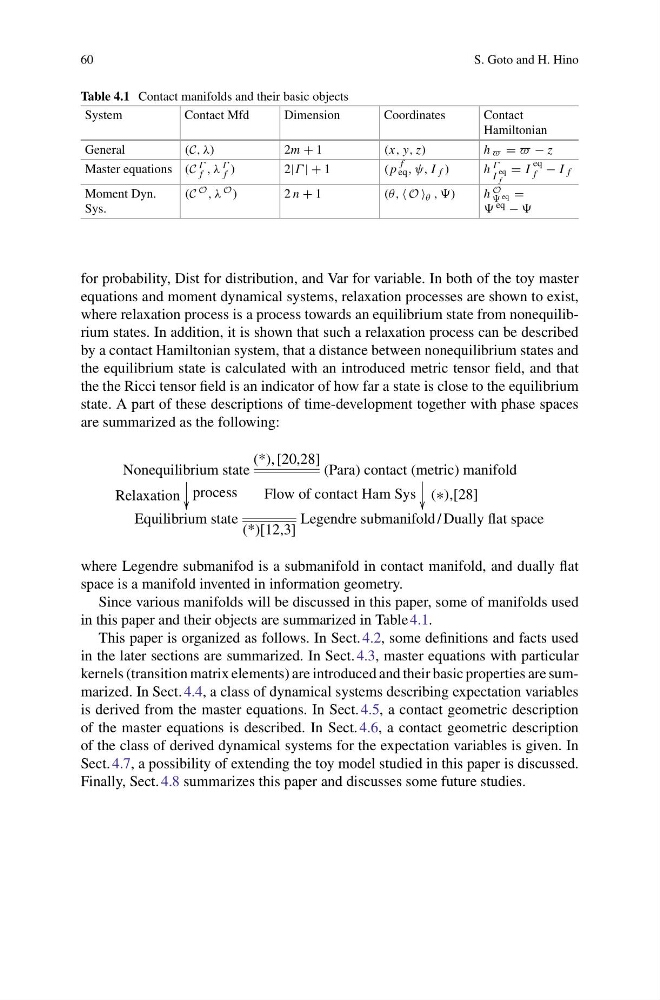
Table 4.1 Contact manifolds and their basic objects
System
Contact Mfd
Dimension
Coordinates
Contact
Hamiltonian
General
(C, λ)
2m + 1
(x, y, z)
h = − z
Master equations (C Γ
f , λ Γ
f )
2|Γ | + 1
( p
f
eq , ψ, I f )
h Γ
I
eq
f
= I
eq
f − I f
Moment Dyn.
Sys.
(C
O , λ
O )
2 n + 1
(θ, O θ , ,)
h
O
eq =
eq −
for probability, Dist for distribution, and Var for variable. In both of the toy master
equations and moment dynamical systems, relaxation processes are shown to exist,
where relaxation process is a process towards an equilibrium state from nonequilibrium states. In addition, it is shown that such a relaxation process can be described
by a contact Hamiltonian system, that a distance between nonequilibrium states and
the equilibrium state is calculated with an introduced metric tensor field, and that
the the Ricci tensor field is an indicator of how far a state is close to the equilibrium
state. A part of these descriptions of time-development together with phase spaces
are summarized as the following:
Nonequilibrium state
Relaxation process
(*), [20,28]
(Para) contact (metric) manifold
Flow of contact Ham Sys (∗),[28]
Equilibrium state
(*)[12,3]
Legendre submanifold / Dually flat space
where Legendre submanifod is a submanifold in contact manifold, and dually flat
space is a manifold invented in information geometry.
Since various manifolds will be discussed in this paper, some of manifolds used
in this paper and their objects are summarized in Table 4.1.
This paper is organized as follows. In Sect. 4.2, some definitions and facts used
in the later sections are summarized. In Sect. 4.3, master equations with particular
kernels (transition matrix elements) are introduced and their basic properties are summarized. In Sect. 4.4, a class of dynamical systems describing expectation variables
is derived from the master equations. In Sect. 4.5, a contact geometric description
of the master equations is described. In Sect. 4.6, a contact geometric description
of the class of derived dynamical systems for the expectation variables is given. In
Sect. 4.7, a possibility of extending the toy model studied in this paper is discussed.
Finally, Sect. 4.8 summarizes this paper and discusses some future studies.
S. Goto and H. Hino
Table 4.1 Contact manifolds and their basic objects
System
Contact Mfd
Dimension
Coordinates
Contact
Hamiltonian
General
(C, λ)
2m + 1
(x, y, z)
h = − z
Master equations (C Γ
f , λ Γ
f )
2|Γ | + 1
( p
f
eq , ψ, I f )
h Γ
I
eq
f
= I
eq
f − I f
Moment Dyn.
Sys.
(C
O , λ
O )
2 n + 1
(θ, O θ , ,)
h
O
eq =
eq −
for probability, Dist for distribution, and Var for variable. In both of the toy master
equations and moment dynamical systems, relaxation processes are shown to exist,
where relaxation process is a process towards an equilibrium state from nonequilibrium states. In addition, it is shown that such a relaxation process can be described
by a contact Hamiltonian system, that a distance between nonequilibrium states and
the equilibrium state is calculated with an introduced metric tensor field, and that
the the Ricci tensor field is an indicator of how far a state is close to the equilibrium
state. A part of these descriptions of time-development together with phase spaces
are summarized as the following:
Nonequilibrium state
Relaxation process
(*), [20,28]
(Para) contact (metric) manifold
Flow of contact Ham Sys (∗),[28]
Equilibrium state
(*)[12,3]
Legendre submanifold / Dually flat space
where Legendre submanifod is a submanifold in contact manifold, and dually flat
space is a manifold invented in information geometry.
Since various manifolds will be discussed in this paper, some of manifolds used
in this paper and their objects are summarized in Table 4.1.
This paper is organized as follows. In Sect. 4.2, some definitions and facts used
in the later sections are summarized. In Sect. 4.3, master equations with particular
kernels (transition matrix elements) are introduced and their basic properties are summarized. In Sect. 4.4, a class of dynamical systems describing expectation variables
is derived from the master equations. In Sect. 4.5, a contact geometric description
of the master equations is described. In Sect. 4.6, a contact geometric description
of the class of derived dynamical systems for the expectation variables is given. In
Sect. 4.7, a possibility of extending the toy model studied in this paper is discussed.
Finally, Sect. 4.8 summarizes this paper and discusses some future studies.