

4 Contact Hamiltonian Systems for Probability Distribution Functions …
59
Summary of this Contribution
In this paper a class of nonequilibrium thermodynamic processes activated by
continuous-time master equations are formulated on a para-contact metric manifold. Here master equations describe the time-development of probability distribution functions, and the time-development of expectation variables are called moment
dynamical systems in this paper, where moment dynamical systems are obtained from
master equations by integrating some functions over states with the probability distribution functions. Thus, roughly speaking, master equations represent microscopic
scale systems, and it is assumed in this paper that moment dynamical systems can be
treated as thermodynamic systems. To show explicit calculations, simple transition
matrices of master equations are considered as a toy model. This model is referred to
as a solvable model (and solvable master equations) in this paper, and is of the form
∂
∂t
p( j, t) = p
eq
θ ( j) − p( j, t),
j ∈ Γ,
(4.2)
where p
eq
θ is a prescribed equilibrium distribution function. Although there is no
interaction term in (4.2), it turns out that there is a link between (4.2) and a model
that has interaction terms. This link is found by introducing the probability generating
function (see Appendix A). Discussions on expectation variables in this paper have
been in [27], and those involving an almost para-contact structure for expectation
variables have been in [28]. In addition to the above discussions, more details, a
contact Hamiltonian system for a class of the master equations, and how the Ricci
tensor fields behave are discussed as additional contributions. Then the following is
shown in this paper:
Claim (Theorem 1): The solvable master equations and moment dynamical system derived
from the solvable master equations are described on para-contact metric manifolds, and its
convergence to the equilibrium states are characterized by the Mrugala metric fields and the
Ricci tensor fields associated with the Levi-Civita connections.
Some of details are as follows.
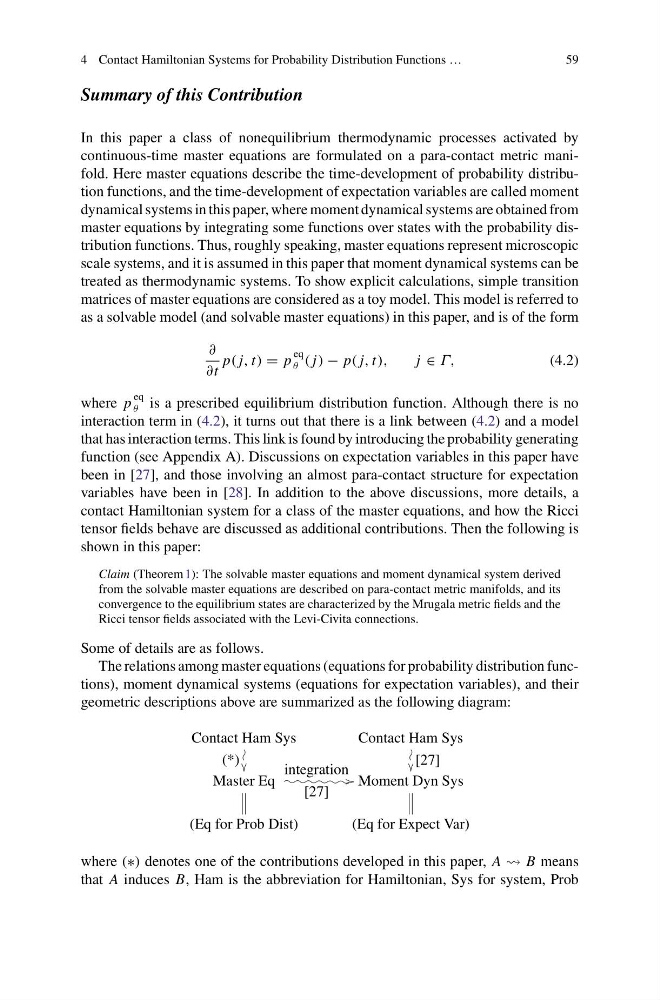
The relations among master equations (equations for probability distribution functions), moment dynamical systems (equations for expectation variables), and their
geometric descriptions above are summarized as the following diagram:
Contact Ham Sys
(*)
Contact Ham Sys
[27]
Master Eq
integration
[27]
Moment Dyn Sys
(Eq for Prob Dist)
(Eq for Expect Var)
where (∗) denotes one of the contributions developed in this paper, A B means
that A induces B, Ham is the abbreviation for Hamiltonian, Sys for system, Prob
59
Summary of this Contribution
In this paper a class of nonequilibrium thermodynamic processes activated by
continuous-time master equations are formulated on a para-contact metric manifold. Here master equations describe the time-development of probability distribution functions, and the time-development of expectation variables are called moment
dynamical systems in this paper, where moment dynamical systems are obtained from
master equations by integrating some functions over states with the probability distribution functions. Thus, roughly speaking, master equations represent microscopic
scale systems, and it is assumed in this paper that moment dynamical systems can be
treated as thermodynamic systems. To show explicit calculations, simple transition
matrices of master equations are considered as a toy model. This model is referred to
as a solvable model (and solvable master equations) in this paper, and is of the form
∂
∂t
p( j, t) = p
eq
θ ( j) − p( j, t),
j ∈ Γ,
(4.2)
where p
eq
θ is a prescribed equilibrium distribution function. Although there is no
interaction term in (4.2), it turns out that there is a link between (4.2) and a model
that has interaction terms. This link is found by introducing the probability generating
function (see Appendix A). Discussions on expectation variables in this paper have
been in [27], and those involving an almost para-contact structure for expectation
variables have been in [28]. In addition to the above discussions, more details, a
contact Hamiltonian system for a class of the master equations, and how the Ricci
tensor fields behave are discussed as additional contributions. Then the following is
shown in this paper:
Claim (Theorem 1): The solvable master equations and moment dynamical system derived
from the solvable master equations are described on para-contact metric manifolds, and its
convergence to the equilibrium states are characterized by the Mrugala metric fields and the
Ricci tensor fields associated with the Levi-Civita connections.
Some of details are as follows.
The relations among master equations (equations for probability distribution functions), moment dynamical systems (equations for expectation variables), and their
geometric descriptions above are summarized as the following diagram:
Contact Ham Sys
(*)
Contact Ham Sys
[27]
Master Eq
integration
[27]
Moment Dyn Sys
(Eq for Prob Dist)
(Eq for Expect Var)
where (∗) denotes one of the contributions developed in this paper, A B means
that A induces B, Ham is the abbreviation for Hamiltonian, Sys for system, Prob